🛒 Best Price Today on Amazon
Prime members get fast, free shipping on everything above, plus member-only deals. New members get a 30-day free trial — cancel anytime.
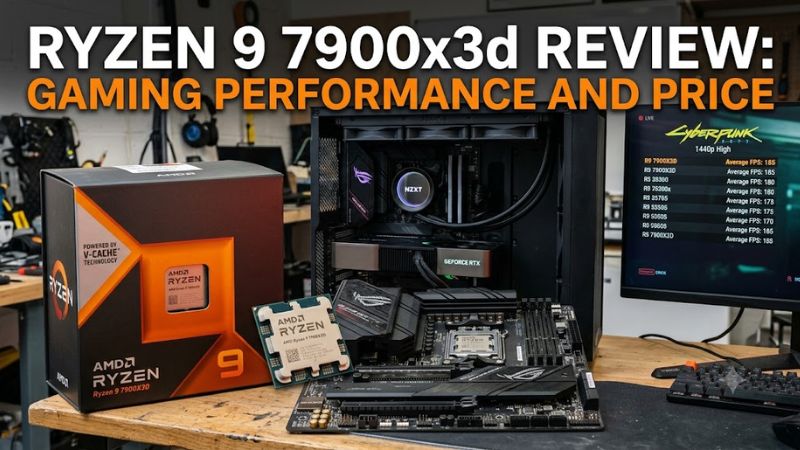
The ryzen 9 7900x3d review: gaming performance and price question comes down to whether its 12 cores and large 3D V-Cache justify buying an older premium processor in 2026. AMD’s chip remains capable for gaming and demanding workloads, but its value depends on current retail pricing, your existing AM5 system, and whether a newer X3D model better fits your budget.
How to Choose a Ryzen 9 Gaming Processor
The Ryzen 9 7900X3D is most attractive to buyers who need both gaming performance and substantial multithreaded capacity. It combines Zen 4 architecture with 12 cores, 24 threads, and 128MB of L3 cache. Before purchasing, compare the total platform cost, the performance of competing processors, cooling requirements, and the amount of time you spend gaming versus creating content.
Consider gaming performance first
The 7900X3D uses AMD’s 3D V-Cache technology to increase the amount of L3 cache available to compatible workloads. This can improve frame rates in CPU-limited games, particularly when a powerful graphics card is paired with a 1080p display. However, results vary by game engine, graphics settings, and GPU, so cache capacity alone cannot predict performance in every title.
Compare the complete purchase price
A processor’s advertised price is only part of the upgrade cost. Buyers moving to AM5 also need a compatible motherboard and DDR5 memory, while existing AM5 owners may reuse those components after confirming BIOS support. Compare the CPU’s actual checkout price with newer alternatives rather than relying on its original $599 launch price, which dates to February 2023.
Check motherboard and memory compatibility
The processor uses AMD’s Socket AM5 and supports DDR5 memory, not DDR4. AMD lists A620, B650, B650E, X670, X670E, B840, B850, X870, and X870E chipsets among its supported families. Individual motherboard support depends on its BIOS and manufacturer compatibility list, so confirm the exact CPU entry before ordering. AMD’s official specifications provide the starting point.
Match the CPU to your workload
A gaming-focused buyer may prefer a less expensive eight-core X3D processor if it delivers similar frame rates in the games they play. The 7900X3D becomes more compelling when gaming shares the system with streaming, software development, rendering, or other threaded workloads. Its 12 cores provide flexibility, although the chip’s cache arrangement and clock behavior can affect productivity performance differently from a standard Ryzen 9.
Top Picks: How the 7900X3D Compares
The following comparison focuses on use cases rather than claiming a universal winner. The Ryzen 9 7900X3D launched at $599, but that historical price is not a current retail quote. Check live listings, warranty coverage, and return terms before deciding. The benchmark references below come from published reviews, not PC Gaming Universe testing.
| Product | Best For | Key Spec | Compatibility | Watch Out For |
| AMD Ryzen 9 7900X3D | Best Overall for mixed workloads at a suitable discount | 12 cores, 24 threads; 128MB L3 | AM5, DDR5 | Older Zen 4 architecture |
| AMD Ryzen 7 7800X3D | Best Value for gaming-focused buyers | 8 cores, 16 threads; 96MB L3 | AM5, DDR5 | Fewer cores for heavy production |
| AMD Ryzen 7 9800X3D | Best for high-end gaming | 8 cores, 16 threads; 96MB L3 | AM5, DDR5 | Premium pricing |
| AMD Ryzen 9 9900X3D | Best for newer gaming and creator builds | 12 cores, 24 threads; 128MB L3 | AM5, DDR5 | Compare its price with the 7900X3D |
Best Overall: Ryzen 9 7900X3D
The 7900X3D makes sense for someone who regularly switches between games and demanding applications. Its 12 cores and 24 threads offer more parallel processing capacity than an eight-core gaming CPU, while the 128MB of L3 cache helps in games that benefit from 3D V-Cache. Its 120W default TDP also distinguishes it from higher-power standard Ryzen 9 models.
The weakness is its position between cheaper gaming-focused processors and more capable alternatives. A buyer focused almost entirely on games should compare it with the 7800X3D and 9800X3D before spending extra. This recommendation assumes the 7900X3D is available at a competitive price; it is not a claim that its original launch price remains appropriate today.
Best Value: Ryzen 7 7800X3D
The Ryzen 7 7800X3D is worth considering when gaming is the primary purpose of the computer. Its eight cores, 16 threads, and 96MB of L3 cache offer a strong gaming-focused configuration, and Tom’s Hardware reported higher aggregate 1080p gaming performance than the 7900X3D in its published comparison. That result reflects its particular test suite, not every game.
Its main limitation is lower core count for workloads that scale well across many threads. Buyers who render frequently, compile large projects, or run several demanding applications together may prefer a 12-core processor. For a gaming-only system, however, the 7800X3D can be a more rational purchase if its current price is substantially lower.
Best for High-End Gaming: Ryzen 7 9800X3D
The Ryzen 7 9800X3D uses the newer Zen 5 architecture and second-generation 3D V-Cache. AMD specifies eight cores, 16 threads, a boost clock up to 5.2GHz, 96MB of L3 cache, and a 120W default TDP. It also supports AM5 motherboards and DDR5 memory, making it a potential upgrade for an existing compatible platform.
The trade-off is that a newer gaming-focused CPU may cost more than a discounted previous-generation chip. The 9800X3D also has fewer cores than the 7900X3D, so users should compare application performance rather than assume newer architecture automatically makes it better for every professional workload. Check current pricing before choosing it solely for gaming.
Best for Newer Mixed Workloads: Ryzen 9 9900X3D
The Ryzen 9 9900X3D combines Zen 5 with 12 cores, 24 threads, 128MB of L3 cache, a boost clock up to 5.5GHz, and a 120W default TDP. It targets users who want a substantial core count alongside the gaming benefits associated with 3D V-Cache. Like the 7900X3D, it requires an AM5 motherboard and DDR5 memory.
Its weakness is value uncertainty: the newer architecture does not automatically justify a large price premium over the 7900X3D. Compare independent gaming and productivity benchmarks alongside the actual cost of each chip. Buyers who mostly play games should also consider whether a dedicated gaming processor offers comparable frame rates for less money.
Gaming Performance, Benchmarks, and Price
The most important finding in this ryzen 9 7900x3d review: gaming performance and price is that strong gaming results do not necessarily make this processor the best purchase. Published comparisons show that its performance depends on the game and test conditions. Its value in 2026 therefore rests on the discount available, the GPU being used, and the buyer’s need for additional CPU cores.
What published gaming benchmarks show
Tom’s Hardware’s March 2023 review used an NVIDIA GeForce RTX 4090 for its gaming comparisons and reported aggregate results from its 1080p game suite. In that specific comparison, the Ryzen 7 7800X3D scored 100% relative gaming performance, while the Ryzen 9 7900X3D scored 94.6%. These are relative scores, not average FPS figures.
Those results should not be interpreted as a universal performance gap. The GPU, game selection, operating system, memory configuration, and graphics settings influence results. The cited comparison reflects the review’s stock gaming test results at 1080p; it does not establish a fixed advantage at 1440p or 4K, where graphics-card limitations can reduce CPU differences.
How the 3D V-Cache affects games
The processor provides 128MB of L3 cache, allowing certain game workloads to access frequently needed data without relying as heavily on system memory. Games that benefit from this arrangement may see higher frame rates or improved frame-time consistency. Other titles gain less, so cache size should be considered alongside architecture, clock speed, and independent game-specific measurements.
The 7900X3D also uses two compute chiplets, with the 3D V-Cache arrangement differing between them. AMD’s software and scheduling mechanisms help direct workloads to the appropriate cores, making current BIOS, chipset drivers, and Windows updates relevant to system behavior. Buyers should avoid assuming that every game will use the cache-equipped cores in exactly the same way.
Cooling, power, and system requirements
AMD lists a 120W default TDP and a maximum operating temperature of 89°C for the 7900X3D. The retail processor does not include a thermal solution, and AMD recommends liquid cooling for optimal performance. A suitable high-quality air cooler may also be considered, but the choice should account for case airflow, ambient temperature, noise expectations, and the cooler manufacturer’s compatibility guidance.
The processor supports PCIe 5.0 and includes integrated Radeon graphics for basic display output and troubleshooting, provided the motherboard offers the necessary display connection. That small integrated GPU is not a substitute for a gaming graphics card. Choose a motherboard with appropriate firmware support and budget for DDR5 memory, a compatible cooler, and a power supply suited to the complete system.
Is the asking price justified?
The original $599 launch price is useful historical context, not a reliable estimate of what a US retailer charges on October 13, 2026. Availability and pricing can change considerably for an older enthusiast CPU. Compare the total cost against the 7800X3D, 9800X3D, and 9900X3D rather than relying on launch-era recommendations.
The purchase is easiest to justify when a discounted 7900X3D meets both gaming and production needs. If the price approaches a newer alternative, compare current independent benchmarks before committing. For a new gaming-only PC, spending less on the CPU and directing the difference toward a stronger graphics card may provide a better overall experience at 1440p or 4K.
FAQ
Is the Ryzen 9 7900X3D good for gaming in 2026?
Yes, the Ryzen 9 7900X3D remains a capable gaming processor because its 12 Zen 4 cores and 128MB of L3 cache support demanding games. However, newer X3D processors may offer better gaming performance, so its value depends on the current price and the games you play.
What is the Ryzen 9 7900X3D’s launch price?
The Ryzen 9 7900X3D launched at $599 in February 2023. That is its historical launch price, not a verified current retail price, so check available listings before buying.
Does the Ryzen 9 7900X3D support DDR4 memory?
No, the Ryzen 9 7900X3D requires DDR5 memory and a compatible Socket AM5 motherboard. DDR4 modules used in an AM4 system cannot be reused with this processor.
Is the Ryzen 9 7900X3D better than the Ryzen 7 9800X3D?
Not universally; the Ryzen 7 9800X3D can be the stronger gaming choice, while the 7900X3D offers more CPU cores for some multithreaded workloads. Compare independent benchmarks and current prices for your intended applications before deciding.
Final Thoughts
The ryzen 9 7900x3d review: gaming performance and price verdict is conditional: this remains a capable AM5 processor for gaming and production, but its value depends on current pricing. Compare newer X3D alternatives, verify motherboard support, and choose it when its core count and discount justify the purchase.