🛒 Best Price Today on Amazon
Prime members get fast, free shipping on everything above, plus member-only deals. New members get a 30-day free trial — cancel anytime.
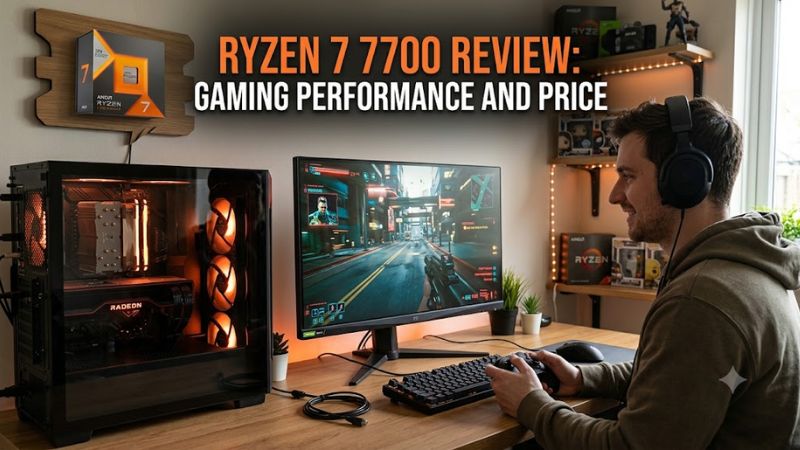
The ryzen 7 7700 review: gaming performance and price question is more interesting in 2026 than at launch because this Zen 4 chip now competes on discounted pricing rather than raw generation leadership. Its eight cores, low 65W TDP and bundled Wraith Prism remain attractive, but newer AM5 CPUs make the purchase price decisive.
Quick answer: For most people in 2026, the best ryzen 7 7700 is the Area — our #1 rated choice. See the full ranked comparison, alternatives and buying advice below.
What the Ryzen 7 7700 Really Comes Down To
The Ryzen 7 7700 is an eight-core, 16-thread Zen 4 desktop processor built for Socket AM5. Its strengths are competent gaming speed, modest stock power and a usable boxed cooler; its main weakness is age. For a new gaming build, the decision depends less on specifications alone and more on how cheaply the CPU is available beside newer AM5 choices.
Is Eight-Core Zen 4 Still Enough for Gaming?
Eight Zen 4 cores remain a sensible configuration for gaming and mixed desktop workloads. AMD specifies 16 threads, a 3.8 GHz base clock, up to 5.3 GHz boost and 32 MB of L3 cache. Those specifications give the chip considerably more general-purpose capacity than an entry-level six-core CPU without pushing it into high-power Ryzen 9 territory.
For buyers researching ryzen 7 7700 review: gaming performance and price, core count is not the limiting issue in most games. Independent launch-era results showed performance close to the Ryzen 7 7700X despite the non-X model’s lower clocks and power target, making the 7700 unusually well balanced within the original Zen 4 lineup.
What Specifications Matter Most?
AMD rates the Ryzen 7 7700 at 65W TDP, with a maximum boost of 5.3 GHz and support for Precision Boost Overdrive, Curve Optimizer and AMD EXPO. It also includes basic Radeon integrated graphics, which can provide display output or troubleshooting capability when a discrete graphics card is unavailable, though it is not intended to replace a gaming GPU.
The retail boxed processor includes AMD’s Wraith Prism cooler, an unusual advantage compared with many higher-end desktop CPUs that ship without cooling hardware. PC Gamer also found the 7700 substantially more power-efficient than the 105W Ryzen 7 7700X while remaining close to it across several application and gaming workloads.
What Platform Does the Ryzen 7 7700 Require?
Ryzen 7 7700 requires an AM5 motherboard and DDR5 memory; it does not support AM4 boards or DDR4. AMD lists A620, B650, B650E, X670, X670E, B840, B850, X870 and X870E among supported chipsets. Exact CPU support can still depend on a motherboard’s BIOS revision, so checking the board vendor’s CPU support page is sensible before installation.
AMD officially lists DDR5-5200 for common two-DIMM configurations, while EXPO enables supported memory-overclocking profiles. The processor exposes PCIe 5.0 connectivity, although the usable PCIe generation for a graphics or M.2 slot also depends on motherboard routing and chipset design. That makes board selection part of the total platform cost, not merely a socket check.
What Are the Real Weaknesses?
The largest weakness in 2026 is that the Ryzen 7 7700 is no longer a current-generation gaming CPU. Newer Ryzen 9000 and X3D processors occupy the higher-performance positions, while AMD has even expanded the older Zen 4 family with the Ryzen 7 7700X3D. Buying the standard 7700 therefore makes most sense when its discount is substantial rather than marginal.
Another limitation is platform cost for anyone moving from AM4. A ryzen 7 7700 review: gaming performance and price assessment must include an AM5 motherboard and DDR5, not just the processor. Existing AM5 owners avoid that penalty, but AM4 users cannot transfer a DDR4 kit or motherboard, which can erase part of the CPU’s apparent bargain pricing.
Ryzen 7 7700 Gaming Performance and Price
Independent benchmark data places the Ryzen 7 7700 close to its 7700X sibling rather than dramatically behind it. Tom’s Hardware measured its gaming suite at both 1080p and 1440p with an RTX 4090, Windows 11 Pro and stock CPU configuration; TechSpot used an RTX 4090, Windows 11 and Resizable BAR enabled for its 10-game comparison.
| Area | Ryzen 7 7700 Result | Context | What It Means |
| Cores / Threads | 8 / 16 | Zen 4, AM5 | Strong general gaming configuration |
| Boost Clock | Up to 5.3 GHz | Stock specification | Close to 7700X peak clock |
| Gaming, 1080p | 86.19% relative score | Tom’s Hardware, RTX 4090, stock | Near the 7700X in its test suite |
| Gaming, 1440p | 88.88% relative score | Tom’s Hardware, RTX 4090, stock | CPU gaps narrow as GPU load rises |
| Default TDP | 65W | AMD specification | Lower stock power than 7700X |
| Current observed listing | About $144 | US new-retail tracker, Oct. 7, 2026 | Attractive only if listing terms suit the build |
How Fast Is It at 1080p?
Tom’s Hardware’s 1080p aggregate gave the Ryzen 7 7700 an 86.19% relative score against the Core i9-13900K reference at 100%. The Ryzen 7 7700X scored 87.13% in the same hierarchy. These figures came from an RTX 4090 system intended to reduce GPU bottlenecks, so they should not be treated as expected frame rates for every gaming PC.
That small separation explains why ryzen 7 7700 review: gaming performance and price discussions often favor the non-X part when prices are favorable. TechSpot reached a similar conclusion: across its 10-game 1080p average, the 7700 was about 5% slower than the 7700X, using Windows 11, an RTX 4090 and Resizable BAR enabled.
What Changes at 1440p?
At 1440p, Tom’s Hardware recorded an 88.88% relative score for the 7700 and 91.55% for the 7700X in its legacy gaming hierarchy. The source also cautioned that CPU performance differences tend to shrink at higher resolutions or fidelity settings because more of the workload shifts toward the graphics card.
TechSpot reported the same trend in its own suite, with the Ryzen 7 7700 averaging roughly 4% behind the 7700X at 1440p instead of 5% at 1080p. That is useful context for a gaming build using a midrange GPU, where processor differences can be less visible than benchmark charts produced with an RTX 4090 suggest.
Does the 65W TDP Matter?
Yes, the 65W stock TDP is one of the Ryzen 7 7700’s clearest practical advantages. AMD rates the 7700X at a higher 105W TDP, while PC Gamer found the non-X model stayed remarkably close in many workloads despite its lower power envelope. That makes the 7700 particularly suitable for builders prioritizing lower heat and simpler cooling.
This does not mean the CPU always consumes exactly 65W at the wall or package level, because TDP is not a direct system-power measurement. It does mean AMD positions the processor around a lower stock thermal envelope. Precision Boost Overdrive can increase performance and power beyond stock behavior, so benchmark results should be identified as stock or PBO rather than mixed together.
Is the Current Price Actually Good?
The answer depends heavily on the exact listing. A US price tracker recorded a new Ryzen 7 7700 listing at $143.62 on October 7, 2026, linked through Newegg, far below its original $329 launch price. At that level, ryzen 7 7700 review: gaming performance and price becomes much more favorable, but buyers should verify whether the offer is boxed, tray or marketplace stock.
That distinction matters because AMD’s boxed specification includes a Wraith Prism cooler, while a tray or differently packaged listing may not provide the same bundle or retail terms. If the 7700 approaches the cost of newer AM5 processors instead, its value drops quickly because those alternatives offer newer architectures or gaming-focused cache designs.
Ryzen 7 7700 FAQ
The most common questions around ryzen 7 7700 review: gaming performance and price concern gaming relevance, cooler requirements, memory compatibility and whether a newer CPU is worth paying for. The answers depend mainly on the system being built: existing AM5 owners face very different upgrade economics from someone replacing an AM4 motherboard, CPU and DDR4 kit together.
Is the Ryzen 7 7700 Still Good for Gaming in 2026?
Yes, the Ryzen 7 7700 is still capable of strong gaming performance in 2026, although it is no longer among AMD’s fastest gaming CPUs. Its eight Zen 4 cores and close launch-era performance to the 7700X remain sufficient for modern discrete-GPU systems, while newer X3D parts mainly change the value comparison rather than making the 7700 unusable.
The CPU becomes especially compelling when sold at a steep discount. Someone already using AM5 can replace the processor without changing memory or socket, while a new builder should compare the total CPU, board and DDR5 cost against newer AM5 combinations rather than assuming an inexpensive processor automatically creates the least expensive complete system.
Does the Ryzen 7 7700 Come With a Cooler?
Yes, AMD lists the boxed Ryzen 7 7700 with a Wraith Prism cooler. That can reduce the upfront cost of a gaming build because a separate CPU cooler is not mandatory for basic stock operation when purchasing the appropriate boxed package, although users wanting lower noise or different thermal behavior may still prefer an aftermarket design.
Buyers should still inspect the specific retailer description before ordering. A discounted tray CPU or marketplace listing may differ from AMD’s retail boxed package, so the product title, seller, warranty terms and cooler contents matter. This is particularly important when comparing an unusually low 2026 sale price against a more expensive conventional retail box.
Can the Ryzen 7 7700 Use DDR4 Memory?
No, the Ryzen 7 7700 requires DDR5 memory and cannot use DDR4. AMD’s AM5 specification lists DDR5 as the supported system-memory type, with dual memory channels and official DDR5-5200 support for common two-module configurations. Users migrating from AM4 therefore need compatible DDR5 in addition to an AM5 motherboard.
That requirement should be included in any ryzen 7 7700 review: gaming performance and price calculation because a cheap CPU alone does not define upgrade cost. Existing AM5 systems already satisfy the platform requirement, while an AM4 owner must budget for a board and memory replacement even if the graphics card, storage, case and power supply remain usable.
Should You Buy a Ryzen 7 7700 Instead of a Newer AM5 CPU?
Buy the Ryzen 7 7700 instead of a newer AM5 CPU when its real purchase price is low enough to justify giving up newer architecture or gaming-focused cache options. At heavily discounted pricing it remains an efficient eight-core option, but paying close to the price of a newer Ryzen 9000 or an affordable X3D chip weakens the argument considerably.
For an existing AM5 system, the comparison is straightforward because motherboard and DDR5 costs are already paid. For a completely new build, evaluate the full platform price and the GPU you intend to use. At 1440p or higher with a less powerful graphics card than an RTX 4090, CPU performance gaps may shrink enough that spending the difference on the GPU makes more sense.
Final Thoughts
Ryzen 7 7700 review: gaming performance and price still leads to a positive verdict when the CPU is deeply discounted. Eight Zen 4 cores, a 65W TDP, AM5 support and a boxed Wraith Prism make it practical, while benchmark data shows gaming close to the 7700X. For a new build, however, compare its final price with newer AM5 CPUs before buying.
Ready to decide? Our #1 pick for 2026 is the Area.
Live price & availability on Amazon.