If you want to know about fake Pokemon cards how to tell them apart from genuine ones, the single most reliable non-destructive test is the light test: hold the card up to a bright light source and a real card blocks almost all of it, because authentic cards contain a thin black layer sandwiched between the front and back print layers. Counterfeits usually skip that layer, so light passes through and you can see the image from the other side.
As an Amazon Associate I earn from qualifying purchases.
That test alone catches the majority of cheap fakes, but higher-quality counterfeits require a checklist. Below are eight genuinely good Pokémon games worth your time, followed by the full authentication process — text, colour, texture, weight and seller checks.
| Game | Platform | Genre | Why It’s Great | Rating |
|---|---|---|---|---|
| Pokémon Legends: Arceus | Nintendo Switch | Action RPG | Reinvented catching as a real-time stealth mechanic in open regions | 8.5/10 |
| Pokémon Legends: Z-A | Nintendo Switch, Switch 2 | Action RPG | Urban Lumiose City setting with real-time battles and Mega Evolution focus | 8.0/10 |
| Pokémon Scarlet and Violet | Nintendo Switch | Open-world RPG | First fully open-world mainline entry with three parallel story paths | 7.5/10 |
| Pokémon Sword and Shield | Nintendo Switch | RPG | Wild Area and Max Raid battles introduced genuine co-op to the series | 8.0/10 |
| Pokémon Brilliant Diamond / Shining Pearl | Nintendo Switch | RPG | Faithful Sinnoh remakes with the Grand Underground greatly expanded | 7.5/10 |
| Pokémon Trading Card Game (GBC) | Nintendo Switch Online, Game Boy Color | Card battler | The best digital adaptation of the early TCG rules, and still charming | 8.5/10 |
| Pokémon TCG Pocket | iOS, Android | Digital card collecting | Daily pack openings and immersive card art; no counterfeits possible | 8.0/10 |
| Pokémon Mystery Dungeon: Rescue Team DX | Nintendo Switch | Roguelike RPG | Surprisingly emotional story wrapped around approachable dungeon crawling | 7.5/10 |
🛒 Best Price Today on Amazon
Prime members get fast, free shipping on everything above, plus member-only deals. New members get a 30-day free trial — cancel anytime.
Fake Pokemon Cards: How to Tell Using the Card Back
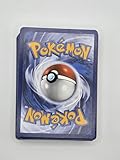
Start with the back, not the front. Counterfeiters obsess over front artwork and get lazy on the reverse. A genuine card back has a distinctive blue swirl pattern with a specific shade of blue, a crisp red-and-white Poké Ball in the centre, and the word “Pokémon” with a correctly rendered accented é.
Common tells on fakes: the blue is too dark, too purple, or too washed out; the swirl detail is blurry rather than sharp; the inner blue border sits unevenly from the card edge; and the é accent is missing entirely. Place a suspect card next to a card you know is genuine from any set — the colour mismatch is often obvious side by side even when the fake looks fine alone.
Font, Spelling and Text Layout Errors
Genuine cards use consistent typography across a set. Fakes routinely get the font weight wrong, letter-space the Pokémon’s name incorrectly, or use a font that is subtly too rounded. Under magnification, real card text has clean edges; counterfeit text often shows a slight fuzzy halo from lower-quality printing.
Also read the small print carefully. Check the copyright line along the bottom, which should credit Pokémon, Nintendo, Creatures and GAME FREAK with a plausible year. Check the “Illus.” artist credit is present. Look for grammatical mistakes in the attack descriptions and the flavour text — awkward phrasing and missing punctuation are extremely common on fakes.
Fake Pokemon Cards How to Tell From Stats That Do Not Exist
This is the check that catches fakes that are otherwise well printed. Counterfeiters invent cards. If a card claims 500 HP, or shows a Basic Pokémon with an evolution-tier attack cost, or presents a Charizard variant that never appeared in any set, it is fake regardless of print quality.
Cross-reference the set symbol and the card number. Real cards show a set symbol and a number in the format “12/198” where the denominator matches the actual set size. Fakes frequently print a number whose denominator does not correspond to any real set, or omit the set symbol entirely. Secret rares legitimately exceed the denominator, but only within known sets.
Texture, Gloss and Holo Patterns
Modern genuine cards have a specific finish. Full-art and textured rares have a raised, tactile pattern you can feel with a fingernail; fakes are almost always flat and glossy, or use a uniform glitter effect rather than a structured holographic pattern. Energy symbols on real cards are crisply printed within their circles.
Holo backgrounds on genuine cards show a directional, layered shimmer that changes with viewing angle. Cheap fakes use a rainbow foil that flashes uniformly. Look at a real holo you own under a desk lamp and the difference becomes immediately learnable. Good task lighting genuinely helps here — many collectors use the same desk setups covered in our gaming desk and monitor arm buying guide.
Weight, Thickness and the Edge Test
A standard Pokémon card weighs roughly 1.7 to 1.8 grams. A jeweller’s scale accurate to 0.01 g will flag most counterfeits, which tend to run either noticeably light or heavy because the card stock differs. Thickness matters too: run a stack of known-genuine cards against the same number of suspects and any difference in stack height is a red flag.
Examine the edges under magnification. Genuine cards show a clean cut with the black core layer visible as a thin dark line. Fakes often show white or grey edges, fraying, or a visible seam where two laminated layers separate. The destructive rip test confirms the black core definitively, but obviously ruins the card, so save it for a card you have already concluded is worthless.
Booster Packs, Boxes and Sealed Product
Sealed product has its own tells. Genuine booster wrappers have sharp print, consistent crimping at both ends, and a specific weight per pack. Resealed packs often show wrinkled crimps, glue residue, or a wrapper that feels thinner than usual. Genuine booster boxes have factory-applied shrink wrap with clean, tight seams rather than loose or hand-heat-shrunk plastic.
Be especially wary of “vintage” sealed product from marketplace sellers. Resealing scams on Base Set and early expansions are widespread and lucrative. Weighing individual packs to fish for holos is also why many older sealed lots have already been searched and resealed.
Buying Habits That Prevent the Problem Entirely
The most effective defence is not a test, it is a sourcing rule. Buy singles from established local game stores, reputable online card retailers, or graded slabs from PSA, CGC or Beckett. Grading companies authenticate as part of the process, so a sealed graded slab from a major grader is effectively a guarantee.
Avoid bulk lots advertised at implausible prices, listings whose photos are stock images rather than the actual card, and any seller who refuses close-up photos of the card back and edges. If a deal on a high-value chase card looks remarkable, price is the tell. For streaming your pack openings, our capture card buying guide and webcam and streaming gear buying guide cover the equipment that actually shows card texture on camera.
Tools Worth Owning If You Collect Seriously
Three inexpensive items cover almost every scenario: a 30x to 60x jeweller’s loupe or a USB microscope for print inspection, a 0.01 g precision scale for weight checks, and a bright, colour-accurate light source for the light test and holo comparison. Together they cost far less than one mid-tier chase card.
Keep a small reference set of cards you know are genuine — one common, one holo, one full-art — as physical comparison baselines. Digital reference photos help, but screen colour reproduction is unreliable unless your display is calibrated, something our gaming monitor buying guide addresses. Our gaming headset buying guide is worth a look if you record commentary while sorting collections, and our gaming chair buying guide matters more than you would expect for the long sorting and sleeving sessions serious collections demand.
Frequently Asked Questions About Fake Pokemon Cards and How to Tell
What is the fastest way to spot a fake Pokemon card?
Hold it up to a bright light. Genuine cards contain an opaque black core layer between the printed faces, so very little light passes through. Most counterfeits omit this layer, meaning you can see the front artwork through the back. This single test takes two seconds and catches the majority of fakes.
Do fake Pokemon cards weigh differently from real ones?
Usually yes. Authentic cards weigh approximately 1.7 to 1.8 grams each, and counterfeits typically deviate because they use different card stock. A precision scale reading to 0.01 grams will flag most fakes, though weight alone is not conclusive since some higher-quality counterfeits deliberately match the target weight.
Are cheap Pokemon cards from marketplaces always fake?
Not always, but unusually low prices on valuable cards are the strongest single warning sign. Common and uncommon cards genuinely sell for very little, so a cheap bulk lot of commons is plausible. A rare holo or full-art card priced far below market value almost certainly is not authentic.
Does grading a card confirm whether it is genuine?
Yes. Major grading companies including PSA, CGC and Beckett authenticate cards as part of the grading process and will reject counterfeits rather than assign them a grade. Buying already-graded slabs from these companies is therefore the most reliable way to avoid counterfeits entirely, albeit at a price premium.
As an Amazon Associate we earn from qualifying purchases at no extra cost to you.