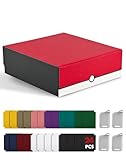
- Top Pick: Trading Card Storage Box, 8-Pack 1000 Count Cardboard TCG & Sport Card Box
- Best Value: ZLCA Card Storage Box Holds 3200+, Deck Storage Case with 4 Stoppers, Card Organizer for TCG MTG PTCG(Red&White)
- Premium Choice: Storage Standard Card Sorting Tray – Stackable Trading Cards Organizer – 15-Compartment Tray Sorter for Organizing Raw, Sleeved or Toploaders – Includes Organization Insert Dividers
A Pokémon card collection goes from charming to unmanageable somewhere around the thousand-card mark. Once you cannot find the card you know you own, or you discover a bent Charizard at the bottom of a shoebox, it is time for a real system. The good news is that the Pokémon TCG is unusually easy to organise because every card tells you exactly where it belongs.
As an Amazon Associate I earn from qualifying purchases.
🛒 Best Price Today on Amazon
Prime members get fast, free shipping on everything above, plus member-only deals. New members get a 30-day free trial — cancel anytime.
How to Organize Pokemon Cards: The Method That Scales
The most reliable way to organise Pokémon cards is to sort by set first, then by collector number within that set. Every modern Pokémon card prints its set symbol and a collector number such as 025/197 in the bottom corner, so this system is self-documenting: any card can be filed or found without a database. Sort loose cards into set piles, order each pile numerically, and store them in a binder or box in release order. Pull anything valuable into a penny sleeve and a toploader before it goes anywhere near the rest.
Alternative schemes exist — by Pokédex number, by energy type, by rarity, alphabetically — and each suits a different kind of collector. Set-and-number ordering wins for most people because it matches how the cards are printed, how they are catalogued online, and how their value is tracked.
Pokémon Games Worth Playing Between Sorting Sessions
| Game | Platform | Genre | Why It’s Great | Rating |
|---|---|---|---|---|
| Pokémon Legends: Arceus | Switch, Switch 2 | Action RPG | The boldest structural reinvention the series has attempted | 8.8/10 |
| Pokémon Scarlet & Violet | Switch, Switch 2 | Open-world RPG | First fully open-world mainline entry with three parallel story paths | 7.8/10 |
| Pokémon Sword & Shield | Switch, Switch 2 | RPG | Wild Area and Dynamax raids made co-op catching genuinely fun | 8.0/10 |
| Pokémon HeartGold & SoulSilver | Nintendo DS | RPG | Widely considered the best remakes in the series | 9.3/10 |
| Pokémon Black & White 2 | Nintendo DS | RPG | Strongest story and post-game content in the franchise | 9.1/10 |
| Pokémon Trading Card Game (Game Boy) | Game Boy Color, 3DS VC | Card battler | Teaches the actual TCG rules better than any tutorial | 8.6/10 |
| Pokémon Snap (New) | Switch, Switch 2 | Photography | Gorgeous, relaxing, and a total change of pace | 8.2/10 |
| Pokémon Mystery Dungeon: Rescue Team DX | Switch, Switch 2 | Roguelike RPG | Charming spin-off with a famously emotional story | 8.0/10 |
Step One: Triage Before You Sort
Before any fine sorting, split the whole collection into three piles. The first is bulk: commons, uncommons and duplicates with no meaningful value. The second is playables: cards you actually use in decks. The third is keepers: holos, full arts, secret rares, vintage cards and anything with sentimental weight.
These three piles want completely different storage. Bulk goes in a long cardboard box, sorted loosely by set. Playables live in a deck box in sleeves. Keepers get individual protection. Trying to apply one storage method to all three is what makes collections unmanageable in the first place.
Step Two: Reading Set Symbols and Collector Numbers
Every card since the Neo era carries a small set symbol, and modern cards print a collector number in the bottom corner. A card marked 025/197 is the twenty-fifth card in a 197-card set. Numbers above the set total — 199/197, for example — are secret rares, which is a useful shortcut for spotting valuable pulls while sorting bulk.
Rarity symbols sit beside the number: a circle for common, a diamond for uncommon, a star for rare, with additional markings for the various ultra and illustration rarities. Sorting a fresh pile is mostly a matter of glancing at that corner, which is far faster than reading names.
Step Three: Choosing Binders, Sleeves and Boxes
Protection matters more than presentation. Use penny sleeves for anything you care about and add a rigid toploader or semi-rigid card saver for high-value cards. Binders should be side-loading with polypropylene pockets; avoid old PVC pages entirely, since PVC breaks down over time and leaches plasticiser onto card faces. Nine-pocket pages are the standard, and a zip-closure binder keeps dust and humidity out.
Bulk lives happily in 800-count or 3200-count cardboard boxes with index dividers cut from spare card stock. Label each divider with the set name and abbreviation. Anyone building a proper collecting and gaming space should look at our gaming desk and storage buying guide, because dedicated shelf space is what stops a collection sprawling across the floor.
Step Four: Pick a Sorting Scheme and Commit
Set and number is the default recommendation, but three alternatives are worth knowing. Sorting by Pokédex number creates a beautiful binder where every Pikachu across every set sits together — ideal for master-set and single-species collectors. Sorting by energy type suits players building decks, since you browse by Fire, Water, Psychic and so on. Sorting by rarity is best for a display binder of hits only.
Whichever you choose, stay consistent. The failure mode is a half-Pokédex, half-set binder that nobody can navigate, including you.
Step Five: Track the Collection Digitally
Once you pass a few thousand cards, a physical system needs a digital index. A simple spreadsheet with columns for set, number, name, rarity, condition and location covers everything most collectors need. Free apps such as the official Pokémon TCG collection tools and community trackers will scan cards with a phone camera and populate the same data automatically.
The killer feature is the location column. Recording “Binder 3, page 12” turns a two-hour search into a ten-second one. If you are cataloguing at a desk, a comfortable setup helps — our gaming chair buying guide and desk lighting buying guide are both relevant, and good lighting genuinely matters when you are inspecting card surfaces for whitening and scratches.
Step Six: Storage Conditions and Long-Term Care
Cards are paper. Keep them away from direct sunlight, which fades ink and yellows borders, and away from damp, which warps and mildews them. A stable indoor temperature and moderate humidity is all they need — lofts, garages and basements are the three worst places in most homes. Store binders upright rather than stacked flat, since weight on a horizontal binder presses pocket edges into card faces.
Handle valuable cards by the edges, wash hands first, and never use rubber bands, which crease cards permanently. If you plan to submit anything for professional grading, use semi-rigid card savers rather than toploaders, as that is what the major grading companies require for submission. A magnifier and a bright lamp make surface inspection far easier; see our desk accessories and monitor light bar buying guide for the practical options.
Step Seven: Keep the System Alive
The reason most systems collapse is that new cards arrive faster than they get filed. Fix this with a staging box: every new pack, bundle or trade goes into one clearly labelled box, and you process that box on a schedule — once a week, or after every purchase. Ten minutes of regular filing beats a six-hour reorganisation twice a year.
Rotate your display binder occasionally so the collection stays enjoyable rather than archival. And if you play as well as collect, keep a separate sleeved deck box so tournament cards never get mixed back into the collection. For the gaming half of the hobby, our handheld console accessories buying guide and Nintendo Switch controller buying guide cover the kit that pairs well with the video games above.
Frequently Asked Questions About How to Organize Pokemon Cards
What is the best way to sort a large Pokémon collection?
Sort by set first and then by collector number within each set, using the set symbol and the number printed in the bottom corner of every modern card. This mirrors how cards are catalogued and priced online, requires no external database to maintain, and lets anyone file or locate a card without memorising your personal system.
Are binders or boxes better for storing Pokémon cards?
Both, for different purposes. Side-loading binders with acid-free polypropylene pages are ideal for cards you want to browse and display, while cardboard long boxes with dividers are far more space-efficient for bulk commons and duplicates. Never use old PVC pages, which degrade and damage card surfaces over time.
Should I sleeve every single card?
No, that is impractical and expensive for bulk. Sleeve anything holographic, rare, vintage or sentimentally important, and add a toploader or semi-rigid holder for genuinely valuable cards. Commons and duplicates are fine loose in a labelled box, since their replacement cost is lower than the sleeves would be.
How do I spot a valuable card while sorting bulk?
Check the bottom corner. A collector number higher than the set total, such as 199/197, indicates a secret rare. Full-art texturing, gold borders and holographic patterns across the entire card face are the other quick visual cues. Set those aside for individual protection and look up current prices before deciding what to keep.
As an Amazon Associate we earn from qualifying purchases at no extra cost to you.