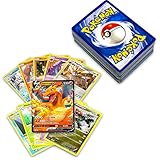
- Top Pick: 50+ Official Pokemon Cards Collection with 5 Foils in Any Combination and at Least 1 Rarity, GX, EX, FA, Tag Team, Or Secret Rare
- Best Value: Pokémon TCG: Mega Evolution—Pitch Black Elite Trainer Box
- Premium Choice: Pokemon TCG: Authentic Factory Sealed Booster Pack (Includes Mystery Card Bundle – V/VMAX 1 in 3 – Bonus Free Protective Card Holder!)
If you want to know how to sell Pokemon cards without leaving money on the table, the short version is this: sort your collection by set and rarity, price each card against recently sold listings rather than optimistic asking prices, sell genuine chase cards individually on eBay or TCGplayer, and offload the leftover commons and uncommons as bulk to a local card shop. Grading is only worth it for a small slice of any collection. The difference between doing this properly and dumping a shoebox on the first buyer who offers is usually enormous.
As an Amazon Associate I earn from qualifying purchases.
Most people who ask how to sell Pokemon cards are sitting on a mix of childhood cardboard and a few modern packs, and the value distribution is brutally uneven: a handful of cards carry almost all the worth. Before we get into the mechanics, here is a quick reference table of the mainline Pokemon video games, because knowing which generation a card set ties into helps you identify what you actually own and which eras collectors chase hardest.
| Game | Platform | Genre | Why It’s Great | Rating |
|---|---|---|---|---|
| Pokemon Red & Blue | Game Boy | RPG | The 151 originals that anchor Base Set nostalgia and the most valuable vintage cards | 9/10 |
| Pokemon Gold & Silver | Game Boy Color | RPG | Two full regions in one cartridge, plus a day/night cycle that was unheard of in 2000 | 9.5/10 |
| Pokemon Ruby & Sapphire | Game Boy Advance | RPG | Introduced abilities and double battles, reshaping competitive play permanently | 8.5/10 |
| Pokemon HeartGold & SoulSilver | Nintendo DS | RPG | Widely considered the best remakes in the series, with your lead Pokemon following you | 9.5/10 |
| Pokemon Black & White | Nintendo DS | RPG | An all-new regional roster and the strongest story the mainline series has told | 9/10 |
| Pokemon X & Y | Nintendo 3DS | RPG | The jump to 3D models and the debut of Mega Evolution | 8/10 |
| Pokemon Sword & Shield | Nintendo Switch | RPG | Dynamax raids and the Wild Area, the series’ first real open-field experiment | 8/10 |
| Pokemon Legends: Arceus | Nintendo Switch | Action RPG | Rebuilt catching from scratch into a genuine stealth-and-throw action game | 9/10 |
🛒 Best Price Today on Amazon
Prime members get fast, free shipping on everything above, plus member-only deals. New members get a 30-day free trial — cancel anytime.
How to sell Pokemon cards: the four-step process
Selling well is mostly organisation. The people who get poor prices are almost always the ones who skipped straight to listing without knowing what they had. Work through the steps below in order and you will capture the large majority of your collection’s realistic market value.
Step 1: Sort and identify before you sell Pokemon cards
Every English card printed since 2003 has a set symbol and a collector number in the bottom corner, formatted as something like 25/102. Vintage Base Set cards from 1999 use a set symbol only. Sort into piles by set, then within each set separate holos, reverse holos, full arts, alternate arts, and secret rares from the plain commons and uncommons. Pay special attention to the 1st Edition stamp on the left side of the artwork and to “shadowless” printing, where the card lacks the drop shadow along the right edge of the art box. Those two markers are the difference between a card worth pocket change and a card worth a serious sum. Japanese cards are a separate pile; they are printed to a higher standard and are graded on tougher centering expectations.
Step 2: Price with sold data, not asking prices
The single biggest mistake sellers make is searching eBay, seeing a listing with a huge number attached, and assuming that is the value. Anyone can ask anything. Filter eBay search results to “Sold Items” and look at the last thirty days only, because the Pokemon market moves fast and a 2021-era comparison is meaningless now. Cross-check against TCGplayer’s market price, which is a rolling average of genuine transactions rather than a wish list. If you are in Europe, Cardmarket is the equivalent benchmark. Write the realistic number on a sticky note next to each pile. If a card has fewer than three recent sales, treat any price you see as a guess. While you are researching, it is worth noting the same “check the completed sales” discipline applies to hardware: our gaming monitor buying guide covers how panel prices swing seasonally in exactly the same way.
Step 3: Grade only when the math actually works
Grading through PSA, CGC or Beckett encases the card and assigns a numeric condition score, and a top grade can multiply the value of a genuinely pristine card several times over. It can also cost you the grading fee, shipping both ways and weeks of waiting to be told your card is a 7. Only submit cards that are already worth a meaningful amount ungraded, that look flawless under a bright light, and that have strong centering front and back. Check the four corners under magnification, tilt the card to catch surface scratches on the holo foil, and inspect the edges for the tiny white specks that come from pack fresh whitening. If you would not confidently call it perfect, sell it raw.
Where to sell Pokemon cards: marketplace by marketplace
eBay has the largest buyer pool and therefore the best price discovery for high-value singles, at the cost of the highest fees and the most buyer-protection risk. TCGplayer is the specialist marketplace serious players use to buy competitive singles; it moves mid-value cards efficiently and buyers there know exactly what they want. Local game stores will buy your collection instantly but typically pay roughly half of market value, which is the price of convenience and immediacy. Card shows and conventions let you shop your binder to multiple dealers in an afternoon and compare offers face to face. Live auction apps have become a real channel for breaking and for chase singles, though the audience skews toward modern sealed product. Facebook groups and Discord servers work but carry the highest scam exposure, so insist on marketplace payment protection rather than friends-and-family transfers.
How to sell Pokemon cards in bulk without losing money
Bulk is everything left after the good cards come out: commons, uncommons, and reverse holos with no demand. Nobody is going to buy them one at a time, and listing them individually costs more in time and postage than they return. Sell bulk by the thousand to a shop or an online bulk buyer, and separate out the energy cards and code cards, which are usually worthless and only dilute your count. One genuinely useful trick is to keep bulk sorted by set rather than shuffled, because a buyer who can see organised, set-separated bulk will pay more than for a jumbled box. Think of it like keeping your desk setup tidy, the same logic behind our gaming desk and mount buying guide.
Packing and shipping so the sale actually sticks
A sale is not complete until the buyer receives an undamaged card. Sleeve the card, put it in a rigid toploader or a semi-rigid holder, tape the toploader closed so the card cannot slide out, and sandwich it between two pieces of card stock inside a bubble mailer. For anything with real value, use tracked and signed-for shipping without exception, and film yourself packing it. That video is your entire defence in an “item not as described” dispute. Ship within one working day of payment; slow shipping is the most common trigger for buyers opening cases.
Which cards to hold instead of sell
Vintage 1st Edition and shadowless Base Set cards in strong condition have appreciated consistently and are rarely a mistake to hold. Sealed product from sets with widely loved alternate arts tends to climb as the print run disappears from circulation. Conversely, modern cards from heavily printed sets almost always fall in value once reprints arrive, so if you pull a chase card from a current set, selling into the launch hype is usually the right call. The safest posture is simple: sell modern into hype, hold vintage in high grade.
Mistakes that quietly cost sellers money
Cleaning a card with anything is an instant value killer, because graders detect surface alteration and will flag it. Rubber-banding stacks leaves permanent indentations. Storing cards in an attic or garage invites humidity warping that is impossible to reverse. Photographing cards under yellow indoor light hides scratches from you but not from the buyer who receives it. And listing a card as “mint” when it has visible edge wear guarantees a return. Describe honestly, photograph in daylight against a plain background, and price fairly; reputation compounds far faster than any single sale. Sellers who stream their collection sorting often ask about capture setups, which our streaming microphone buying guide and gaming webcam buying guide both address in detail.
Turning card money into gaming gear
Plenty of collectors liquidate a binder specifically to fund a hardware upgrade, and cards convert well into a controller, a headset or a monitor. If that is your plan, decide the target before you sell so you are not tempted to spend the proceeds in pieces. Our gaming headset buying guide and Nintendo Switch controller buying guide are the two most common landing spots for people who just cashed out a childhood collection.
Frequently Asked Questions
How do I know if my Pokemon card is a 1st Edition?
Look for a small black stamp reading “Edition 1” inside a circle, positioned on the left-hand side of the card just below the artwork box and above the Pokemon’s stats. Only cards from the earliest print runs of 1999 and 2000 era sets carry it, and its presence typically multiplies a card’s value substantially compared to the unlimited printing.
Is it worth grading Pokemon cards before selling them?
Only for cards that are already valuable raw and that look genuinely flawless under bright light with strong centering. Grading fees, two-way shipping and long turnaround times mean a mid-grade result on a modest card loses you money, so most collections should have fewer than a dozen cards submitted at most.
Where can I sell Pokemon cards the fastest?
A local card shop or a card show will buy your collection the same day, which is by far the quickest route. The trade-off is that dealers generally pay around half of retail market value because they carry the inventory risk, so speed costs you a meaningful chunk of the total return.
Are modern Pokemon cards worth anything compared to vintage?
A small number of modern alternate arts and secret rares command serious prices, but modern print runs are vastly larger than vintage ones, so the average modern card is worth very little. Vintage holos in high grade remain the reliable value anchor, while modern chase cards are best sold quickly into launch demand.
As an Amazon Associate we earn from qualifying purchases at no extra cost to you.