Our Short List of 3

- Sensor: HERO 12K optical sensor, up to 12,000 DPI
- Weight: 99 grams
- Connectivity: LIGHTSPEED Wireless with USB receiver
- Battery: Up to 250 hours on one AA battery

- Sensor: Focus Pro 30K optical sensor
- Weight: 82 grams
- Connectivity: HyperSpeed Wireless
- Battery: Up to 280 hours

- Sensor: 12K DPI optical sensor
- Weight: 70 grams
- Connectivity: 2.4 GHz wireless and Bluetooth
- Battery: Up to 100 hours
All 4 Picks at a Glance
| Product | Specs | Action |
|---|---|---|
| 1. Logitech G305 LIGHTSPEED |
| Check price on Amazon |
| 2. Razer Viper V3 HyperSpeed |
| Check price on Amazon |
| 4. HyperX Pulsefire Haste 2 Core Wireless |
| Check price on Amazon |
 5. ATK VXE Dragonfly R1 SE+ |
| Check price on Amazon |
Introduction
You do not need to spend a fortune to get a wireless gaming mouse that feels fast, tracks cleanly, and lasts for weeks on a charge. The under-50 tier has become one of the most competitive parts of the gaming mouse market, and the mice in it now carry sensors, wireless links, and battery figures that would have belonged to flagship models only a few years ago. The difference between a good under-50 mouse and a great one is no longer about raw speed: it is about shape, battery life, and the details that matter every day.
This guide focuses on wireless mice only. Every pick below connects without a cable, and each one was chosen because it delivers genuine gaming performance in the under-50 tier: a modern optical sensor, a low-latency wireless link, and a battery that lasts for weeks or months. Wired mice are excluded on purpose, because a wireless-only list keeps the comparison honest and the choices clear.
All five mice are real wireless gaming mice sold on Amazon US, with their own Amazon product links. We cover compact travel mice, all-round wireless workhorses, and ultralight options for fast play. Use the guide to find the wireless mouse that fits your hand and your games without stretching your budget.
What to Look For in a Wireless Mouse for Gaming Under 50
Wireless connection quality. A 2.4 GHz wireless link with a 1 ms report rate is the standard for gaming, and every mouse in this guide provides one. Some models also include Bluetooth, which is handy for laptop use and saves a USB port, while others are 2.4 GHz only. A dual-mode mouse gives you the most flexibility, especially if you play on a laptop.
Sensor performance. The sensor is where under-50 mice have improved the most. Modern optical sensors in this tier reach 12,000 DPI and beyond, with clean tracking at high speeds and no smoothing or acceleration. Most players use a fraction of the maximum DPI, so treat the headline number as a sign of sensor quality rather than a setting you will actually use.
Battery life. A wireless mouse that needs charging every few days will become a chore, no matter how good its sensor is. Look for at least 70 hours of battery life, and more is better: some mice in this guide last for 250 hours or more on a single battery. Rechargeable models should last for weeks between charges, and replaceable-battery models can run for months.
Weight and shape. Lighter mice reduce wrist fatigue and make fast movements easier, while a comfortable shape matters even more during long sessions. Compact shells suit claw and fingertip grips, while mid-size ergonomic shells suit palm grips. Match the shell to your grip style and hand size before anything else.
Buttons and on-board memory. Six or more programmable buttons cover most games, and on-board memory keeps your DPI settings and button assignments on the mouse when you move between computers. Companion software is useful for remapping buttons, but the mouse should work well even without it.
Build quality. A mouse in this tier should feel solid in the hand, with no flex in the shell, crisp clicks, and a scroll wheel that is easy to use. A well-built under-50 mouse can last for years, so check the switch rating and the overall feel before you decide.
Our Top Picks
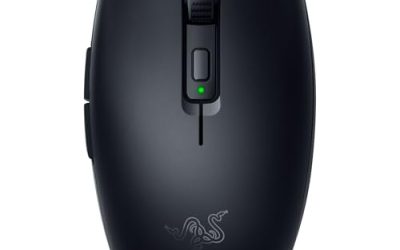
1. Logitech G305 LIGHTSPEED
- Sensor: HERO 12K optical sensor, up to 12,000 DPI
- Weight: 99 grams
- Connectivity: LIGHTSPEED Wireless with USB receiver
- Battery: Up to 250 hours on one AA battery
The Logitech G305 LIGHTSPEED is the benchmark wireless mouse in the under-50 tier, and it has earned that position through years of dependable performance. It weighs 99 grams, uses the HERO 12K sensor with up to 12,000 DPI, and runs for up to 250 hours on a single AA battery. The LIGHTSPEED wireless link delivers a 1 ms report rate, so the connection feels as responsive as a wired mouse in fast games.
What makes the G305 stand out is how complete the package is. The USB receiver stores inside the mouse body, so you never have to worry about losing it, and the compact symmetrical shell works for left and right-handed players alike. Six programmable buttons and on-board memory let you store your DPI settings and button assignments on the mouse itself, so it behaves the same way on any computer you use it with.
The G305 connects over LIGHTSPEED wireless only, with no Bluetooth mode, so it always uses one USB port for its receiver. That is a fair trade for the connection quality and battery life on display here. If you want a proven wireless mouse that simply works every time, the G305 is the safest pick in this guide.
2. Razer Viper V3 HyperSpeed
- Sensor: Focus Pro 30K optical sensor
- Weight: 82 grams
- Connectivity: HyperSpeed Wireless
- Battery: Up to 280 hours
The Razer Viper V3 HyperSpeed brings flagship-level wireless technology into the under-50 tier, and it is the fastest mouse in this guide. It weighs 82 grams, uses the Focus Pro 30K optical sensor, and supports wireless polling up to 4000 Hz over HyperSpeed Wireless, which gives it exceptionally smooth cursor movement. Battery life reaches up to 280 hours, so you can play for weeks between battery changes.
The symmetrical shell suits claw and fingertip grips, and the Gen-2 mechanical switches feel crisp and consistent. The Viper V3 HyperSpeed is built for fast, competitive play, with a sensor and polling rate that match mice costing far more. The light weight makes quick flicks and long sweeping movements easier, while the long battery life means you rarely have to think about power.
If you play fast competitive games and you want the highest polling rate and the most advanced sensor in this tier, the Viper V3 HyperSpeed is the pick. It is the clearest example of how far under-50 mice have come.
3. SteelSeries Rival 3 Wireless
The SteelSeries Rival 3 Wireless is the battery-life champion of this guide, and it is built for players who hate thinking about charging. SteelSeries rates it at more than 400 hours of battery life, and it connects over both 2.4 GHz wireless and Bluetooth 5.0, so you can pair it directly with a laptop over Bluetooth and keep your USB ports free, then switch to the 2.4 GHz link for the fastest response in a game.
The TrueMove Air optical sensor reaches 18,000 CPI and tracks accurately on most surfaces, while the switches are rated for 60 million clicks. The right-handed ergonomic shell suits palm and claw grips, and the mouse works on PC and Mac alike. Two AAA batteries power the mouse, and the long battery life means you may go months between swaps.
At 106 grams, the Rival 3 Wireless is the heaviest mouse in this guide, but the weight brings a solid, planted feel that many players prefer for steady aim. If your priority is a mouse you can pair once and then forget about for months, this is the one to choose.
- Sensor: TrueMove Air optical sensor, up to 18,000 CPI
- Weight: 106 grams
- Connectivity: 2.4 GHz wireless and Bluetooth 5.0
- Battery: More than 400 hours
- Buttons: 6 programmable buttons
- Extras: 60 million click switch rating
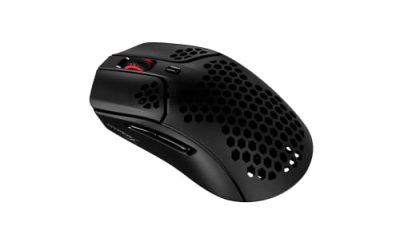
4. HyperX Pulsefire Haste 2 Core Wireless
- Sensor: 12K DPI optical sensor
- Weight: 70 grams
- Connectivity: 2.4 GHz wireless and Bluetooth
- Battery: Up to 100 hours
The HyperX Pulsefire Haste 2 Core Wireless is the streamlined version of the Haste 2, and it keeps the features that matter most while staying firmly in the under-50 tier. It weighs 70 grams, uses a 12K DPI optical sensor, and connects over both 2.4 GHz wireless and Bluetooth, so you can pair it directly with a laptop or use the faster wireless link for games. Battery life reaches up to 100 hours, and the mouse charges over USB-C.
The shell is a symmetrical design that suits claw and fingertip grips, with TTC Gold switches that feel crisp and consistent. Dual wireless connectivity is the headline feature: Bluetooth for everyday use and travel, and the 2.4 GHz link for games where every millisecond matters. The sensor tracks cleanly at high speeds, and the light weight makes fast movements easy.
For players who want a light, fast, dual-wireless mouse without paying for features they will not use, the Haste 2 Core Wireless is a strong choice. It is easy to carry, easy to pair, and quick enough for serious play.
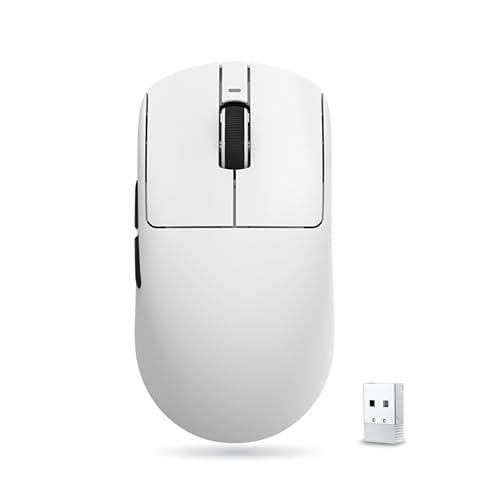
5. ATK VXE Dragonfly R1 SE+
- Sensor: PAW3395 SE optical sensor, up to 18,000 DPI
- Weight: 55 grams
- Connectivity: 2.4 GHz wireless, Bluetooth, and wired USB
- Battery: Up to 70 hours
The ATK VXE Dragonfly R1 SE+ is the lightest mouse in this guide and a strong example of how much performance the under-50 tier now delivers. It weighs just 55 grams and uses a PAW3395 SE sensor with up to 18,000 DPI, plus a 1000 Hz polling rate for smooth tracking. It connects over 2.4 GHz wireless, Bluetooth, and wired USB, so you can use whichever link suits the moment, and the battery lasts up to 70 hours on a charge.
For laptop play and travel, the appeal is simple: very little weight, a compact shell, and three ways to connect. The light weight makes fast flicks and long sessions easier on the wrist, and the tri-mode connection means you are never stuck without a working link. The sensor is a proven performer in its class, and the mouse is a strong fit for claw and fingertip grips.
If low weight and flexible connectivity are your top priorities, the Dragonfly R1 SE+ deserves a close look. It is the lightest wireless mouse in this guide, and it proves that an under-50 mouse can be genuinely fast.
Comparison Table
| Product | Key Feature | Best For |
|---|---|---|
| Logitech G305 LIGHTSPEED | 250 hr battery, built-in receiver storage | Dependable everyday wireless gaming |
| Razer Viper V3 HyperSpeed | Focus Pro 30K sensor, 4000 Hz polling | Fast competitive play |
| SteelSeries Rival 3 Wireless | More than 400 hr battery, Bluetooth 5.0 | Long battery life and Bluetooth pairing |
| HyperX Pulsefire Haste 2 Core Wireless | 70 g, dual wireless, 12K DPI sensor | Lightweight dual-wireless play |
| ATK VXE Dragonfly R1 SE+ | 55 g, tri-mode, 18,000 DPI sensor | Ultralight play on a budget |
Buying Guide: Things to Consider
Wireless-only means checking the link. Every mouse in this guide is wireless, but the wireless link itself varies. A 2.4 GHz receiver link is the fastest option and the right choice for competitive games, while Bluetooth is more convenient for laptop use and saves a USB port. A dual-mode mouse gives you both, and that flexibility is worth prioritising if you play on more than one machine.
Battery life is a daily concern. A wireless mouse that needs charging every few days will become a chore. Look for at least 70 hours of battery life, and remember that the headline figure is often measured in the most efficient mode. Mice with replaceable batteries can run for months, while rechargeable models should last for weeks between charges.
Shape beats specs. A sensor number will not help you if the mouse does not fit your hand. Palm grips need a longer shell, claw grips suit mid-size shells with a defined hump, and fingertip grips work best with compact mice. If you can, compare the shell dimensions with a mouse you already own before you decide.
Weight matters more at this tier. Many under-50 mice are light, but the difference between 55 grams and 106 grams is large in the hand. Lighter mice reduce wrist fatigue during long sessions and make fast movements easier. If you play fast games, prioritise the lightest mouse that still fits your hand.
Check the switch and sensor ratings. A switch rated for tens of millions of clicks and a modern optical sensor are signs of a mouse built to last. These details matter more than a flashy shell, and they separate the durable picks from the ones that wear out quickly.
Do not overbuy on DPI. Almost every modern gaming sensor in this tier is more than accurate enough. Spend your attention on shape, weight, battery, and connectivity instead, because those are the things you will notice every single day.
Frequently Asked Questions
Is a wireless mouse under 50 good enough for competitive gaming?
Yes. The mice in this guide carry modern optical sensors and low-latency 2.4 GHz wireless links with a 1 ms report rate, which feels the same as a wired connection in practice. The Viper V3 HyperSpeed even supports wireless polling up to 4000 Hz. Use the 2.4 GHz receiver mode rather than Bluetooth for ranked matches.
Should I choose Bluetooth or a 2.4 GHz receiver for gaming?
Use Bluetooth when you want to save a USB port and play casually, and use the 2.4 GHz receiver when you want the lowest latency for competitive games. A dual-mode mouse lets you switch between the two in seconds, which is the most flexible setup, especially on a laptop.
How much battery life do I need in a wireless gaming mouse?
Aim for at least 70 hours of battery life in the mode you use most, and more is better. Mice with replaceable batteries can run for hundreds of hours, while rechargeable models usually last for weeks between charges. Long battery life matters most when you play away from a charger.
What is the lightest wireless gaming mouse under 50?
The lightest pick in this guide is the ATK VXE Dragonfly R1 SE+ at 55 grams, followed by the HyperX Pulsefire Haste 2 Core Wireless at 70 grams. Both are genuine ultralight mice with modern sensors, and both suit claw and fingertip grips best.
Conclusion
The best wireless mouse for gaming under 50 is the one that fits your hand, connects the way you need it to, and keeps running for weeks without a charge. The Logitech G305 LIGHTSPEED remains the most dependable all-rounder, while the Razer Viper V3 HyperSpeed brings flagship speed into this tier. The SteelSeries Rival 3 Wireless is the pick for players who want to forget about charging, the HyperX Pulsefire Haste 2 Core Wireless is the lightest dual-wireless option here, and the ATK VXE Dragonfly R1 SE+ is the lightest mouse in the guide.
Whichever mouse you choose, prioritise shape and connectivity over headline specs. A wireless mouse that feels right in your hand and connects the way you need it to will serve you far better than a heavier or more complicated model. Pick your grip, pick your connection, and enjoy wireless gaming without stretching your budget.
Disclosure: As an Amazon Associate, we earn from qualifying purchases.