A data analysis desk is not decided by a single benchmark number. The real choice is how much data you can hold in memory, how quickly you can read and write large files, and how many monitors you can keep open at once while a notebook, a spreadsheet and a database client all run together. A small box that chokes on a wide dataset will waste more of your day than a slightly slower chip ever will.
This guide is for analysts, students, researchers and home-office workers who want a compact Ryzen machine for spreadsheets, SQL work, Python notebooks and dashboard tools. Every system below was chosen from the processor, memory, storage and connectivity stated in its Amazon listing, so you can compare what each box actually ships with before you buy.
Quick Picks
As an Amazon Associate we earn from qualifying purchases
| Product | Best for | Key spec from title |
|---|---|---|
| Beelink SER8 Ryzen 7 8845HS | A quiet main desk for daily notebook work | Ryzen 7 8845HS, 32GB DDR5, 1TB SSD |
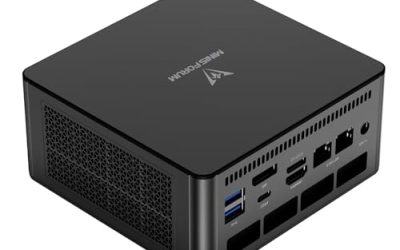
| Minisforum UM790 Pro Ryzen 9 7940HS | Heavy multitasking across several tools at once | Ryzen 9 7940HS, 32GB DDR5, 1TB SSD |
| GMKtec K11 Ryzen 9 8945HS | A growing setup that may add an external GPU later | Ryzen 9 8945HS, 32GB DDR5, 1TB SSD, OCuLink |
| Beelink SER5 MAX Ryzen 7 7735HS | A smaller analysis box for a tight desk | Ryzen 7 7735HS, 24GB LPDDR5, 1TB SSD |
| GMKtec K8 Plus Ryzen 7 8845HS | A dual-network desk with room to expand storage | Ryzen 7 8845HS, 32GB DDR5, 1TB SSD |
How to Choose
Start with memory, not the processor badge
Data work lives or dies in RAM. A wide table, a large join or a notebook holding several dataframes can push a 16GB machine into swapping, and once that happens every click feels slow. For regular analysis, 32GB of DDR5 is the sensible target, and it leaves room for a browser full of documentation tabs beside your tools. A 24GB box can work for lighter datasets, but check whether its memory is soldered before you buy, because soldered memory cannot grow later. If your files keep getting bigger, buy the memory headroom first and worry about the chip second.
Match the core count to how you actually work
Most analysis tasks are a mix of single-threaded waiting and bursts of parallel work. Loading a file, filtering a column or running a group-by can use several cores at once, while writing code and reading results stays light. An eight-core Ryzen 7 or Ryzen 9 with sixteen threads handles that mix well, keeping a notebook responsive while a query runs in the background. A six-core chip is fine for spreadsheets and small scripts, but it will feel crowded when you run a database, a notebook server and a dashboard at the same time.
Count storage slots and speed before you run out
A single drive fills up fast when raw downloads, cleaned extracts and model outputs all live on the same machine. Look for a PCIe 4.0 NVMe SSD of at least 1TB, and prefer a box with a second M.2 slot so you can add a dedicated data drive later without replacing the first one. Keeping the operating system and applications on one drive and your datasets on another also makes backups simpler. Check the listing for the number of M.2 slots and the maximum supported capacity, because some compact boxes share a slot with an expansion adapter.
Check displays, networking and cooling honestly
Analysis usually means two or three screens: code on one, results on another, and reference material on a third. Count the HDMI, DisplayPort and USB4 outputs in the listing and confirm they can all run at once, because a port that only mirrors another display is no help. A 2.5GbE wired port matters when you pull large files from a local server or network storage, and Wi-Fi 6 keeps cloud work smooth. Finally, remember that a small chassis under a sustained load needs room to breathe, so leave space around its vents and keep it off a carpeted floor.
The 5 Best Options
Beelink SER8 Ryzen 7 8845HS

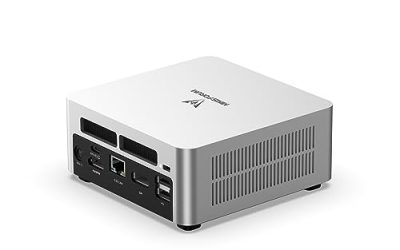
The SER8 suits an analyst who wants a quiet, compact main machine without paying for a flagship chip. Its eight-core Ryzen 7 8845HS and 32GB of DDR5 handle large spreadsheets, notebook sessions and database clients side by side, while the Radeon 780M graphics drive multiple monitors for code, tables and charts. Two M.2 slots give you a clear path to add a second drive when your dataset collection grows, and the USB4 port leaves room for a fast dock or external storage later.
Specs
- AMD Ryzen 7 8845HS, 8 cores and 16 threads, up to 5.1GHz
- 32GB DDR5 RAM
- 1TB M.2 PCIe 4.0 SSD
- AMD Radeon 780M graphics
- Triple 4K display support through HDMI, DisplayPort and USB4
- Wi-Fi 6 and Bluetooth 5.2
- 2.5Gbps Ethernet
- Windows 11 Pro
Best for: A quiet everyday analysis desk with three monitors and room to grow storage.
Watch out for: Confirm the exact RAM and SSD configuration in the listing you select, because the SER8 is sold in several configurations.
Minisforum UM790 Pro Ryzen 9 7940HS

The UM790 Pro is the pick for analysts who keep many tools open at once and want the extra headroom of a Ryzen 9. Its eight-core Ryzen 9 7940HS, 32GB of DDR5 and 1TB SSD make short work of large filters, joins and notebook runs, and the dual USB4 ports are handy for docks, fast external drives and extra displays. Dual M.2 slots mean your working data can live on its own drive, which keeps the system drive clear and makes project folders easier to manage.
Specs
- AMD Ryzen 9 7940HS, 8 cores and 16 threads, up to 5.2GHz
- 32GB DDR5 RAM
- 1TB PCIe 4.0 SSD
- AMD Radeon 780M graphics
- 2x HDMI 2.1 and 2x USB4 outputs
- Wi-Fi 6E and Bluetooth 5.3
- 2.5G Ethernet
- Dual M.2 2280 PCIe 4.0 slots
Best for: Heavy multitasking with a notebook, a database client and dashboards open together.
Watch out for: Check the listing for the exact configuration, because older UM790 Pro listings redirect to newer configuration pages.
GMKtec K11 Ryzen 9 8945HS
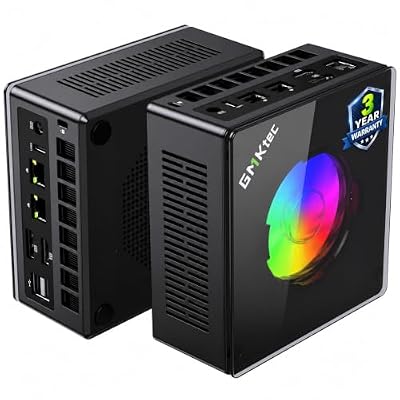
The K11 fits an analyst whose setup is still growing, because it pairs a strong Ryzen 9 chip with an OCuLink port for an external graphics card later. Right now its eight cores, 32GB of DDR5 and 1TB SSD cover demanding notebook work and large table operations, while dual 2.5GbE ports suit a desk wired into local network storage. The quad-display output is useful when you want code, results, a dashboard and documentation all visible at once without constant window switching.
Specs
- AMD Ryzen 9 8945HS, 8 cores and 16 threads, up to 5.2GHz
- 32GB DDR5 RAM, expandable to 128GB
- 1TB PCIe 4.0 M.2 SSD, dual slots expandable to 8TB
- AMD Radeon 780M graphics
- OCuLink port
- Dual NIC 2.5GbE LAN
- HDMI 2.1, DisplayPort 2.1 and 2x USB4
- Wi-Fi 6 and Bluetooth 5.2
Best for: A growing analysis setup that may add an external GPU or a second network link later.
Watch out for: The OCuLink port needs a compatible external GPU enclosure and cable, which are separate purchases.
Beelink SER5 MAX Ryzen 7 7735HS

The SER5 MAX is the sensible choice when desk space is tight and your datasets are moderate rather than enormous. Its eight-core Ryzen 7 7735HS and 24GB of LPDDR5 memory handle spreadsheets, SQL queries and notebook work comfortably, and the triple-display output covers the usual code, results and reference layout. The 1TB SSD gives you room for working files, and the compact chassis tucks behind a monitor or under a shelf without crowding the desk.
Specs
- AMD Ryzen 7 7735HS, 8 cores and 16 threads, up to 4.75GHz
- 24GB LPDDR5 RAM
- 1TB M.2 PCIe 4.0 SSD
- AMD Radeon Graphics, 12 cores, 2200MHz
- Triple 4K display support through HDMI, DisplayPort and Type-C
- Wi-Fi 6 and Bluetooth 5.2
- 2.5G LAN
- Windows 11 Pro
Best for: A compact desk where moderate datasets and a three-screen layout are the daily routine.
Watch out for: The 24GB of memory is soldered and cannot be upgraded, so be sure it covers your largest datasets.
GMKtec K8 Plus Ryzen 7 8845HS

The K8 Plus suits an analyst who moves large files across a local network and wants storage flexibility from the start. Its Ryzen 7 8845HS and 32GB of DDR5 keep notebook sessions and database tools responsive, while dual 2.5GbE ports give you a wired link to a server or network drive and a second link for another device. Dual M.2 slots and an OCuLink port mean the box can grow with your data and, later, with an external graphics card if your work turns toward heavier visual tasks.
Specs
- AMD Ryzen 7 8845HS, 8 cores and 16 threads, up to 5.1GHz
- 32GB DDR5 RAM, expandable to 96GB
- 1TB PCIe 4.0 M.2 SSD, dual slots expandable to 8TB
- AMD Radeon 780M graphics
- OCuLink port
- Dual Intel i226V 2.5Gbps LAN
- HDMI 2.1, DisplayPort 2.1 and 2x USB4
- Wi-Fi 6 and Bluetooth 5.2
Best for: A dual-network desk with large local files and plans to expand storage later.
Watch out for: Confirm whether the configuration you choose includes Windows 11 Pro, because the K8 Plus is also sold as a barebones kit.
Which One Fits Your Situation
You analyse data all day on one desk
Choose the Beelink SER8. Its 32GB of DDR5, 1TB SSD and triple-display support cover the daily cycle of loading, cleaning, modelling and presenting results, and the quiet chassis suits a desk you sit at for hours. Add a second SSD later when your project folders grow. The triple-display output also means you can keep a notebook, a dashboard and a reference document open side by side without switching windows.
You run several heavy tools at the same time
Choose the Minisforum UM790 Pro. The Ryzen 9 chip and dual USB4 ports keep a notebook, a database client and a dashboard responsive together, and the second M.2 slot lets you separate working data from the system drive. The 32GB of memory also gives you room to run a browser with several tabs alongside your tools, so research and documentation stay open while you work.
You want an upgrade path to an external GPU
Choose the GMKtec K11. The OCuLink port and dual 2.5GbE networking give you a clear route to add graphics power or faster local storage later, while the Ryzen 9 and 32GB of memory handle current analysis work without strain. The dual 2.5GbE ports also suit a desk wired into local network storage, so large files move quickly between the mini PC and a server.
Your desk is small and your datasets are moderate
Choose the Beelink SER5 MAX. It delivers eight cores and triple-display output in a compact box, and its 24GB of memory is enough for spreadsheets, SQL work and notebook sessions that do not hold enormous tables in memory. The compact chassis also fits behind a monitor or on a shelf, which frees up desk space for a notebook, a second screen or the paperwork that piles up during a project.
Common Mistakes
- Buying 16GB of memory for work that regularly holds wide tables in memory, then hitting slowdowns when the system starts swapping.
- Choosing a box with a single M.2 slot and no room for a second data drive.
- Assuming every video port can run a separate monitor at the same time without checking the listing.
- Picking a soldered-memory model when your datasets are still growing.
- Putting a small, hard-working chassis in a closed cabinet with no airflow around its vents.
Frequently Asked Questions
How much RAM do I need for data analysis on a mini PC?
For most analysis work, 32GB is the practical target. It holds large tables, a notebook, a database client and a browser together without forcing the system to swap to disk. Lighter spreadsheet and SQL work can run on 24GB, but check whether the memory is soldered before you buy, because that decides whether you can add more later.
Is a Ryzen 7 or a Ryzen 9 better for data analysis?
Both use eight cores in the models here, so the difference is clock speed, cache and headroom rather than core count. A Ryzen 7 handles daily notebook and spreadsheet work well, while a Ryzen 9 gives you extra margin when several heavy tools run at once. Spend the difference on memory or a second SSD if your current chip already keeps up.
Can a mini PC drive three monitors for analysis?
Yes, provided the listing states triple-display support and you use the right combination of ports. The models in this guide offer HDMI, DisplayPort and USB4 or USB-C outputs for three screens. Check the listing for the exact port combination, because some ports share a single display output.
Do I need an external GPU for data analysis?
Usually not. Integrated Radeon graphics handle spreadsheets, notebooks, dashboards and multiple monitors. An external GPU only becomes useful when your work turns to heavy visualisation, machine learning or video tasks. If that is a possibility, choose a model with an OCuLink or USB4 port so the option stays open.