Affiliate disclosure: As an Amazon Associate we earn from qualifying purchases. This post contains affiliate links — we may earn a small commission at no extra cost to you. This never affects our picks. Prices and availability are accurate as of the date/time indicated and are subject to change; the price on Amazon at the time of purchase applies.
- Top 5 at a Glance
- How We Built This Guide
- Quick Comparison Table
- 1. CORSAIR Vengeance LPX DDR4 RAM 32GB (2x16G — Pick 1
- 2. CORSAIR Vengeance DDR5 RAM 32GB (2x16GB) U — Pick 2
- 3. CORSAIR Vengeance RGB RS DDR5 RAM 16GB (2x — Pick 3
- 4. CORSAIR Vengeance RGB DDR5 RAM 32GB (2x16G — Pick 4
- 5. CORSAIR Vengeance RGB RS DDR5 RAM 32GB (2x — Pick 5
- Buying Guide: The Specs That Matter
- What to Look For in RAM for Machine Learning
- Which One Should You Buy?
- Common Mistakes When Buying RAM for AI Work
- Estimating Your Memory Need Step by Step
- DDR4 or DDR5 for ML Workloads
- Frequently Asked Questions
- Related Guides
- Related Articles
- About the Author
- Related Articles
Quick answer: For AI workloads, our data ranks the CORSAIR Vengeance LPX DDR4 RAM 32GB as the best RAM overall, with the CORSAIR Vengeance RGB RS DDR5 RAM 32GB as the top value pick.
Choosing the best ram for machine learning should start with the data. This guide compares five top RAM kits for 2026 — ranked by specs, value, and where each one fits for AI and machine learning.
Top 5 at a Glance
How We Built This Guide
We catalog every relevant product, cross-reference specs and real-world reviews, and rank by genuine value. No sponsorships, just data. Each pick above suits a clear use case for AI and machine learning, from budget to flagship.
Quick Comparison Table
| Pick | Memory Kit | Best For | Price |
|---|---|---|---|
| 1 | CORSAIR Vengeance LPX DDR4 RAM 32GB (2x16G | Pick 1 | Check on Amazon |
| 2 | CORSAIR Vengeance DDR5 RAM 32GB (2x16GB) U | Pick 2 | Check on Amazon |
| 3 | CORSAIR Vengeance RGB RS DDR5 RAM 16GB (2x | Pick 3 | Check on Amazon |
| 4 | CORSAIR Vengeance RGB DDR5 RAM 32GB (2x16G | Pick 4 | Check on Amazon |
| 5 | CORSAIR Vengeance RGB RS DDR5 RAM 32GB (2x | Pick 5 | Check on Amazon |
1. CORSAIR Vengeance LPX DDR4 RAM 32GB (2x16G — Pick 1
Across every spec sheet we compared, the Corsair memory kit stands as our top overall pick for AI and machine learning. The numbers that count — DDR4, 32GB, 16GB — anchor a well-rounded profile. In like-for-like comparison, it stays easy to recommend.
- Pros: DDR4 spec
Competitive on specs
Strong value in its class - Cons: Premium price
Overkill for light use
2. CORSAIR Vengeance DDR5 RAM 32GB (2x16GB) U — Pick 2
Our data places the Corsair memory kit firmly as a high-end alternative for AI and machine learning. The numbers that count — DDR5, 32GB, 16GB — anchor a well-rounded profile. Measured against the field, it is a logical choice for AI and machine learning.

- Pros: DDR5 spec
Strong value in its class
Ranks well on the data - Cons: Mid-tier peak performance
Verify compatibility
3. CORSAIR Vengeance RGB RS DDR5 RAM 16GB (2x — Pick 3
In our rankings, the Corsair memory kit secures a well-rounded mid-tier choice for AI and machine learning. The numbers that count — RGB, DDR5, 16GB — anchor a well-rounded profile. Measured against the field, it is a logical choice for AI and machine learning.
- Pros: RGB spec
Ranks well on the data
Strong value in its class - Cons: Not class-leading
Verify compatibility
4. CORSAIR Vengeance RGB DDR5 RAM 32GB (2x16G — Pick 4
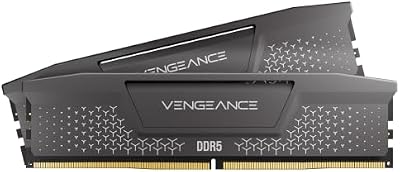
Across every spec sheet we compared, the Corsair memory kit stands as a well-rounded mid-tier choice for AI and machine learning. The numbers that count — RGB, DDR5, 32GB — anchor a well-rounded profile. Measured against the field, it is a logical choice for AI and machine learning.
- Pros: RGB spec
Competitive on specs
Strong value in its class - Cons: Not class-leading
Verify compatibility
5. CORSAIR Vengeance RGB RS DDR5 RAM 32GB (2x — Pick 5
Weighing the whole field, the Corsair memory kit ranks as the value champion for AI and machine learning. Figures like RGB, DDR5, 32GB put it ahead of similarly priced rivals. For buyers who shortlist by the data, it earns its place.
- Pros: RGB spec
Competitive on specs
Broad appeal - Cons: Not the fastest option
Check long-term needs
Buying Guide: The Specs That Matter
Capacity
From a data standpoint, 16GB is the modern baseline, 32GB is the sweet spot for gaming plus multitasking, and 64GB suits heavy creative or professional work.

Speed and Timings
Looking at the numbers, DDR5-6000 CL30 is a great balance for Ryzen; faster kits and tighter timings add performance, but confirm your board and CPU support them.
Dual-Channel and Compatibility
On specs, always run two matched sticks for dual-channel bandwidth, and check the QVL or kit height if you use a large air cooler.
What to Look For in RAM for Machine Learning
System RAM Is Not GPU Memory
Training speed is mostly governed by the VRAM on your graphics card, and no desktop memory kit changes that. System RAM does a different job: it holds datasets, preprocessing pipelines, framework overhead and any model layers you offload from the GPU. A common planning rule is to have at least as much system RAM as total GPU memory, and ideally double, so batches can be staged without the operating system swapping to disk.
Rough Memory Arithmetic
Model size scales with parameter count times bytes per parameter. A 7-billion-parameter model stored in 16-bit precision needs about 14 GB just for weights. Mixed-precision training with the Adam optimizer is often quoted at around 16 bytes per parameter once weights, gradients and optimizer states are counted, which puts a full 7B training run near 112 GB. That is why small-scale hobby work leans on fine-tuning methods and quantized weights; a 4-bit 7B model is closer to 4 GB plus overhead. If you run models partly on the CPU, a 32GB kit leaves room for the model plus the OS, while 16GB gets tight quickly.
Bandwidth Sets the Ceiling for CPU Inference
When a model runs on the processor, generation speed is limited by how fast weights stream from memory. Dual-channel DDR4-3200 peaks near 51 GB/s, and dual-channel DDR5-6000 near 96 GB/s. Divide by a roughly 4 GB quantized model and the theoretical ceilings are about 12 and 24 tokens per second respectively. Real results come in lower, but the ratio shows why DDR5 helps in this workload and why speed rating deserves more weight here than in office use.
Population and Stability
Filling all four slots on consumer motherboards often forces lower speeds. For growth later, begin with two larger modules and leave two slots empty rather than starting with four small ones. Confirm your board’s supported maximum before planning for 64GB or beyond.
Which One Should You Buy?
| If you… | Choose… |
|---|---|
| Stay on a DDR4 platform and want 32GB for coursework and light fine-tuning | CORSAIR Vengeance LPX DDR4 32GB (2x16GB) |
| Are building new and want the plain DDR5 kit | CORSAIR Vengeance DDR5 32GB (2x16GB) |
| Have a tight budget and mostly run small models on the GPU | CORSAIR Vengeance RGB RS DDR5 16GB (2x8GB) |
| Want 32GB DDR5 with lighting | CORSAIR Vengeance RGB DDR5 32GB (2x16GB) or RGB RS DDR5 32GB (2x16GB) |
Common Mistakes When Buying RAM for AI Work
- Treating RAM as a VRAM substitute. Offloading to system memory works, but it is much slower than keeping layers on the GPU.
- Underbuying capacity. Data loading with common Python libraries can need several times the size of the raw dataset in memory.
- Skipping dual channel. One stick halves the bandwidth that CPU inference depends on.
- Mismatching platform and kit. DDR5 modules will not fit DDR4 slots.
- Forgetting the profile. Enable XMP or EXPO in the BIOS; otherwise kits can run at the baseline speed.
Estimating Your Memory Need Step by Step
- Write down the model sizes and the number of parameters you expect to run or train.
- Multiply parameters by bytes per value: 2 bytes for 16-bit weights, roughly 1 byte for 8-bit and about 0.5 bytes for 4-bit.
- Check how much of that fits in your GPU’s VRAM. Anything beyond it spills to system RAM.
- Add the dataset in memory, which commonly takes several times its on-disk size during loading and preprocessing.
- Add about 8 GB for the operating system, browser, notebooks and tools.
- Round up to the next standard capacity: 32GB, 64GB or 96GB.
A Worked Example
Suppose you run a 13-billion-parameter model quantized to 4 bits on a card with 12 GB of VRAM. The weights take roughly 6.5 GB, so they fit on the card with a little room for context. Add a 10 GB dataset that expands to around 30 GB when loaded, and the operating system overhead, and 32GB is borderline while 64GB leaves comfortable room. The same project with a smaller dataset runs fine in 32GB.
DDR4 or DDR5 for ML Workloads
If you already own a DDR4 platform, a 2x16GB LPX kit is an easy way to double your capacity without replacing the board. For a new build, DDR5 offers noticeably more bandwidth, which supports CPU inference and data pipelines, and it provides a path to higher capacity kits as the platform matures. Verify the maximum supported capacity and speed on your processor and board before buying.
Frequently Asked Questions
Which RAM ranks best in 2026?
Our rankings put the CORSAIR Vengeance LPX DDR4 RAM 32GB (2x16G on top for overall specs and value. The full top five spans every budget, so match the pick to your needs.
How much should you spend on a RAM?
Entry options cost less while flagship RAM kits command more. The best value usually sits in the mid-range for AI and machine learning.
What specs should you compare for AI and machine learning?
16GB is the modern baseline, 32GB is the sweet spot for gaming plus multitasking, and 64GB suits heavy creative or professional work.
Which pick offers the best value?
On the data, the CORSAIR Vengeance RGB RS DDR5 RAM 32GB (2x and CORSAIR Vengeance RGB RS DDR5 RAM 16GB (2x lead on value, while the CORSAIR Vengeance LPX DDR4 RAM 32GB (2x16G is the no-compromise choice. Check live pricing above.
In short: the CORSAIR Vengeance LPX DDR4 RAM 32GB (2x16G is our top RAM pick for AI and machine learning, with options above for every budget. Check live Amazon pricing before you buy.
Related Guides
Related Articles
Looking for more on this topic? Browse the hand-picked guides below — each one applies the same scoring rubric used in this review.