🛒 Best Price Today on Amazon
Prime members get fast, free shipping on everything above, plus member-only deals. New members get a 30-day free trial — cancel anytime.
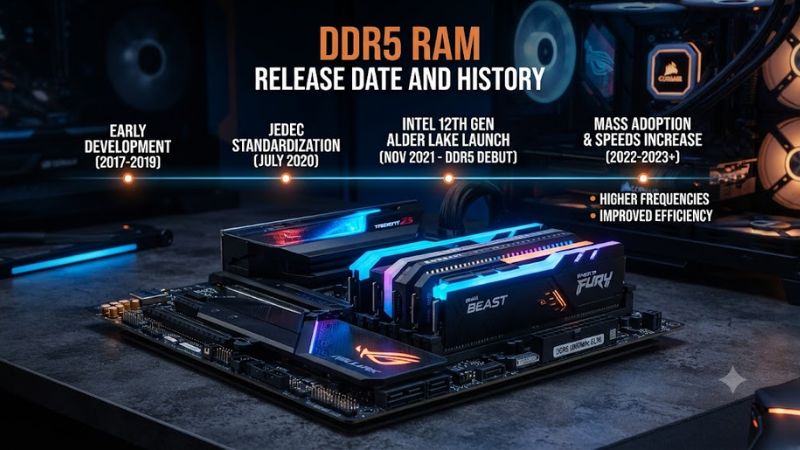
DDR5 ram release date and history starts well before the first consumer desktop kits appeared. The standard became official in July 2020, while development milestones reached back to 2017. Consumer adoption followed with Intel Alder Lake in 2021, then AMD Ryzen 7000 and AM5 in 2022, turning DDR5 into a mainstream PC memory platform.
Quick answer: Our top pick in 2026 is the Stage — our #1 rated choice. See the full ranked comparison, alternatives and buying advice below.
What DDR5 RAM Release Date and History Really Comes Down To
The short answer is that DDR5 has several meaningful “release dates”: early working hardware appeared in 2017, SK hynix announced a DDR5 DRAM chip in 2018, JEDEC finalized the DDR5 SDRAM specification on July 14, 2020, and consumer desktop memory reached the market during 2021. Separating these milestones prevents the history from being reduced to one date.
The 2017 Starting Point
The earliest major public milestone in the ddr5 ram release date and history timeline came in September 2017, when Rambus announced functional silicon for a server DIMM buffer chipset aimed at the upcoming DDR5 standard. This was prototype technology rather than a finished consumer memory platform, but it showed that the next generation was moving from specification work toward physical implementation.
At that stage, DDR5 was being developed around higher memory bandwidth, greater density, and lower operating voltage than DDR4. Rambus described a target of up to 6.4Gb/s data rates, while the final JEDEC specification later established 6.4Gb/s as its initial maximum standard data rate. Early projections were therefore useful directionally, but not the same thing as final retail specifications.
SK hynix Reached a Major Milestone
Another important point in the ddr5 ram release date and history timeline arrived in November 2018, when SK hynix announced development of a 16Gb DDR5 DRAM chip. The company said the device could operate at 5,200Mbps and described support for higher rates as the technology matured. This was still a component-level milestone rather than a mainstream desktop launch.
SK hynix followed with a production DDR5 DRAM announcement on October 6, 2020, only a few months after the final JEDEC specification. Its initial product targeted premium server and data-center applications, illustrating why “DDR5 released in 2020” can be misleading for PC builders: the memory standard existed before ordinary gaming PCs could use it.
JEDEC Made DDR5 Official
For the ddr5 ram release date and history, July 14, 2020 is the key standards date. JEDEC released the final DDR5 SDRAM specification that day, establishing the technical foundation for compatible memory devices and platforms. The specification targeted higher density and bandwidth than DDR4 while introducing architectural changes such as two 32-bit subchannels per DIMM and on-module power management.
The original DDR5 specification set a maximum standard data rate of 6.4Gb/s, equivalent to DDR5-6400 terminology when expressed as memory transfer speed. It also specified a nominal 1.1V supply compared with 1.2V for DDR4. These figures describe the standard, not every later retail kit, since manufacturers subsequently offered faster memory through platform support and memory overclocking profiles.
Consumer PCs Arrived in 2021
The consumer chapter of the ddr5 ram release date and history timeline began in earnest in 2021. Intel’s 12th Generation Core desktop platform, Alder Lake, supported DDR5-4800 alongside DDR4-3200, depending on the motherboard design. Intel’s documentation lists DDR5 UDIMM support and shows that the platform could also use DDR4, making the motherboard an important compatibility boundary.
Memory vendors followed the platform launch with retail products. Micron announced Crucial DDR5 desktop memory on October 27, 2021, with modules starting at DDR5-4800 and capacities including 8GB, 16GB, and 32GB per module. Kingston announced its FURY Beast DDR5 range on November 2, 2021, closely aligning its launch with Intel’s new platform.
How to Read DDR5 RAM Release Date and History: Step by Step
A useful way to read the ddr5 ram release date and history is to separate the technology into four stages: prototype development, silicon production, standards completion, and consumer platform adoption. This avoids treating a manufacturer announcement, a JEDEC specification, and a retail launch as interchangeable events. The table below summarizes the main milestones and their practical meaning for PC users.
| Stage | Date | What Happened | PC Significance |
| Prototype | September 2017 | Rambus announced functional DDR5-targeted buffer silicon | Early engineering milestone |
| DRAM development | November 2018 | SK hynix announced a 16Gb DDR5 DRAM chip | DDR5 silicon development advanced |
| Standard | July 14, 2020 | JEDEC released the final DDR5 SDRAM specification | Compatibility framework became official |
| Production DRAM | October 6, 2020 | SK hynix announced its DDR5 DRAM product | Server-focused commercial availability |
| Consumer desktop | October–November 2021 | Crucial and Kingston announced desktop DDR5 products around Alder Lake | Mainstream PC adoption began |
| AMD desktop | September 27, 2022 | Ryzen 7000 launched with Socket AM5 and DDR5 | AMD’s mainstream desktop transition |
Step 1: Start With the Standard Date
When researching the ddr5 ram release date and history, start with July 14, 2020 because that date identifies the completed JEDEC DDR5 SDRAM specification. It is the cleanest answer to “when was DDR5 released?” when the question concerns the memory standard itself rather than a particular chip, module, processor, or motherboard.
The standard also explains why DDR5 differs from DDR4 beyond a simple speed increase. JEDEC defined two independent 32-bit subchannels within a standard non-ECC DIMM, increased the burst length, expanded bank organization, and moved voltage regulation functions onto the module. These changes were intended to support scaling as memory bandwidth and density increased.
Step 2: Separate DRAM From DIMM Availability
The ddr5 ram release date and history becomes clearer when DRAM chips and finished DIMMs are treated separately. A DRAM manufacturer can develop or produce DDR5 silicon before motherboard manufacturers provide a compatible consumer platform. That is why SK hynix’s 2020 DDR5 DRAM announcement predates the first widely available DDR5 gaming desktops.
Retail availability also arrived in stages. TeamGroup announced DDR5-4800 modules for late June or early July 2021, while Micron announced immediate availability of Crucial DDR5 desktop memory in October. These products were aimed at the upcoming Intel Alder Lake ecosystem, showing that memory availability and CPU availability were closely linked.
Step 3: Check the CPU and Motherboard Together
For the ddr5 ram release date and history, Intel Alder Lake is the key consumer desktop transition point. Intel’s documentation lists support for DDR5-4800 and DDR4-3200, but a motherboard normally supports one memory technology rather than allowing DDR4 and DDR5 modules to be mixed. Therefore, DDR5 compatibility depends on the exact motherboard and platform design, not merely the processor family.
AMD followed a different path with Ryzen 7000. On September 27, 2022, AMD launched the Ryzen 7000 desktop processors together with Socket AM5, whose platform specification includes dual-channel DDR5 memory. AM5 therefore marked AMD’s major desktop transition to DDR5, while older AM4 systems remained DDR4 platforms.
Step 4: Treat Speed Ratings as a Separate Timeline
The ddr5 ram release date and history should not be confused with the history of every DDR5 speed grade. The original JEDEC specification reached DDR5-6400, while early consumer Alder Lake platforms officially supported DDR5-4800. Later memory kits could advertise higher transfer rates through manufacturer profiles and platform-specific memory support, so a higher number does not represent a new DDR generation.
This distinction matters when comparing historical claims. DDR5-4800 was an important early consumer baseline, while DDR5-5600 and DDR5-6400 appeared in subsequent standards updates and products. JEDEC’s JESD79-5A update in October 2021 expanded specifications for DDR5-5600 and DDR5-6400, illustrating how the ecosystem continued developing after the original 2020 standard.
FAQ: DDR5 RAM Release Date and History
The main historical question has several valid answers because DDR5 moved through separate development, standardization, production, and consumer-adoption stages. The four questions below address the dates most relevant to PC gamers and builders, while keeping component announcements separate from actual platform availability.
When was DDR5 officially released?
DDR5 was officially standardized on July 14, 2020, when JEDEC published the final DDR5 SDRAM specification. That date refers to the memory standard rather than the arrival of retail desktop kits, which came later as CPU and motherboard platforms gained DDR5 support.
For hardware history, this distinction is important because DDR5 development began years earlier. Rambus had demonstrated DDR5-targeted buffer silicon in 2017, and SK hynix announced a 16Gb DDR5 chip in 2018. Those milestones show development progress, but neither should be labeled the consumer PC release.
When did DDR5 first appear in consumer PCs?
DDR5 first reached mainstream consumer desktop platforms with Intel’s 12th Generation Core Alder Lake ecosystem in 2021. Intel’s platform documentation supports DDR5-4800, while motherboard manufacturers produced DDR5-capable LGA1700 boards alongside separate DDR4 versions for the same processor generation.
Retail memory followed the platform rollout, with Micron announcing Crucial DDR5 desktop products on October 27, 2021, and Kingston announcing FURY Beast DDR5 on November 2. AMD’s consumer desktop transition came later with Ryzen 7000 and AM5 on September 27, 2022.
Was DDR5 available before Intel Alder Lake?
Yes, DDR5 memory products existed before Alder Lake, but broad consumer desktop support had not yet arrived. TeamGroup announced DDR5-4800 modules for sale in mid-2021, months before Intel’s Alder Lake launch, while the modules were explicitly positioned for upcoming platforms.
Earlier DDR5 activity was even more specialized. SK hynix launched its first DDR5 DRAM product in October 2020 for premium server and AI/data-center applications, while Samsung was mass-producing DDR5 DRAM using its 14nm EUV process by October 2021. These events belong to the commercial memory supply chain rather than a single gaming-PC release date.
Can DDR4 and DDR5 be used on the same PC?
DDR4 and DDR5 cannot be installed together as interchangeable DIMMs, because they use different memory technologies and require motherboard designs intended for the corresponding standard. Intel’s Alder Lake platform supported both technologies at the processor level, but individual motherboards were designed around DDR4 or DDR5 memory support.
This is one of the most important compatibility lessons from the ddr5 ram release date and history. A DDR5 upgrade normally requires a compatible motherboard and processor platform, while the graphics card, PCIe generation, and power supply are separate compatibility considerations. DDR5 memory itself does not determine PCIe support or GPU compatibility.
Final Thoughts
The ddr5 ram release date and history is best understood as a progression from 2017 prototypes to 2018 DRAM development, the July 2020 JEDEC standard, 2020 server products, and 2021 consumer desktops. Intel brought DDR5 to mainstream PCs first, while AMD followed with AM5 in 2022, establishing the modern desktop transition.
Ready to decide? Our #1 pick for 2026 is the Stage.
Live price & availability on Amazon.