GTA VI launched on 19 November 2026 for PlayStation 5 and Xbox Series X|S, published by Rockstar Games, and its arrival has put big open-world games back at the center of gaming. No PC version of GTA VI has been announced, so PC players are spending launch week revisiting the open-world games already on PC, including earlier GTA titles and the many large-map games like them. Those sessions tend to run long, and long sessions are exactly where a graphics card shows its strengths and weaknesses.
This guide picks five discrete graphics cards that suit long open-world sessions on PC. The priorities are VRAM capacity for texture-heavy worlds, memory bandwidth for streaming large maps, coolers that stay composed after hours of play, and modern upscaling support through DLSS or FSR. Each pick below is a specific board-partner model with published specifications, organized from a flagship 4K option down to a budget 16GB card for 1080p and 1440p.
As an Amazon Associate, we earn from qualifying purchases.
Quick Answer
For long open-world sessions, pick a card with at least 12GB of VRAM, a large cooler and modern upscaling. The ASUS TUF RTX 5070 Ti and Sapphire Pulse RX 9070 XT lead at 1440p with 16GB each, the MSI RTX 5080 Gaming Trio OC covers 4K, and the XFX Swift RX 9060 XT 16GB is the budget route.
1. MSI GeForce RTX 5080 16G Gaming Trio OC
The premium pick for 4K open-world play, the Gaming Trio OC pairs the RTX 5080 with MSI’s TRI FROZR 4 triple-fan cooler and dual Gaming and Silent BIOS modes. The Silent mode matters for marathon sessions, since it favors lower fan speeds once the card is under a steady load. With 16GB of fast GDDR7 and the widest memory bandwidth in this roundup, it is the card here with the most headroom for dense cities, long draw distances and ray-traced lighting at 4K, using DLSS 4 upscaling and frame generation to hold smooth frame rates.
Specs:
- GPU: NVIDIA GeForce RTX 5080, 10,752 CUDA cores
- Memory: 16GB GDDR7, 256-bit interface, 30 Gbps, 960 GB/s bandwidth
- Boost clock: up to 2,715 MHz in Gaming mode
- Upscaling: DLSS 4 with Multi Frame Generation
- Power: 360 W board power, single 16-pin connector, 850 W power supply recommended
- Outputs: 3x DisplayPort 2.1b, 1x HDMI 2.1b
- Size: 338 mm long, triple-fan cooler
2. ASUS TUF Gaming GeForce RTX 5070 Ti OC Edition
The TUF card is built around sustained use: a 3.125-slot cooler, three Axial-tech fans, military-grade components and a protective PCB coating. Its 16GB of GDDR7 gives open-world games room for high texture settings at 1440p and 4K, and the RTX 5070 Ti supports DLSS 4, which helps in CPU-heavy city scenes where raw raster power alone does not decide smoothness. For most players planning long sessions at 1440p, this is the balanced premium choice in this guide.
Specs:
- GPU: NVIDIA GeForce RTX 5070 Ti, 8,960 CUDA cores
- Memory: 16GB GDDR7, 256-bit interface, 28 Gbps, 896 GB/s bandwidth
- Boost clock: 2,610 MHz in OC mode
- Upscaling: DLSS 4 with Multi Frame Generation
- Power: 300 W board power, single 16-pin connector, 750 W power supply recommended
- Outputs: 2x HDMI 2.1b, 3x DisplayPort 2.1b
- Size: 329 mm long, 3.125-slot design
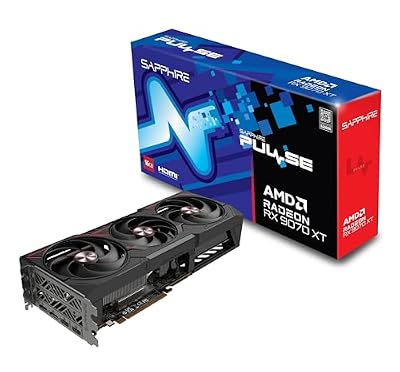
3. Sapphire Pulse Radeon RX 9070 XT
Sapphire’s Pulse is the raster-performance pick. The RX 9070 XT brings 16GB of GDDR6, RDNA 4 ray-tracing accelerators and FSR 4 upscaling, which uses machine learning on RX 9000 series cards. The Pulse cooler is comparatively compact at 240 mm long, so it fits cases that cannot take the larger cards above, and its dual 8-pin power connectors suit existing power supplies without an adapter. It is a strong fit for 1440p open-world play at high settings, and a sensible 4K option when FSR 4 is enabled.
Specs:
- GPU: AMD Radeon RX 9070 XT, 4,096 stream processors, 64 compute units
- Memory: 16GB GDDR6, 256-bit interface, 20 Gbps, 640 GB/s bandwidth
- Boost clock: up to 2,970 MHz; game clock up to 2,400 MHz
- Upscaling: FSR 4
- Power: 304 W board power, 2x 8-pin connectors, 750 W power supply recommended
- Outputs: 2x HDMI 2.1, 2x DisplayPort 2.1
- Size: 240 mm long
4. ASUS Prime GeForce RTX 5070 OC Edition
The Prime is the mid-range route into DLSS 4. Its 12GB of GDDR7 is the smallest memory pool among the NVIDIA picks here, which makes it a better match for 1440p than for 4K texture settings in the largest open-world games, but bandwidth is healthy and the SFF-Ready 2.5-slot design fits smaller cases. Dual BIOS and axial-tech fans with dual ball bearings suit long daily sessions, and ASUS rates this model for a 750 W power supply.
Specs:
- GPU: NVIDIA GeForce RTX 5070, 6,144 CUDA cores
- Memory: 12GB GDDR7, 192-bit interface, 28 Gbps, 672 GB/s bandwidth
- Boost clock: 2,587 MHz in OC mode
- Upscaling: DLSS 4 with Multi Frame Generation
- Power: 250 W board power, single 16-pin connector, 750 W power supply recommended
- Outputs: 1x HDMI 2.1b, 3x DisplayPort 2.1b
- Size: 306 mm long, 2.5-slot design
5. XFX Swift Radeon RX 9060 XT OC Triple Fan 16GB
The budget pick makes one important choice correctly: it is the 16GB version of the RX 9060 XT, not the 8GB version. That capacity is what open-world games ask for first, and it gives this card a longer useful life at 1080p and 1440p than its 8GB sibling. The triple-fan Swift cooler, a modest 182 W board power and a single 8-pin connector make it an easy upgrade for older systems, and FSR 4 support is included for heavier scenes.
Specs:
- GPU: AMD Radeon RX 9060 XT, 2,048 stream processors, 32 compute units
- Memory: 16GB GDDR6, 128-bit interface, 20 Gbps, 320 GB/s bandwidth
- Boost clock: up to 3,320 MHz; game clock up to 2,780 MHz
- Upscaling: FSR 4
- Power: 182 W board power, 1x 8-pin connector, 450 W power supply recommended
- Outputs: 1x HDMI 2.1, 2x DisplayPort 2.1
- Interface: PCI Express 5.0 x16
How to Choose
Start with VRAM. Open-world games hold large texture pools in memory as you cross the map, and capacity is the spec that ages fastest. For long sessions at 1440p, 16GB is the comfortable target; 12GB works at 1440p with sensible texture settings; 8GB cards are best left to 1080p. Memory bandwidth matters next, because the card constantly streams assets while you move. The RTX 5080 leads here at 960 GB/s, followed by the RTX 5070 Ti at 896 GB/s.
Match the card to your resolution. At 1080p, the RX 9060 XT 16GB is enough for high settings in most open-world games. At 1440p, the RTX 5070, RX 9070 XT and RTX 5070 Ti are the natural tier. At 4K, plan on the RTX 5070 Ti or RTX 5080, and expect to use upscaling.
Ray tracing and upscaling decide how those resolutions feel in practice. NVIDIA’s RTX 50 series supports DLSS 4 with Multi Frame Generation; AMD’s RX 9000 series supports FSR 4. Either path raises frame rates in dense city scenes, so choose based on the games you play and the features they support, rather than on raw specifications alone.
Check power and fit before ordering. The RTX 5080 asks for an 850 W power supply and a 16-pin connector; the RX 9070 XT uses two 8-pin connectors and a 750 W recommendation; the RX 9060 XT needs only one 8-pin and a 450 W unit. Measure case clearance too: the TUF RTX 5070 Ti is 329 mm long and over three slots thick, while the Pulse RX 9070 XT is 240 mm.
Finally, pair the card with a capable CPU. Open-world games lean on the processor for traffic, crowds and physics, so an older four-core CPU can hold back any card in this guide during city driving scenes, no matter how strong the GPU is.
Who Should Skip
Skip this roundup if you play mostly esports or competitive titles at 1080p, where a cheaper card and a high-refresh monitor matter more than VRAM. Skip it if your power supply is well under the recommendation for the card you want and you are not planning to replace it. Skip the flagship tier if your monitor is 1080p, since the RTX 5080’s headroom goes unused there. And skip every card here if your only goal is GTA VI itself: it launched on PlayStation 5 and Xbox Series X|S, no PC version has been announced, and a console is the hardware that plays it today.
FAQ
Can any of these graphics cards run GTA VI on PC?
No. GTA VI launched on 19 November 2026 for PlayStation 5 and Xbox Series X|S only, published by Rockstar Games, and no PC version has been announced. These cards are picks for open-world games like GTA that are already available on PC, not for GTA VI.
How much VRAM do open-world games need for long sessions?
For 1440p play with high texture settings, 16GB is the comfortable choice and 12GB is workable. At 1080p, 16GB still helps the largest games, while 8GB cards increasingly need reduced texture settings. Capacity matters more the longer the session, because the card keeps more of the world loaded.
Is DLSS or FSR better for open-world games?
Both raise frame rates by rendering at a lower internal resolution and upscaling. DLSS 4 on RTX 50 series cards adds Multi Frame Generation, while FSR 4 on RX 9000 series cards uses machine learning for cleaner upscaling than earlier FSR versions. The better choice depends on which games you play and which features they support.
Do I need a new power supply for these cards?
Check the recommendation for the specific model. The RX 9060 XT 16GB needs a 450 W unit and one 8-pin connector, so many existing systems qualify. The RTX 5070 Ti and RX 9070 XT point to 750 W, and the RTX 5080 to 850 W with a 16-pin connector or the adapter included with the card.
Final Verdict
For most PC players settling into long open-world sessions this launch season, the ASUS TUF RTX 5070 Ti and Sapphire Pulse RX 9070 XT are the sweet spot: 16GB of VRAM, strong 1440p performance and coolers built for hours of play. Step up to the MSI RTX 5080 Gaming Trio OC for 4K, choose the ASUS Prime RTX 5070 for DLSS 4 in a smaller case, or take the XFX Swift RX 9060 XT 16GB as the budget card that still gets the memory capacity right.