🛒 Best Price Today on Amazon
Prime members get fast, free shipping on everything above, plus member-only deals. New members get a 30-day free trial — cancel anytime.
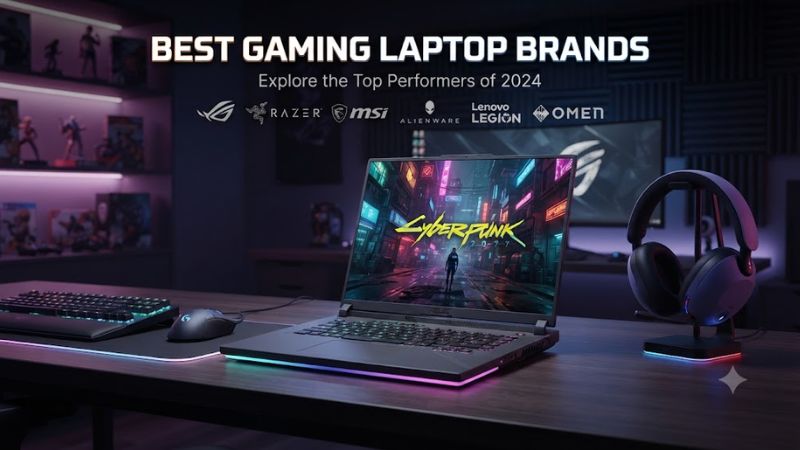
The best gaming laptop brands in 2026 differ most in value, cooling, portability, displays, and upgrade options rather than logos alone. ASUS, Lenovo, MSI, and Razer each target a different buyer, so the right choice depends on budget, performance goals, screen preference, and how often you carry the laptop.
How to Choose a Gaming Laptop Brand
Brand lineup matters because a manufacturer may offer everything from affordable RTX 50-series systems to premium desktop replacements. The four most useful criteria are performance, value, portability, and compatibility. These priorities point toward the ROG Strix G16, Legion Pro 7i, MSI Raider 18 HX AI, and Razer Blade 16 respectively.
GPU Performance
For demanding AAA games, prioritize the laptop GPU and its configured power limit before choosing a brand. ASUS ROG is a strong fit here because the current Strix G16 reaches an RTX 5080 Laptop GPU at up to 175W, while its 2.5K 300Hz panel suits high-refresh gaming.
The best gaming laptop brands can use the same GPU class but produce different results because cooling, power delivery, and chassis design vary. As a reference, the Legion Pro 7i Gen 10 with RTX 5080 reached 99.8 FPS in Cyberpunk 2077 at 2560×1440 Ultra without frame generation in Notebookcheck’s published results.
Value
Value is more than the lowest purchase price because memory, storage, display quality, and GPU power all affect the usable lifespan of a laptop. Lenovo Legion is particularly attractive for buyers seeking high-end hardware without moving immediately to the most expensive chassis or display configurations.
The best gaming laptop brands also differ in how much configuration choice they provide. Legion Pro 7i Gen 10 configurations can reach an RTX 5090 Laptop GPU with 24GB GDDR7, while lower configurations use RTX 5070 Ti or RTX 5080 graphics.
Portability
A portable gaming laptop needs more than a smaller screen because weight, thickness, power requirements, and memory design all matter. Razer is the clearest choice for this criterion: the 2026 Blade 16 is 14.9mm at its thinnest point, weighs 2.14kg, and can pair an RTX 5090 Laptop GPU with a 16-inch QHD+ OLED display.
Portability still requires accepting compromises. The Blade 16 uses soldered LPDDR5X memory rather than removable SO-DIMMs, so buyers should select sufficient memory when ordering. The 2026 model supports up to 64GB depending on configuration, while storage uses two M.2 NVMe positions.
Compatibility and Expansion
Laptop compatibility means checking the exact configuration rather than assuming every model in a series has identical hardware. ASUS’s current Strix G16 supports DDR5 SO-DIMM memory up to 64GB, while Lenovo’s Pro 7i Gen 10 supports up to 64GB DDR5 and offers PCIe Gen4 and Gen5 SSD configurations.
This makes Lenovo the more attractive pick when upgrade flexibility matters, while Razer suits buyers who prefer a thin fixed-memory design. MSI’s Raider 18 HX AI goes further for desktop-replacement use, offering two memory slots, up to 128GB DDR5, and both PCIe Gen4 and Gen5 M.2 storage support depending on configuration.
Top Picks
The best gaming laptop brands make the most sense when matched with a specific representative model. The four picks below cover different priorities rather than claiming one manufacturer is ideal for every buyer. Configuration availability and pricing can vary by retailer and region, so compare the exact model number before purchasing.
| Product | Best For | Key Spec | Compatibility | Watch Out For |
| ASUS ROG Strix G16 (2026) | Best Overall | RTX 5080, 2.5K 300Hz | DDR5 SO-DIMM, up to 64GB | 300Hz requires Ultimate GPU mode |
| Lenovo Legion Pro 7i Gen 10 | Best Value | Up to RTX 5090, OLED 240Hz | DDR5, up to 64GB; M.2 Gen4/Gen5 | Large 400W adapter |
| Razer Blade 16 (2026) | Best For Portability | RTX 5090 up to 165W, OLED 240Hz | Soldered LPDDR5X; two M.2 | Memory is not upgradeable |
| MSI Raider 18 HX AI | Best For Big Screens | RTX 5090, 4K Mini LED 120Hz | 2 DDR5 slots; M.2 Gen4/Gen5 | Large desktop-replacement design |
Best Overall: ASUS ROG Strix G16
The ASUS ROG Strix G16 (2026) is the strongest general-purpose choice because it combines an RTX 5080 Laptop GPU, Intel Core Ultra 9 290HX Plus, 32GB DDR5-5600, and a 2.5K 300Hz display in a 16-inch format. It suits players who want high-end gaming without moving to an 18-inch machine.
The main weakness is that the headline 300Hz refresh rate is not active in every GPU mode; ASUS specifies 240Hz as the default in Standard, Eco, and Optimized modes, with 300Hz requiring Ultimate mode. Buyers who want quieter operation or longer battery-focused use should not choose this model solely for its 300Hz specification.
Best Value: Lenovo Legion Pro 7i Gen 10
The Legion Pro 7i Gen 10 is the value-oriented pick because its platform spans RTX 5070 Ti, RTX 5080, and RTX 5090 Laptop GPU configurations while retaining a 16-inch 2560×1600 OLED option at 240Hz. Its 64GB maximum DDR5 capacity and mixed PCIe Gen4/Gen5 storage support also give buyers useful configuration flexibility.
Its real weakness is portability at the power-system level. Lenovo lists a 400W AC adapter with the high-end configuration, which adds to the travel burden even though the laptop itself remains a 16-inch system. It is therefore a better fit for buyers who move between desk and home than frequent travelers.
Best For Portability: Razer Blade 16
The 2026 Razer Blade 16 is the standout choice for buyers who want premium gaming hardware in a comparatively thin chassis. Its configurable RTX 5090 reaches 165W, while the 16-inch 2560×1600 OLED panel supports up to 240Hz, and the CNC-milled aluminum chassis weighs about 2.14kg.
The compromise is price and upgradeability. Razer fixes the LPDDR5X memory to the motherboard, so RAM cannot be replaced later, while independent benchmarks also show that the thin design does not always match the raw performance of larger RTX 5090 laptops. Buyers seeking maximum value or desktop-replacement power should look elsewhere.
Best For Big Screens: MSI Raider 18 HX AI
The MSI Raider 18 HX AI targets buyers who want a large desktop-replacement system. Its upper configuration combines an Intel Core Ultra 9 285HX, RTX 5090 Laptop GPU with 24GB GDDR7, 18-inch 3840×2400 Mini LED at 120Hz, and up to 260W combined CPU-GPU power.
The drawback is physical size and the resulting desktop-first character. Independent coverage of the Raider family shows strong high-resolution gaming performance, but large high-power configurations trade portability for sustained performance and can produce substantial heat and fan noise. Buyers who commute frequently should choose a smaller system instead.
FAQ
Which gaming laptop brand is best overall?
ASUS is the best overall brand for buyers who want a broad gaming lineup, because ROG covers high-end performance while TUF provides less expensive alternatives. The current ROG range includes Strix, Zephyrus, and other gaming systems spanning RTX 5050 through RTX 5090 configurations, giving ASUS unusual coverage across different budgets and formats.
However, there is no single winner for every buyer. Lenovo is more compelling for upgrade flexibility and value, Razer emphasizes thin premium systems, and MSI offers powerful desktop-replacement designs. The model and configuration still matter more than the manufacturer name when two laptops have substantially different GPU power limits or displays.
Is Lenovo Legion better than ASUS ROG?
Lenovo Legion is better than ASUS ROG for buyers prioritizing configuration flexibility and high-end performance per dollar, while ASUS ROG is better suited to shoppers who want a wider mix of gaming designs and display options. The Legion Pro 7i Gen 10 can reach RTX 5090 graphics and 64GB DDR5.
ASUS remains attractive when display refresh rate and model variety are priorities. The 2026 ROG Strix G16 combines an RTX 5080 configuration with a 2.5K 300Hz panel and 64GB maximum DDR5 capacity, although the 300Hz mode requires the Ultimate GPU setting.
Are Razer gaming laptops worth the premium?
Razer laptops are worth the premium for buyers who specifically value thinness, premium construction, OLED displays, and portability alongside gaming performance. The 2026 Blade 16 combines a 2.14kg chassis with up to an RTX 5090 at 165W and a 16-inch QHD+ OLED display reaching 240Hz.
They are harder to justify for buyers focused mainly on maximum FPS per dollar. PC Gamer’s 2026 review notes that the Blade 16 can trail the larger Legion Pro 7i in raw performance, while the fixed LPDDR5X memory also removes the option of a later RAM upgrade.
Which gaming laptop brand is best for a large-screen gaming setup?
MSI is the best fit for buyers who want a large-screen desktop replacement, particularly with the Raider 18 HX AI. The current model can combine an RTX 5090 Laptop GPU, 18-inch 4K Mini LED 120Hz display, 99.9Wh battery, and up to 260W combined CPU-GPU power.
The trade-off is portability, so this choice makes more sense when the laptop normally stays on a desk. For context, PCWorld’s Raider 18 testing recorded 149 FPS in Cyberpunk 2077 at 1080p Ultra without ray tracing and 42 FPS using the Overdrive ray-traced preset; those figures are specific to its reviewed configuration and should not be transferred to every Raider model.
Final Thoughts
The best gaming laptop brands are easiest to choose by matching their strengths to your priorities. ASUS ROG suits broad high-end gaming, Lenovo Legion emphasizes flexible value, Razer favors portability, and MSI targets large desktop replacements. Compare the exact GPU, power limit, display, memory, and storage configuration before buying.