Picking a gaming CPU under $300 has quietly become the hardest decision in a modern build. The mid-range is crowded with chips that all look similar on a spec sheet — six cores here, eight cores there, boost clocks within a few hundred megahertz of each other — yet real-world frame rates between them can differ by 30% or more. Worse, the specs that matter most for gaming (cache size, memory latency, platform longevity) are rarely the ones printed on the box, so buyers routinely overpay for core counts they’ll never use in a game engine.
This guide cuts through that. We’ve focused on processors that deliver genuine 1080p and 1440p gaming performance without pushing you past the $300 mark, and we’ve weighed each one on the things that actually move frame rates: 3D V-Cache, single-thread speed, cooler inclusion, and how much life is left in the socket you’re buying into. Whether you’re building fresh on AM5 or squeezing one last upgrade out of an AM4 board, there’s a sensible pick below.
As an Amazon Associate we earn from qualifying purchases at no extra cost to you. Product prices and availability are accurate as of the date shown and are subject to change.





⚡ Save on Your Next PC — Amazon Prime
Prime members get fast free shipping on the systems above, plus early access to Prime Day & Black Friday PC deals. New members get a 30-day free trial.
Watch: Best CPU for Gaming Under $300 — Video Review
How to Choose CPU for Gaming Under $300
- Prioritize cache over core count: Games are far more sensitive to L3 cache than to thread count. AMD’s 3D V-Cache chips routinely beat processors with double the cores in gaming benchmarks, so an 8-core X3D part will outperform a 16-core non-X3D chip in almost every title.
- Match the socket to your upgrade horizon: AM5 is still receiving new CPUs and will accept future generations, making it the smarter long-term platform. AM4 is end-of-life but remains outstanding value if you already own a compatible motherboard and DDR4 memory.
- Budget for the whole platform, not just the chip: A $250 CPU on AM5 also requires DDR5 memory and a newer board. If your total spend matters more than raw performance, an AM4 drop-in upgrade can free up $200 or more for a better graphics card.
- Check whether a cooler is included: Most high-performance chips ship bare, adding $30–$80 to your build. Budget-tier processors that bundle a Wraith cooler are genuinely cheaper than their sticker price suggests.
- Pair sensibly with your GPU and resolution: At 4K, most modern CPUs perform within a few percent of each other because the GPU is the bottleneck. Spend more on the processor only if you’re targeting high-refresh 1080p or 1440p, or playing simulation and strategy titles that hammer the CPU.
The Best Picks Reviewed
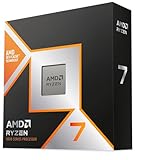
AMD Ryzen 7 9800X3D
This remains the fastest gaming processor most people can realistically buy, combining second-generation 3D V-Cache with fully unlocked overclocking and clock speeds that no longer trail its non-X3D siblings. It sits at the very top of the budget here and often drifts above it, so buy it on a dip — but if you catch it in range, nothing else at this price touches its 1% lows.
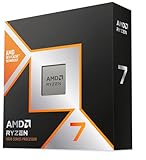
AMD Ryzen 7 7800X3D
The chip that defined gaming value for two years is now comfortably within budget, and it still delivers roughly 90% of the 9800X3D’s frame rates for meaningfully less money. It runs cool, sips power under gaming loads, and drops into any AM5 board, making it arguably the smartest all-round buy on this list.
AMD Ryzen 7 5800X3D
For anyone sitting on an AM4 motherboard with DDR4 memory, this is the single most cost-effective upgrade available — a straight BIOS-update-and-swap that lifts an aging build into modern territory. It’s no longer competitive with AM5 in absolute terms, but as a way to avoid replacing a board, RAM, and CPU simultaneously, it’s unmatched.
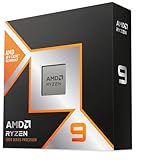
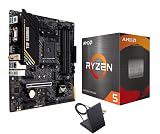
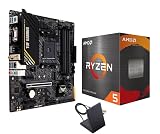
AMD Ryzen 5 9600X
A lean, efficient six-core that punches well above its price in esports and lightly threaded titles, with strong single-thread performance and low thermals that work fine on a modest air cooler. It’s the sensible entry point to AM5 if you want a current-generation platform now and plan to drop in an X3D chip in a couple of years.
AMD Ryzen 5 5500
The genuine budget option, and the only one here that includes a Wraith Stealth cooler in the box, keeping total build cost impressively low. It won’t feed a high-end GPU at high refresh rates, but paired with a mid-tier card at 1080p it’s more than enough — and it leaves far more of your budget for graphics.
Frequently Asked Questions
Is 3D V-Cache actually worth paying extra for?
For gaming, yes — the additional L3 cache dramatically reduces memory latency, and X3D chips typically deliver 15–30% higher frame rates in CPU-bound titles compared to standard parts at similar clock speeds. The benefit is largest in simulation, strategy, and open-world games, and smallest in GPU-limited scenarios at 4K.
Do I need more than six cores for gaming in 2026?
Six fast cores remain sufficient for the vast majority of games, though eight is now the comfortable sweet spot if you stream, record, or keep browsers and Discord running alongside. Beyond eight cores, gaming gains flatten out sharply and the money is better spent on your GPU.
Should I build on AM4 or AM5?
Build on AM5 if you’re starting from scratch, since it supports DDR5 and will accept future processor generations. Choose AM4 only if you already own a compatible motherboard and DDR4 kit, in which case a drop-in upgrade delivers exceptional value for very little outlay.
Will these processors bottleneck a high-end graphics card?
At 1440p and 4K, the X3D chips here will keep pace with essentially any current GPU. The budget six-core options can limit very fast cards at 1080p, so match your processor tier to your resolution and target frame rate rather than buying the cheapest chip available.
Final Thoughts
If you want the best gaming performance available under $300, the Ryzen 7 7800X3D is the pick we’d hand to most builders — it’s fast, efficient, and drops into a platform with years of upgrades ahead of it. Stretch to the Ryzen 7 9800X3D if it dips into budget and you’re chasing maximum frame rates at high refresh rates, or take the Ryzen 7 5800X3D if you already own an AM4 board and want the largest possible performance jump for the smallest possible spend.