🛒 Best Price Today on Amazon
Prime members get fast, free shipping on everything above, plus member-only deals. New members get a 30-day free trial — cancel anytime.
Which six-core gaming CPU stands out? Ryzen 5 7600X3D; what is the value pick? Ryzen 5 7600; which Zen 5 option matters? Ryzen 5 9600X; what platform do these use? AM5 with DDR5. Choosing the best 6 core cpu for gaming means weighing cache, clocks, platform cost, cooling, and current benchmark behavior rather than core count alone.
How to Choose a 6-Core Gaming CPU
A six-core processor remains a practical match for a gaming PC when the workload is primarily games rather than heavy rendering or compilation. CPU differences are easiest to expose at 1080p with a fast graphics card; higher resolutions can become GPU-limited. Tom’s Hardware uses an RTX 5090 FE at 1080p with High and Ultra settings for its current CPU gaming hierarchy.
Gaming Performance
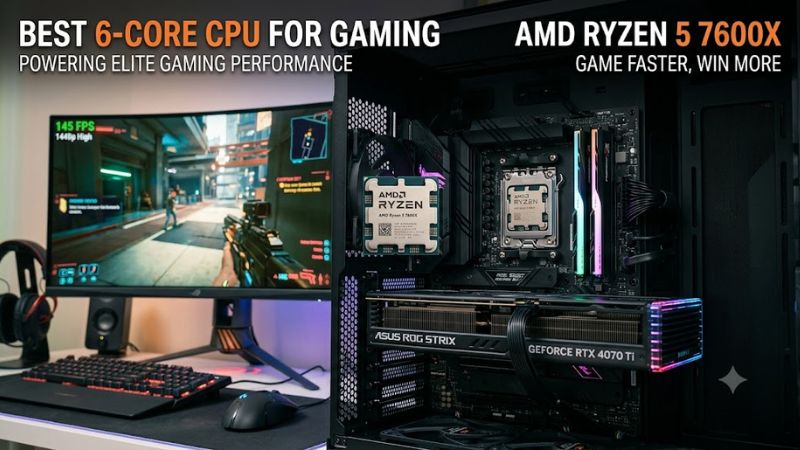
For the best 6 core cpu for gaming, look beyond boost frequency and compare results from the same test suite. Tom’s Hardware currently places the Ryzen 5 7600X3D at an 80.6% 1080p gaming score, versus 72.6% for the Ryzen 5 9600X and 67.3% for the Ryzen 5 7600X, using the Ryzen 7 9850X3D as the 100% reference.
Those figures do not mean every game follows the same order. TechSpot’s 12-game comparison used an RTX 5090 at 1080p with medium and higher presets, finding the 9600X about 6% ahead of the 7600X at medium settings and about 3.5% ahead at high or ultra settings. That variation is why test conditions matter when comparing six-core CPUs.
Cache and Clock Speed
The best 6 core cpu for gaming can depend heavily on cache design. The Ryzen 5 7600X3D has six cores, 12 threads, a 4.1GHz base clock, up to 4.7GHz boost, and 96MB of L3 cache. The Ryzen 5 9600X has six cores, 12 threads, a 3.9GHz base clock, up to 5.4GHz boost, and 32MB of L3 cache.
The cache difference also explains why a lower-clocked X3D chip can remain highly competitive in games. Tom’s Hardware lists the 7600X3D at 80.6% in its 1080p hierarchy, while the 9600X reaches 72.6% under the same methodology. Application performance is a separate consideration, where the newer Zen 5 design can have advantages.
Platform Compatibility
For the best 6 core cpu for gaming, motherboard and memory compatibility should be checked before comparing CPU prices. The Ryzen 5 9600X and 9600 use AM5 and DDR5, as do the Ryzen 5 7600X3D and 7600. All four support PCIe 5.0, while motherboard chipset support varies by model and BIOS version.
A new build therefore needs an AM5 motherboard, DDR5 memory, a compatible CPU cooler, and a power supply connected to the motherboard’s required CPU power input. Case clearance depends on the selected cooler. Existing AM4 systems cannot reuse their motherboard or DDR4 memory for these AM5 processors.
Cooling and Power
The best 6 core cpu for gaming does not necessarily need the highest cooling capacity. AMD rates the Ryzen 5 9600X, 9600, and 7600X3D at 65W default TDP, while the 7600X carries a 105W default TDP. The 7600 includes AMD’s Wraith Stealth cooler; the other three listed processors do not include a boxed thermal solution.
Cooling requirements should therefore be included in the platform budget rather than treated as an afterthought. AMD lists a premium air cooler recommendation for the 9600X and 7600X, while its 7600X3D specification calls for liquid cooling. The 7600’s included cooler can reduce the initial parts list for a budget-oriented system.
Top Picks
The current six-core market is unusual because AMD’s Ryzen 9000 family supplies the current Zen 5 six-core 9600 and 9600X, while the Ryzen 5 7600X3D remains a previous-generation Zen 4 option with 3D V-Cache. AMD has not confirmed a retail Ryzen 5 9600X3D, so rumored products are excluded from this list.
| Product | Best For | Key Spec | Compatibility | Watch Out For |
| Ryzen 5 7600X3D | Best Overall | 6C/12T, 96MB L3 | AM5, DDR5, PCIe 5.0 | No included cooler |
| Ryzen 5 9600X | Best Value | 6C/12T, up to 5.4GHz | AM5, DDR5, PCIe 5.0 | Smaller L3 cache |
| Ryzen 5 9600 | Best for Cooler-Included Builds | 6C/12T, up to 5.2GHz | AM5, DDR5, PCIe 5.0 | Lower clocks than 9600X |
| Ryzen 5 7600X | Best for Deep Discounts | 6C/12T, up to 5.3GHz | AM5, DDR5, PCIe 5.0 | Older Zen 4 platform |
Ryzen 5 7600X3D
The Ryzen 5 7600X3D suits buyers prioritizing gaming performance within the six-core class. Its six Zen 4 cores, 12 threads, 96MB of L3 cache, and 65W default TDP make its specification unusual, while Tom’s Hardware records an 80.6% 1080p gaming score with an RTX 5090 FE.
The real weakness is flexibility outside gaming and cooling cost. AMD does not include a thermal solution, and the processor has a lower 4.7GHz boost than the 9600X. Tom’s Hardware also notes weaker application performance than newer competing CPUs. Buyers focused on rendering, compilation, or broad productivity should consider the newer Zen 5 alternatives.
Ryzen 5 9600X
The Ryzen 5 9600X is the value-oriented Zen 5 choice for buyers who want a modern AM5 processor without moving to eight cores. It has six cores, 12 threads, a 3.9GHz base clock, up to 5.4GHz boost, 32MB of L3 cache, and a 65W default TDP.
Its weakness is that the gaming advantage over cheaper Zen 4 six-core CPUs varies by game. TechSpot’s 12-game results put the 9600X roughly 6% ahead of the 7600X at 1080p medium, but only about 3.5% ahead at high or ultra settings. Existing AM5 owners may therefore see limited gaming benefit from upgrading.
Ryzen 5 9600
The Ryzen 5 9600 fits buyers who want Zen 5 performance while keeping the cooler requirement simpler. It has six cores, 12 threads, a 3.8GHz base clock, up to 5.2GHz boost, 32MB of L3 cache, and a 65W default TDP, while AMD lists a Wraith Stealth thermal solution in the boxed specification.
Its main limitation is lower stock clock speed than the 9600X, so buyers should compare the complete CPU-and-cooler cost rather than only processor pricing. The 9600 still uses AM5 and DDR5, making it unsuitable for an older AM4/DDR4 motherboard. It is also less compelling when the 9600X is only slightly more expensive.
Ryzen 5 7600X
The Ryzen 5 7600X remains relevant when its street price is substantially below newer alternatives. Its Zen 4 design provides six cores, 12 threads, a 4.7GHz base clock, up to 5.3GHz boost, 32MB of L3 cache, and a 105W default TDP. AMD specifies AM5 and DDR5 support with PCIe 5.0 connectivity.
Its weakness is age relative to Zen 5 and the lack of an included cooler. Tom’s Hardware’s current 1080p hierarchy gives the 7600X a 67.3% gaming score, below the 9600X at 72.6%, although actual game differences vary with settings and GPU limits. It makes less sense when pricing approaches the 9600X.
FAQ
The four questions below cover the main buying issues: gaming performance, value, platform compatibility, and the difference between X3D and conventional Zen 5 designs. The answers focus on currently documented specifications and comparable independent benchmark results rather than rumored future products.
Is a 6-Core CPU Enough for Gaming?
Yes, a six-core CPU can be enough for modern PC gaming, particularly when the system is primarily used for games and the GPU is doing most of the rendering work. The Ryzen 5 9600X, 9600, 7600X3D, and 7600X all provide six cores and 12 threads.
The decision changes when gaming is combined with heavily threaded workloads. Streaming, compiling, rendering, and other background tasks can benefit from additional cores, while CPU-heavy games may also expose differences between six-core and higher-core processors. Resolution and GPU choice can further change the size of those gaps.
Is the Ryzen 5 7600X3D Still Worth Considering?
Yes, the Ryzen 5 7600X3D remains a relevant option when gaming performance is the main priority and its price fits the build. Tom’s Hardware currently records an 80.6% 1080p gaming score for the chip, higher than the 9600X’s 72.6% score in the same hierarchy.
The tradeoff is that the 7600X3D uses the older Zen 4 architecture and has a 4.7GHz maximum boost. It also lacks a boxed cooler. Its 96MB of L3 cache is the major gaming-oriented feature, while buyers doing substantial productivity work may have stronger reasons to choose a Zen 5 processor.
Can These CPUs Use DDR4 Memory?
No, these four processors require an AM5 motherboard with DDR5 memory. AMD lists DDR5 support for the Ryzen 5 9600X, 9600, 7600X3D, and 7600, so DDR4 modules from an older AM4 build cannot be carried over to this platform.
This platform change should be included in the total upgrade cost. A buyer moving from AM4 needs an AM5 motherboard and DDR5 in addition to the processor, while the existing graphics card, storage, case, and power supply may remain usable if their specifications and physical connections are suitable.
Should You Choose X3D or Zen 5?
Choose X3D when gaming is the primary workload and the 7600X3D’s pricing makes sense; choose Zen 5 when newer architecture, application performance, or a broader balance of workloads matters more. The 7600X3D has 96MB of L3 cache, while the 9600X has 32MB and a higher 5.4GHz boost ceiling.
Benchmark results show why neither specification alone settles the question. Tom’s Hardware records the 7600X3D at 80.6% and the 9600X at 72.6% in its 1080p gaming hierarchy, while TechSpot found smaller differences between Zen 5 and Zen 4 in several individual games. Test resolution, settings, GPU, and workload all remain relevant.
Final Thoughts
The best 6 core cpu for gaming depends on whether gaming cache, Zen 5 efficiency, included cooling, or discounted platform cost matters most. The Ryzen 5 7600X3D targets gaming-first builds, while the 9600X and 9600 provide newer Zen 5 options for AM5 systems, and the 7600X fits only when discounted enough to justify Zen 4.