A gaming wrist rest for a mouse sounds minor until a long session makes it feel essential. When your wrist presses against a hard desk edge, rests at an awkward angle, or drags across a pad during repeated small corrections, comfort can fade long before the match does. The right rest does not aim for you or lock your hand in place. It supports the heel of your hand between movements, reduces pressure on the desk, and helps you keep the relaxed control you started with.
That balance separates a gaming rest from a generic office cushion. Palm-grip wrist aimers need a rest that stays put without fencing in swipes. Arm aimers need something low, or a rest that glides with the hand. Fingertip and claw players may want almost no lift, using a rest only during menus and slower play. This guide compares five mouse-specific rests: two fixed gaming cushions, a compact textured foam cushion, and two gliding palm rests. Every option is a wrist rest for mouse use, not a keyboard rest or a pad with a bump attached.
As an Amazon Associate we earn from qualifying purchases.
Quick Picks
These five rests split cleanly by fill, movement style, and support level.
| Product | ASIN | Best For |
|---|---|---|
| HyperX Wrist Rest – Mouse | B09SGTWKWV | Cooling gel memory foam in a fixed gaming rest |
| Razer Ergonomic Wrist Rest for Gaming Mice | B07733H7VP | Angled, wipe-clean leatherette support |
| BRILA Ergonomic Memory Foam Mouse Wrist Rest | B07DF83HK7 | Compact cushion with a textured massage surface |
| DELTAHUB Carpio 2.0 – Large, Black, Right-Handed | B098P8C3BT | Gliding palm support that moves with the mouse |
| DELTAHUB Carpio G2.0 – Large, Black, Right-Handed | B0BMQV5QRT | Strapped gliding support for faster, wider movement |
How to Choose
Choosing a mouse wrist rest starts with how you actually move the mouse, then narrows to height, fill, and base behaviour on your desk.
Fixed Rest or Gliding Rest
A fixed rest, like the HyperX and Razer models here, sits in front of your mouse pad and supports your wrist when your hand is settled. It works well for palm grip, for deliberate repositioning, and for anyone who mainly wants relief from a hard desk edge. The trade-off is range: if you make wide, fast swipes, a fixed cushion can become a boundary your wrist keeps bumping into.
A gliding rest solves that differently. The DELTAHUB Carpio designs sit under the heel of your palm and slide on low-friction feet, so support moves with each swipe. That suits arm aimers on a large pad, though it takes a short adjustment period and a smooth surface.
Height and Wrist Angle
Height most affects comfort, and more is not automatically better. A rest that is too tall can bend your wrist upward and make the mouse harder to control. A rest that is too low may do little more than soften the desk edge. Look for a height that keeps your wrist roughly neutral and level with the mouse, rather than sharply raised or dropped.
The options here cluster in a similar band: the HyperX is listed at 22 mm thick, the Razer at 20 mm high, and the BRILA at 0.8 inches high with a grooved centre that lowers the contact point. Shape matters as much as the number: an incline, groove, or contoured cradle can feel more natural than a flat block of the same height.
Fill: Memory Foam, Gel-Infused Foam, or Silicone
Memory foam compresses and slowly rebounds, spreading load across a wider area. That is why foam rests feel settled rather than bouncy, suiting players who rest their weight between actions. Gel-infused foam, used in the HyperX rest, adds a cooling element for warm rooms, although no foam stays cold indefinitely under your hand.
Silicone gliding rests feel firmer: they lift and cradle the palm heel and redistribute pressure while the base glides, suiting players who dislike a soft, warm, sinking feel. The BRILA instead adds massage holes and a textured top to foam.
Width, Length, and Hand Size
A rest should support your wrist through your normal movement range without intruding into keyboard space or pushing your mouse farther away. The HyperX and Razer are both around 228 mm long, giving a generous landing zone. The BRILA is far more compact at about 5.1 inches, suiting smaller desks.
Gliding rests are sized by hand. The Carpio 2.0 and G2.0 come in size options, and the large versions here suit larger hands. Size matters more here, because the cradle must sit under the correct part of your palm. Check maker sizing guidance, and be precise about handedness, since these designs are handed.
Surface Material and Cleaning
Your wrist stays on the cover for hours, so material affects feel and upkeep. Lycra, like the BRILA top, feels soft and breathable but can absorb sweat and needs gentle spot cleaning. Leatherette, used on the Razer, wipes clean easily and is described as water resistant, but can feel warmer in a hot room.
Anti-fray stitching is worth looking for on fabric foam, because the edge wears first; HyperX lists it on its mouse rest. Silicone gliding rests avoid fabric wear, and perforated pads on the Carpio G2.0 improve airflow under the palm, though they still need regular wiping.
Base Grip and Desk Surface
A fixed rest should not wander. Textured rubber undersides, rubber feet, and skid-resistant polyurethane bases keep a cushion where you placed it, even when you lift and reset your mouse repeatedly. If it slides, you end up chasing it and losing the consistent hand position you bought it for.
For gliding rests the requirement reverses: the base must move smoothly without catching on pad stitching or desk seams, which is what PTFE feet provide. A gliding rest is a poor match for a rough desk, a very small pad, or cables crossing your hand’s travel area.
Grip Style and Game Type
Low-sensitivity shooter play involves long swipes and frequent lifts, so a gliding rest or a low fixed rest set slightly back interferes least. MOBA, strategy, and MMO play involve smaller movements and long settled periods, where a fixed cushion feels more restful. A wrist rest is a comfort accessory, not a medical device: persistent numbness, tingling, or pain needs proper advice, not a softer cushion.
5 Best Options
These five cover fixed foam, angled leatherette, compact foam, and two gliding designs.
HyperX Wrist Rest – Mouse

Specs
- Fill: Cooling gel-infused memory foam
- Size: Mouse version, 228 mm long by 88 mm wide by 22 mm thick
- Model number: 4Z7X2AA
- Base: Textured natural rubber underside for anti-slip grip
- Construction: Anti-fray stitching around the edge
- Colour: Black
- ASIN: B09SGTWKWV
Best for: Players who want the straightforward gaming-brand answer: a fixed cushion sized for a mouse, not a cut-down keyboard rest. Gel-infused foam addresses warmth building up over a long session, the 228 mm length gives palm-grip players room to settle and reset, and the rubber underside and stitched edge make it a sensible default for a cloth pad.
Watch out for: It does not follow your hand on wide swipes, so low-sensitivity arm aimers may lift over it during fast play. Cooling moderates warmth rather than providing active cold. Its 22 mm thickness is also at the fuller end here, which fingertip players may find is more lift than they want.
Razer Ergonomic Wrist Rest for Gaming Mice

Specs
- Fill: Memory foam cushion
- Cover: Plush leatherette, described as water and damage resistant
- Dimensions: 228 mm by 73 mm by 20 mm
- Weight: 71.5 g
- Base: Anti-slip rubber feet
- Shape: Angled incline with anti-fray stitched frame
- Model number: RC21-01170100-R3M1
- ASIN: B07733H7VP
Best for: Gamers who prefer an angled, firmer rest that wipes clean. The incline tilts support toward the mouse, which many palm and relaxed claw players find keeps the wrist in a neutral line. At 73 mm wide it takes less desk depth than the HyperX, and leatherette suits setups where drinks and dust are part of real life.
Watch out for: Leatherette is less breathable than fabric, can feel warm, and contains no cooling gel. The incline is a preference, not a universal improvement: players who like a flat, soft landing may find it firmer than expected. It is a wrist rest, not an arm support.
BRILA Ergonomic Memory Foam Mouse Wrist Rest

Specs
- Fill: Slow bounce-back memory foam
- Cover: Lycra fabric
- Dimensions: 5.1 inches by 3.1 inches by 0.8 inches
- Surface: Massage holes design with a wrist-shaped groove
- Base: Skid-proof rubbery polyurethane bottom
- Intended use listed: Computer, laptop, office work, and PC gaming
- Model: 8541655831
- ASIN: B07DF83HK7
Best for: Players with a compact desk or laptop setup who want support only directly under the wrist. The BRILA is the smallest rest here, fits in front of an existing pad, and moves easily in a laptop bag. The groove gives the wrist a defined place to settle, and the massage holes add texture during slower games and everyday use.
Watch out for: Wide-area players will travel off this small cushion quickly, and it offers little forearm support. The textured surface divides opinion: if you prefer a smooth contact patch, the holes may feel distracting. Lycra needs gentler cleaning than leatherette, with no water-resistance claim in the listing.
DELTAHUB Carpio 2.0 – Large, Black, Right-Handed
Specs
- Type: Gliding ergonomic wrist rest for mouse, right-handed
- Size: Large
- Colour: Black
- Material: Silicone
- Model number: DELTAHUB-Carpio-Ergo-RH-WR-LS-BL-LG-BK
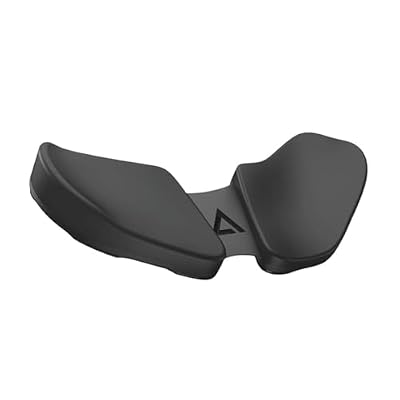
- Design: Contoured palm support that glides with the hand
- Intended use listed: Office, computer, laptop, and gaming
- ASIN: B098P8C3BT
Best for: Arm aimers and wide-swipe players for whom a fixed cushion gets in the way. The Carpio 2.0 sits under the heel of your palm and moves with you, so support is present at the end of a long flick as well as at rest. That suits large pads and low-sensitivity shooter play, and the structured silicone gives lift without sinking into foam.
Watch out for: Fit is critical: this is the large, right-handed, black version, and the wrong size or hand puts the cradle in the wrong place. Expect an adjustment period, and a smooth surface. It supports the palm heel rather than cushioning the whole wrist, so players seeking a soft pad may prefer foam.
DELTAHUB Carpio G2.0 – Large, Black, Right-Handed

Specs
- Type: Gliding gaming wrist rest for mouse, right-handed
- Size: Large
- Colour: Black
- Strap: Adjustable silicone strap with magnetic closure
- Padding: Perforated pads for airflow
- Feet: PTFE feet for smooth glide
- Manufacturer part number: GCR-L-BL-R
- ASIN: B0BMQV5QRT
Best for: Competitive players who like gliding support but worry about a loose rest shifting during intense movement. The G2.0 adds an adjustable silicone strap with a magnetic lock, keeping the rest aligned through fast corrections and lifts. Perforated pads address airflow, and the design is presented specifically for gaming and esports use.
Watch out for: A strap is not for everyone: some players find any attachment around the hand distracting, and putting it on adds a ritual a cushion does not require. It is handed and sized, so this large right-handed version will not suit left-handed players or smaller hands, and it needs a clean, smooth surface.
Which One Fits You
- You want a simple, cooling fixed cushion: Choose the HyperX Wrist Rest – Mouse for gel-infused memory foam, a generous mouse-specific length, and a grippy rubber underside.
- You prefer an angled rest that wipes clean: Choose the Razer Ergonomic Wrist Rest for Gaming Mice for its incline, leatherette cover, and narrower desk footprint.
- Your desk or laptop setup is small: Choose the BRILA Ergonomic Memory Foam Mouse Wrist Rest for compact, grooved support that fits around an existing pad.
- You aim with your arm and swipe widely: Choose the DELTAHUB Carpio 2.0 so support glides with your palm instead of staying fixed at the edge of the pad.
- You play fast and want the rest secured to your hand: Choose the DELTAHUB Carpio G2.0 for its magnetic silicone strap, perforated pads, and PTFE glide feet.
- You use a fingertip grip and barely rest your wrist: Start with the Razer set slightly back, or use any rest only between rounds rather than during active play.
Common Mistakes
- Resting your full weight on the wrist while aiming: Pressing down into any cushion during active movement can increase pressure and drag; use the rest mainly between movements and keep your aim loose.
- Buying a keyboard-length rest for mouse use: A long keyboard bar places support in the wrong position, crowds the mouse area, and encourages reaching; choose a mouse-sized or gliding design instead.
- Ignoring height and ending up with a bent wrist: A rest that lifts your wrist well above the mouse changes your angle rather than neutralising it, so compare thickness and shape against your current hand position.
- Choosing a gliding rest in the wrong hand or size: Carpio-style rests are handed and sized, and a mismatch puts the cradle under the wrong part of your palm, making a good design feel immediately wrong.
- Expecting a rest to fix pain on its own: Persistent numbness, tingling, or aching needs attention to desk height, chair position, breaks, and possibly professional advice, not just a softer cushion.
FAQ
Should I rest my wrist on the pad while I am actually aiming?
Use the rest as support between movements rather than pressing into it while aiming. Keeping weight off the wrist during swipes helps you move freely, while the cushion still removes the hard desk edge when your hand settles. If a rest makes you plant and pivot, move it back or try a gliding design.
Is a gliding wrist rest better than a fixed foam rest for FPS games?
Neither is universally better. Low-sensitivity players who make long swipes often prefer a gliding Carpio, since support travels with the hand, while higher-sensitivity wrist aimers often prefer a fixed foam rest in one predictable place. Gliding feet also need room and a smooth surface.
How do I choose the right size of gliding wrist rest?
Follow maker sizing guidance and measure your hand, rather than guessing from mouse size. A gliding rest must sit under the heel of your palm: too small feels perched, too large can interfere with mouse contact. Confirm handedness first, because left and right versions are separate products.
How should I clean a gaming wrist rest for a mouse?
Wipe leatherette and silicone with a lightly damp cloth and let them dry before playing. For Lycra and fabric foam, spot clean gently rather than soaking it, since saturated foam dries slowly and holds odours. Keep glide feet free of grit, because debris under PTFE feet turns a smooth glide scratchy.
Closing
The best gaming wrist rest for a mouse matches how your hand moves: HyperX cooling foam for settled palm play, Razer for angled wipe-clean support, BRILA for small setups, or a gliding Carpio for wide movement, with the strapped G2.0 for players who want support locked in. Check height, size, and handedness first, keep your wrist neutral, and long sessions become noticeably easier to finish.