🛒 Best Price Today on Amazon
Prime members get fast, free shipping on everything above, plus member-only deals. New members get a 30-day free trial — cancel anytime.
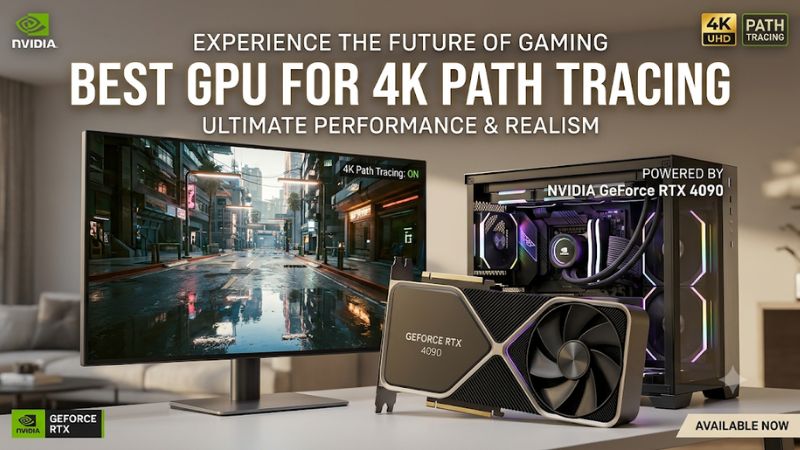
Choosing the best gpu for 4k path tracing requires more than buying a card with high conventional gaming performance. Path tracing places exceptional demands on ray-tracing hardware, memory, and power delivery. This guide compares four GeForce GPUs, explains their limitations, and helps you choose the right upgrade for demanding 4K gaming.
How to Choose the Best GPU for 4K Path Tracing
The most important purchasing decision is balancing ray-tracing performance with memory capacity, upscaling support, and system requirements. Native 4K path tracing remains exceptionally demanding, even for flagship graphics cards. Buyers should also distinguish traditionally rendered frames from AI-generated frames when comparing advertised performance.
1. Prioritize Ray-Tracing Performance
Traditional rasterization performance does not accurately predict how well a graphics card handles path tracing. While conventional rendering primarily relies on shader performance, path tracing places additional demands on dedicated ray-tracing hardware and memory bandwidth.
NVIDIA’s GeForce RTX 50 Series uses the Blackwell architecture with fourth-generation RT Cores. These dedicated processing units make the RTX 5090, RTX 5080, and RTX 5070 Ti particularly relevant for demanding lighting workloads. Independent GPU rankings from Tom’s Hardware also place NVIDIA’s flagship cards ahead of competing options in its 4K ray-tracing hierarchy.
Tom’s Hardware+1
When comparing graphics cards, prioritize dedicated ray-tracing performance rather than relying exclusively on CUDA core counts, boost clocks, or conventional gaming benchmarks.
2. Choose Enough VRAM for 4K Gaming
Video memory becomes increasingly important when rendering complex scenes at high resolutions. Path tracing can require substantial memory for lighting information, geometry, textures, and other graphical resources.
For demanding 4K applications, 16GB should be considered a more sensible starting point than 8GB. However, 16GB does not guarantee that every game will run comfortably at maximum settings.
For example, MSI’s October 2026 Control Resonant benchmark recorded approximately 13.7GB of VRAM allocation on the RTX 5080 during native 4K Ultra path tracing. The RTX 5090 allocated approximately 15GB under the same conditions. These figures illustrate why memory capacity deserves serious consideration.
sg.msi.com+1
The RTX 5090’s 32GB configuration provides additional memory headroom, particularly for demanding games and future graphics workloads.
3. Understand DLSS and Frame Generation
Upscaling and frame generation are important technologies for making demanding path-traced games more playable.
NVIDIA DLSS Super Resolution reconstructs a higher-resolution image from a lower-resolution internal rendering. This can substantially reduce the GPU workload while maintaining a high-quality image.
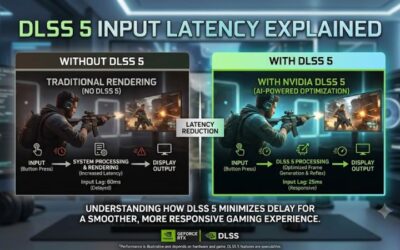
Frame Generation works differently. It creates additional frames between traditionally rendered frames, increasing the displayed frame rate without proportionally increasing the underlying rendering performance.
For the best experience, evaluate both the actual rendered frame rate and the generated frame rate. A display counter showing a high number does not necessarily mean the game responds like a traditionally rendered game running at that same frame rate.
The RTX 50 Series supports Multi Frame Generation, making it particularly attractive for compatible games. However, support varies by game, and generated frames should complement rather than replace adequate baseline GPU performance.
NVIDIA+1
4. Check Power Supply and Case Compatibility
A powerful graphics card is only useful if the rest of the PC can support it. High-end GPUs require substantial power delivery, adequate cooling, and sufficient physical clearance.
NVIDIA lists the following reference power requirements:
- RTX 5090: 575W total graphics power and 1,000W recommended system power.
- RTX 5080: 360W total graphics power and 850W recommended system power.
- RTX 4090: 450W total graphics power and 850W recommended system power.
These recommendations are based on NVIDIA’s reference configurations. Individual graphics cards can have different dimensions, cooling arrangements, and power requirements.
NVIDIA+2
Before purchasing, check the exact manufacturer’s specifications, PSU connectors, GPU length, expansion-slot thickness, and case clearance. A quality power supply with the correct connectors is more important than choosing one based exclusively on its advertised wattage.
Top Picks: Best Graphics Cards for 4K Path Tracing
The following recommendations focus on dedicated ray-tracing capabilities, memory capacity, independent performance information, and practical system requirements. The RTX 5090 is the flagship choice, while the RTX 5080 offers a more balanced alternative. The RTX 5070 Ti and RTX 4090 serve different purchasing situations.
1. NVIDIA GeForce RTX 5090 – Best Overall
Best Overall
The NVIDIA GeForce RTX 5090 is the strongest choice among these four graphics cards for enthusiasts who want the highest available 4K path-tracing performance.
Its specifications include 32GB of GDDR7 memory, a 512-bit memory interface, 21,760 CUDA cores, and fourth-generation RT Cores. NVIDIA also specifies 575W total graphics power and recommends a 1,000W system power supply.
NVIDIA+1
The additional memory capacity is particularly useful for demanding 4K workloads. In MSI’s Control Resonant benchmark, the RTX 5090 achieved 34.9 average FPS at native 4K with the Ultra preset, path tracing enabled, DLAA, and Multi Frame Generation disabled. With 6X Multi Frame Generation, the reported average increased to 179.1 FPS.
These results demonstrate the card’s capabilities, but they also reveal an important limitation: even this flagship GPU does not deliver 60 traditionally rendered FPS in that particularly demanding configuration.
sg.msi.com+1
Why choose it:
- 32GB GDDR7 memory.
- Excellent high-end ray-tracing capabilities.
- Strong headroom for demanding 4K workloads.
- Support for DLSS Super Resolution and Multi Frame Generation.
What to consider: The RTX 5090 is expensive, consumes substantial power, and requires a large, well-ventilated case. Its capabilities are excessive for gamers primarily interested in conventional rasterized games.
Choose this card if maximum path-tracing performance matters more than purchase price or electricity consumption.
2. NVIDIA GeForce RTX 5080 – Best Balanced Choice
Best Balanced
The NVIDIA GeForce RTX 5080 is a compelling alternative for gamers who want high-end 4K performance without moving to the RTX 5090’s power requirements.
It features 16GB of GDDR7 memory, a 256-bit memory interface, 10,752 CUDA cores, and fourth-generation RT Cores. Its reference total graphics power is 360W, with an 850W recommended system power supply.
NVIDIA+1
The RTX 5080 delivers substantially more conventional ray-tracing performance than lower-tier cards. Tom’s Hardware’s 2026 GPU hierarchy places it behind the RTX 5090 and RTX 4090 in its overall 4K ray-tracing ranking.
Tom’s Hardware
In MSI’s Control Resonant native 4K Ultra path-tracing benchmark, the RTX 5080 produced 20.7 average FPS without Multi Frame Generation and 107.3 FPS with 6X generation. The underlying rendered performance remains 20.7 FPS, making the distinction important for buyers who prioritize responsiveness.
africa.msi.com
Why choose it:
- 16GB GDDR7 memory.
- Strong ray-tracing hardware.
- Lower reference power requirements than the RTX 5090.
- DLSS and Multi Frame Generation support.
What to consider: Its 16GB memory capacity offers less headroom than the RTX 5090, and native 4K path tracing can still require aggressive upscaling.
The RTX 5080 is the sensible choice for enthusiasts who want a powerful 4K gaming system without paying for the flagship’s additional hardware.
3. NVIDIA GeForce RTX 5070 Ti – Best Lower-Cost Entry Point
Best Lower-Cost Pick
The NVIDIA GeForce RTX 5070 Ti is worth considering for gamers who want access to modern path-tracing features without purchasing an RTX 5080 or RTX 5090.
Its 16GB GDDR7 memory configuration is an important advantage over graphics cards with smaller memory capacities. It also includes fourth-generation RT Cores and supports NVIDIA’s DLSS technologies. NVIDIA lists a 300W total graphics power rating and a 750W recommended system power supply.
NVIDIA+1
However, buyers should understand that the RTX 5070 Ti is not a native 4K Ultra path-tracing powerhouse. In MSI’s Control Resonant benchmark, it delivered 17.3 average FPS at native 4K with Ultra path tracing and no Multi Frame Generation. The result increased to 91.2 FPS with 6X generation enabled.
africa.msi.com
Why choose it:
- 16GB GDDR7 memory.
- Lower power requirements than the higher-tier models.
- Modern ray-tracing and DLSS support.
- Suitable for experimenting with demanding lighting effects using optimized settings.
What to consider: Native 4K path tracing can be extremely demanding. You will likely need upscaling, reduced ray-tracing settings, or both in the most demanding games.
This graphics card makes more sense for gamers who also play conventional 4K titles and are comfortable adjusting settings rather than expecting maximum path tracing everywhere.
4. NVIDIA GeForce RTX 4090 – Best Previous-Generation Alternative
Best Previous-Generation Option
The NVIDIA GeForce RTX 4090 remains a relevant alternative for enthusiasts considering an older flagship GPU, particularly when a legitimate secondhand deal is available.
It features 24GB of GDDR6X memory, a 384-bit memory interface, 16,384 CUDA cores, and third-generation RT Cores. Its reference total graphics power is 450W, with an 850W recommended system power supply.
NVIDIA+1
Tom’s Hardware’s 2026 ray-tracing hierarchy places the RTX 4090 between the RTX 5090 and RTX 5080 in its aggregate 4K results. This demonstrates that its previous-generation architecture still has considerable capability for demanding graphics workloads.
Tom’s Hardware
Its 24GB memory capacity also provides more room than the RTX 5080’s 16GB, although memory capacity alone does not determine overall performance.
Why choose it:
- 24GB GDDR6X memory.
- Strong previous-generation ray-tracing performance.
- Mature DLSS and Frame Generation support.
- Substantial memory capacity for demanding games.
What to consider: It uses an older architecture and does not support the RTX 50 Series Multi Frame Generation features. Availability and secondhand pricing also require careful consideration.
The RTX 4090 is worth investigating when its actual purchase price makes sense compared with a new RTX 5080. Avoid paying flagship-level premiums for an older generation without checking current alternatives.
GPU Comparison Table
The following table summarizes the four recommendations and their main technical differences.
| Product | Best For | Key Spec | Compatibility | Watch Out For |
| RTX 5090 | Maximum 4K path tracing | 32GB GDDR7, 575W | 1,000W recommended PSU | High cost and power |
| RTX 5080 | Balanced high-end gaming | 16GB GDDR7, 360W | 850W recommended PSU | Native PT limitations |
| RTX 5070 Ti | Lower-cost entry | 16GB GDDR7, 300W | 750W recommended PSU | Requires compromises at 4K |
| RTX 4090 | Previous-generation flagship | 24GB GDDR6X, 450W | 850W recommended PSU | Older architecture and availability |
Power recommendations refer to NVIDIA reference specifications, not guaranteed requirements for every partner model.
FAQ
1. Is the RTX 5090 worth buying for 4K path tracing?
Yes, the RTX 5090 is worth considering if maximum path-tracing performance is your priority and your budget supports it. Its 32GB GDDR7 memory and powerful ray-tracing hardware make it the strongest option in this comparison. However, native 4K path tracing can still require upscaling or reduced settings in particularly demanding games.
2. Is 16GB VRAM enough for 4K path tracing?
Yes, 16GB can be sufficient for many 4K path-tracing workloads, but requirements vary by game and graphics settings. Some demanding titles can allocate nearly all available memory. The RTX 5080 and RTX 5070 Ti offer 16GB, while the RTX 5090 provides additional headroom with 32GB.
3. Is AMD Radeon suitable for 4K path tracing?
AMD Radeon graphics cards can run games with ray tracing and path tracing, but NVIDIA currently has a stronger position in demanding 4K ray-tracing performance. Tom’s Hardware’s 2026 GPU hierarchy places the RX 9070 XT behind NVIDIA’s leading options in its ray-tracing rankings. AMD can still make sense for gamers who prioritize conventional rendering performance and value.
Tom’s Hardware
4. Does Frame Generation make native 4K path tracing faster?
No, Frame Generation does not increase the underlying rendering rate in the same way as a more powerful GPU or upscaling. It creates additional displayed frames between traditionally rendered frames. This can improve perceived smoothness, but responsiveness remains influenced by the original rendering rate, latency, and game implementation.
Final Thoughts
The best gpu for 4k path tracing depends on how much performance, memory capacity, and power consumption you can accommodate. The RTX 5090 leads this comparison, while the RTX 5080 offers a more balanced high-end option. Compare actual game requirements and your PSU before choosing your next graphics card.