🛒 Best Price Today on Amazon
Prime members get fast, free shipping on everything above, plus member-only deals. New members get a 30-day free trial — cancel anytime.
The ryzen 5 8500g review: gaming performance and price question comes down to whether an affordable processor with integrated graphics can meet your gaming needs without a dedicated GPU. AMD’s six-core AM5 chip offers a practical starting point for budget desktops, but its Radeon 740M graphics and limited PCIe connectivity deserve attention before you buy.
How to Choose a Budget Gaming Processor
Choosing an entry-level gaming CPU means balancing graphics performance, processing power, platform cost, and future upgrades. The Ryzen 5 8500G makes the most sense when you need a working desktop without a separate graphics card. If you already own a capable GPU, a processor with stronger gaming-focused specifications may offer better value.
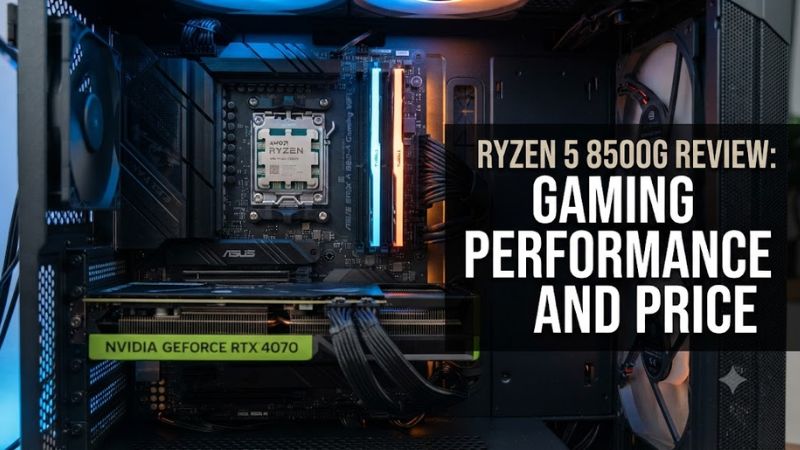
Integrated graphics for an affordable build
The Radeon 740M is the key reason to consider this processor. Its four graphics compute units can handle esports games and lighter titles at reduced settings, while demanding releases may require lower resolutions or upscaling. This approach saves the upfront cost of a dedicated graphics card, although performance varies considerably by game.
CPU performance for everyday gaming
The processor combines six cores and twelve threads, using two Zen 4 cores and four compact Zen 4c cores. Maximum boost reaches 5.0 GHz, while the standard TDP is 65 watts. This configuration supports everyday multitasking, general desktop use, and gaming workloads, but it is not equivalent to a higher-tier gaming CPU in every situation.
Memory and motherboard compatibility
The Ryzen 5 8500G uses the AM5 socket and requires a compatible AM5 motherboard with DDR5 memory. It does not support DDR4. AMD lists DDR5-5200 as the maximum official memory speed for common two-module configurations, although faster EXPO profiles may work depending on the board, BIOS, and memory controller.
Upgrade planning and graphics cards
This processor can start a budget system that later receives a dedicated GPU, but its PCIe 4.0 interface and ten usable PCIe lanes are important limitations. Check the motherboard manual for the graphics slot’s actual electrical configuration. Buyers planning a high-end GPU should compare platform connectivity and CPU performance before committing to this entry-level APU.
Top Picks: Ryzen 5 8500G Alternatives Compared
The right choice depends on whether integrated graphics or a dedicated GPU matters more to your build. In this ryzen 5 8500g review, the main trade-off is the cost of a complete AM5 system against the graphics performance available from each processor. The following comparisons use manufacturer specifications and independent review findings, not PC Gaming Universe laboratory results.
Best Overall: AMD Ryzen 5 8600G
The Ryzen 5 8600G is a compelling alternative for buyers who want to game without a separate graphics card. It has six full Zen 4 cores and Radeon 760M graphics with eight compute units, compared with the 8500G’s four-unit Radeon 740M. Both processors have twelve threads and a 65W default TDP.
Its main weakness is the additional purchase cost, which can be difficult to justify in a strictly budget build. Choose it if integrated graphics will remain your primary gaming hardware. If you already have a dedicated GPU and prioritize processor performance, compare conventional Ryzen CPUs before deciding.
Best Value: AMD Ryzen 5 8500G
The 8500G is most attractive when its street price is substantially lower than that of the 8600G and a discrete graphics card is outside your current budget. Its six-core, twelve-thread design and integrated display output allow you to build a functioning desktop with fewer initial components. AMD’s launch suggested a $179 price, but current retailer pricing varies.
The compromise is its smaller graphics engine and mixed Zen 4/Zen 4c core arrangement. Buyers expecting demanding modern games at high settings should look elsewhere. For esports, everyday computing, and gradual upgrades, however, it can be a sensible entry point if the complete platform remains affordable.
Best for Stronger Integrated Gaming: AMD Ryzen 7 8700G
The Ryzen 7 8700G has eight Zen 4 cores, sixteen threads, and Radeon 780M graphics with twelve compute units. It is better suited to users who want more integrated graphics capability alongside additional CPU resources. Its 65W default TDP makes it compatible with appropriately designed mainstream AM5 cooling solutions.
The higher purchase price is its major disadvantage, particularly when a modest dedicated GPU could provide better gaming value. Choose this chip when a GPU-free system is a firm requirement. Skip it if you intend to install a powerful graphics card immediately and do not need its stronger integrated graphics.
Best for a Dedicated-GPU Build: AMD Ryzen 5 7600
The Ryzen 5 7600 offers six full Zen 4 cores, twelve threads, and 32MB of L3 cache. Unlike the 8500G’s mixed core layout, it uses conventional Zen 4 CPU cores. Its small integrated graphics capability is intended primarily for display output and basic troubleshooting, not comparable gaming to a dedicated GPU.
Its key limitation is that a separate graphics card is needed for serious gaming. The 7600 also uses AM5 and DDR5 memory, so it does not provide the older platform’s low-cost DDR4 advantage. Consider it when the GPU is already part of your build and you want to prioritize CPU-focused gaming performance.
| Product | Best For | Key Spec | Compatibility | Watch Out For |
| Ryzen 5 8600G | Overall iGPU gaming | 6 cores, Radeon 760M | AM5, DDR5 | Higher cost |
| Ryzen 5 8500G | Budget entry | 6 cores, Radeon 740M | AM5, DDR5 | Limited iGPU power |
| Ryzen 7 8700G | Stronger iGPU | 8 cores, Radeon 780M | AM5, DDR5 | Higher price |
| Ryzen 5 7600 | Dedicated-GPU builds | 6 Zen 4 cores, 32MB L3 | AM5, DDR5 | Needs a GPU for serious gaming |
FAQ
Is the Ryzen 5 8500G good for gaming?
Yes, the Ryzen 5 8500G is suitable for budget gaming, especially esports and less demanding titles at reduced graphics settings. Its Radeon 740M integrated graphics avoids the immediate cost of a dedicated GPU, but newer graphically intensive games may need lower resolutions and upscaling. Results depend on memory configuration, drivers, game version, and settings.
What is the Ryzen 5 8500G price?
AMD announced the Ryzen 5 8500G at $179, but that is its historical launch price rather than a guaranteed current retail price. Check current listings for the processor and compare the combined cost of an AM5 motherboard and DDR5 memory. A cheaper CPU can still produce a more expensive complete build if the supporting platform costs more.
Does the Ryzen 5 8500G support DDR4?
No, the Ryzen 5 8500G requires DDR5 memory on an AM5 motherboard. AMD lists DDR5-5200 for standard two-module configurations, while faster memory profiles depend on the processor, motherboard, BIOS, and memory kit. Dual-channel memory is particularly important for integrated graphics because the GPU shares system memory rather than using its own dedicated VRAM.
Can the Ryzen 5 8500G run games without a graphics card?
Yes, its integrated Radeon 740M graphics can run supported games without a discrete graphics card. Connect your monitor to a video output on the motherboard, provided the board has a compatible output. Gaming performance varies by title, and a dedicated GPU remains the more suitable option for demanding games at high resolutions and visual settings.
Final Thoughts
The ryzen 5 8500g review: gaming performance and price verdict is straightforward: this processor suits budget builders who need integrated graphics now and want an AM5 desktop. Its six cores and twelve threads are useful, but Radeon 740M limits demanding gaming. Compare the 8600G and Ryzen 5 7600 before buying, especially if your budget includes a dedicated GPU.