🛒 Best Price Today on Amazon
Prime members get fast, free shipping on everything above, plus member-only deals. New members get a 30-day free trial — cancel anytime.
For buyers in 2026, the key question is not whether this APU can run games, but whether its AM4 platform and integrated graphics still justify the price. Ryzen 7 5700g review: gaming performance and price points to a capable eight-core chip whose Vega 8 graphics suit lighter 1080p play, yet newer AM5 APUs are far stronger.
How to Choose an AM4 Gaming APU
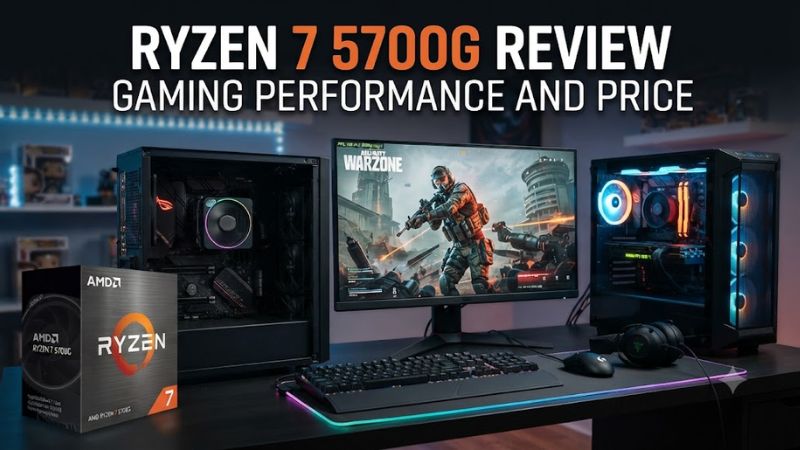
The 5700G uses Zen 3 CPU cores with Radeon graphics on one desktop package, so it can form a PC without a discrete card. AMD lists AM4, DDR4, PCIe 3.0, 65W default TDP, and a bundled Wraith Stealth cooler; those limits matter when comparing it with newer AM5 parts.
Platform compatibility
A Ryzen 7 5700G review: gaming performance and price assessment should start with the platform, because the processor is tied to AM4 and DDR4 rather than today’s AM5 and DDR5 ecosystem. Existing AM4 owners can avoid replacing the motherboard and memory, while new builders have newer alternatives.
The 5700G requires an AM4 motherboard and DDR4 memory, with AMD specifying support up to DDR4-3200. BIOS support can vary by board, so buyers should confirm the CPU appears on the motherboard’s supported-processor list before ordering. The AM4 choice suits an existing compatible system best.
Integrated graphics target
A Ryzen 7 5700G review: gaming performance and price comparison should separate iGPU gaming from CPU performance. Vega 8 can handle esports, older games and reduced-quality settings, but demanding releases may require 720p, very low presets or an eventual discrete GPU. Dual-channel memory is important because the iGPU shares system RAM bandwidth.
Memory configuration deserves equal attention because the integrated Radeon graphics use system RAM. Independent results from Tom’s Hardware show a large gap between dual-channel and bandwidth-constrained configurations, making two matched DIMMs a sensible baseline for an iGPU build rather than treating memory capacity alone as the deciding factor.
New-build value
For a Ryzen 7 5700G review: gaming performance and price decision, the CPU’s value changes sharply depending on whether a graphics card is included. At roughly the low-$200 boxed price seen in recent US listings, it can suit an AM4 replacement, but a completely new system deserves an AM5 comparison.
AMD’s current 8000G family changes that comparison. The Ryzen 7 8700G uses Zen 4, AM5, DDR5 and Radeon 780M graphics, while the Ryzen 5 8600G uses Radeon 760M. Tom’s Hardware measured the 8700G at 81% ahead of the 5700G in its 1080p iGPU suite.
Discrete GPU plans
A Ryzen 7 5700G review: gaming performance and price analysis becomes less favorable when a discrete GPU is planned from day one. TechSpot found the processor broadly around Ryzen 7 3700X or Core i5-10600K-class gaming performance in its CPU-limited suite, while the smaller L3 cache held it behind faster Zen 3 chiplet designs in several tests.
PCIe connectivity is another limitation. AMD specifies PCIe 3.0 for this processor, so an AM4 system built around it should not be described as a PCIe 4.0 CPU platform. The chip can still use a discrete GPU or NVMe storage, but its interface generation remains an older platform characteristic.
Top Picks
The table separates the 5700G from newer APUs because their platforms and benchmark conditions differ. It is not a cross-review FPS ranking: the useful comparison is hardware generation, memory platform and intended buyer. Current-generation alternatives show what the 5700G gives up, while the 5700G remains relevant for existing AM4 systems.
| Product | Best For | Key Spec | Compatibility | Watch Out For |
| Ryzen 7 8700G | Best Overall | 8C/16T, Radeon 780M | AM5, DDR5, PCIe 4.0 | Higher platform cost |
| Ryzen 5 8600G | Best Value | 6C/12T, Radeon 760M | AM5, DDR5, PCIe 4.0 | Fewer CPU cores |
| Ryzen 7 5700G | Best For AM4 | 8C/16T, Vega 8 | AM4, DDR4, PCIe 3.0 | Older iGPU/platform |
| Ryzen 5 8500G | Best For Lower-Cost AM5 | 6C/12T, Radeon 740M | AM5, DDR5, PCIe 4.0 | Weaker iGPU than 8600G |
Best Overall: Ryzen 7 8700G
A Ryzen 7 5700G review: gaming performance and price comparison now has a clear newer reference point in the Ryzen 7 8700G. AMD lists 8 cores, 16 threads, a 5.1 GHz maximum boost, Radeon 780M graphics and AM5 support. It also uses DDR5 and PCIe 4.0, making it the stronger fresh-build APU.
The 8700G should suit buyers who want integrated gaming without immediately purchasing a discrete GPU. PC Gamer and Tom’s Hardware both reported major iGPU gains over the 5700G, although a complete AM5 platform costs more. It should not be chosen solely for future discrete-GPU use, where other CPUs can be better suited.
Best Value: Ryzen 5 8600G
For a Ryzen 7 5700G review: gaming performance and price comparison, the Ryzen 5 8600G is an important value alternative because it brings Zen 4, AM5, DDR5 and Radeon 760M graphics at AMD’s $229 launch SEP. Its six cores and twelve threads are enough for mainstream gaming, while the newer platform has more upgrade headroom.
The 8600G is the better fit for a new budget APU build when its platform cost fits the budget. Tom’s Hardware reported it 65% faster than the 5700G in its 1080p iGPU testing, although that result belongs to a specific test suite and configuration. Buyers should still budget for the AM5 motherboard and DDR5 memory.
Best For AM4: Ryzen 7 5700G
A Ryzen 7 5700G review: gaming performance and price case remains strongest for someone who already owns a compatible AM4 board and DDR4 memory. The chip provides 8 cores, 16 threads, up to 4.6 GHz boost and Radeon graphics with eight graphics cores at up to 2.0 GHz, while retaining a 65W default TDP.
Its real weakness is the older Vega architecture and PCIe 3.0 platform. TechSpot recorded 33 fps in Assassin’s Creed Valhalla at 1080p lowest and 112 fps in CS:GO at 1080p medium, illustrating how strongly results depend on the game and preset. Those are historical independent benchmarks, not current universal FPS figures.
Best For Lower-Cost AM5: Ryzen 5 8500G
The Ryzen 5 8500G gives a new builder another AM5 route, using six cores, twelve threads, Zen 4 and Zen 4c cores, with Radeon 740M graphics. AMD specifies DDR5 memory, PCIe 4.0 and a 65W default TDP, so it provides a newer platform than the 5700G even though its integrated GPU is less capable than the 8600G.
The 8500G should not be selected when integrated gaming performance is the primary goal and the 8600G fits the budget. Its advantage is access to AM5 at a lower processor tier, while the 5700G remains attractive when an existing AM4 platform makes the total upgrade cheaper. Compare complete system cost before deciding.
FAQ
Does the Ryzen 7 5700G have integrated graphics?
Yes, the Ryzen 7 5700G includes Radeon graphics with eight graphics cores running at up to 2.0 GHz, so a compatible system can produce display output without a discrete GPU. That integrated graphics capability is the central reason to consider it over an AM4 processor without a comparable iGPU.
The iGPU uses system memory, so dual-channel DDR4 configuration is important for gaming performance. Tom’s Hardware demonstrated a substantial difference between properly configured dual-channel memory and a constrained memory setup, meaning an OEM configuration with one DIMM can change the gaming result considerably.
Can the Ryzen 7 5700G play games at 1080p?
Yes, the Ryzen 7 5700G can run lighter or older games at 1080p with reduced settings, while demanding titles may need lower resolution or image quality. Tom’s Hardware reported strong 720p results and selective 1080p play across its iGPU benchmark suite, with the exact result depending heavily on the game and preset.
TechSpot’s results show that range clearly: the chip averaged 33 fps in Assassin’s Creed Valhalla at 1080p lowest but reached 112 fps in CS:GO at 1080p medium. These figures come from an older review environment, so they should be used as performance context rather than a forecast for every modern release.
Does the Ryzen 7 5700G support DDR5?
No, the Ryzen 7 5700G uses DDR4 memory, with AMD listing official support up to DDR4-3200. A DDR5 kit cannot be used with this processor, so moving from an AM4 system to AM5 requires a compatible processor, motherboard and memory rather than a simple RAM replacement.
The memory requirement also affects the total value calculation. An existing AM4 owner can reuse compatible DDR4, whereas a new AM5 build needs DDR5. That is one reason the 5700G can remain sensible as an upgrade even though its underlying platform is older than the current AM5 APU family.
Is the Ryzen 7 5700G worth buying in 2026?
It can be worthwhile when an existing AM4 platform keeps the total upgrade cost low, but it is harder to recommend for a new build because newer AM5 APUs provide much stronger integrated graphics and a newer platform. Check the complete system cost, motherboard support and the games you actually intend to play before deciding.
The strongest case for the 5700G is therefore practical rather than cutting-edge: it combines eight Zen 3 cores, usable integrated graphics and low platform complexity for an AM4 owner. The weakest case is a brand-new gaming PC where the budget can absorb AM5 and DDR5, especially when integrated graphics are a major priority.
Final Thoughts
The Ryzen 7 5700G review: gaming performance and price verdict is straightforward: it remains useful as an AM4 APU, but its value depends on existing hardware. Vega 8 can support lighter gaming, while newer 8000G chips deliver much stronger iGPU performance. Buy the 5700G when platform reuse makes the numbers work, not simply for its Ryzen 7 label.