🛒 Best Price Today on Amazon
Prime members get fast, free shipping on everything above, plus member-only deals. New members get a 30-day free trial — cancel anytime.
The ryzen 9 7900x review: gaming performance and price question is more complicated in 2026 because this Zen 4 CPU now competes with newer Ryzen 9000 chips. Its 12 cores, 24 threads and high clocks remain useful for gaming plus heavier workloads, but the value depends on how its current price compares with newer AM5 options.
How to Choose a 12-Core Gaming CPU
For a sensible purchase, compare gaming performance, current price, platform compatibility and workload needs rather than judging the CPU by core count alone. The 7900X uses AM5 and DDR5, while newer AM5 processors can deliver better gaming performance or efficiency. Its main attraction is the combination of 12 cores and a lower listed price than newer 12-core models.
Gaming Performance Matters More Than Core Count
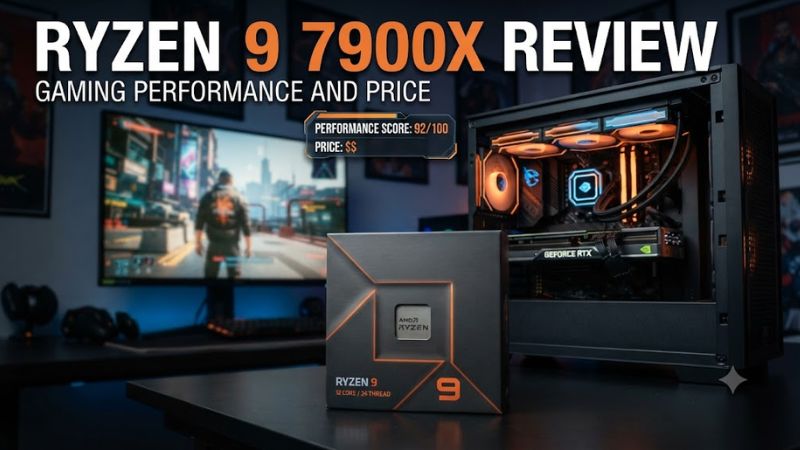
The ryzen 9 7900x review: gaming performance and price case is strongest when gaming is combined with demanding background workloads. Tom’s Hardware recorded a 92.9% result for the 7900X in its 1080p gaming index, using an NVIDIA GeForce RTX 3090 to reduce GPU limitations. The 7900X was also 15% ahead of the Ryzen 9 5900X in that suite.
That benchmark used 1080p and stock CPU settings, so it should not be treated as a universal FPS figure. At 1440p, Tom’s Hardware found the differences between high-end CPUs narrowed as GPU limits became more important. A faster graphics card, game engine, memory configuration and graphics preset can all change the ranking substantially.
Price Changes the Value Equation
The ryzen 9 7900x review: gaming performance and price verdict changes substantially from its original $549 launch price. AMD’s US store currently lists the processor at $359, although the dedicated product page currently marks it out of stock. That makes the 7900X much easier to justify than at launch, provided a retailer offers a comparable price.
A current-generation Ryzen 7 9700X is listed by AMD at $341, while the Ryzen 9 9900X is listed at $445. The 7900X therefore sits close to the 9700X while offering four additional cores, but the 9700X belongs to the newer Zen 5 generation and has a much lower 65W default TDP.
AM5 and DDR5 Are Required
The ryzen 9 7900x review: gaming performance and price cannot ignore platform cost because the processor requires an AM5 motherboard and DDR5 memory. AMD specifies two memory channels and DDR5 support, with official memory speeds varying by DIMM configuration. The processor also supports PCIe 5.0 and includes basic Radeon integrated graphics.
The 7900X is compatible with supported AM5 chipsets including A620, B650, B650E, X670, X670E, X870 and X870E, with additional newer chipsets listed by AMD. Motherboard BIOS support should still be checked before purchase, particularly when pairing an older processor with a newer board generation.
Cooling and System Planning
The 7900X has a 170W default TDP, a maximum operating temperature of 95°C and no bundled thermal solution. AMD lists a liquid cooler as recommended for optimal performance, so a buyer should budget for a capable CPU cooler rather than treating the processor price as the complete platform cost.
The ryzen 9 7900x review: gaming performance and price therefore favors buyers who already understand AM5 system costs. The chip itself uses the AM5 socket and DDR5 memory, while cooler selection must match the processor and case. No specific PSU wattage or case clearance should be assumed from the CPU specification alone.
Top Picks
The comparison below puts the 7900X against newer AMD choices rather than pretending its 2022 launch position still applies. Prices are AMD US store listings checked for October 6, 2026, while gaming conclusions use independent benchmark sources where available. The 7900X remains a Zen 4 option, whereas the other listed CPUs use Zen 5.
| Product | Best For | Key Spec | Compatibility | Watch Out For |
| Ryzen 9 9900X | Best overall | 12C/24T, up to 5.6GHz | AM5, DDR5 | Higher listed price |
| Ryzen 9 7900X | Best value 12-core | 12C/24T, up to 5.6GHz | AM5, DDR5 | Older Zen 4 platform |
| Ryzen 7 9700X | Best efficiency | 8C/16T, 65W | AM5, DDR5 | Fewer cores |
| Ryzen 7 9850X3D | Best gaming | 8C/16T, 96MB L3 | AM5, DDR5 | Higher price and power |
Ryzen 9 9900X: Best Overall
The Ryzen 9 9900X is the stronger all-round alternative if the budget stretches beyond the 7900X. AMD lists 12 cores, 24 threads, a 4.4GHz base clock, up to 5.6GHz boost and a 120W default TDP. It uses Zen 5, AM5 and DDR5, retaining the same broad platform direction while lowering the stated TDP substantially.
Buy it for a new AM5 build where gaming is combined with streaming, encoding or other multithreaded work and the roughly $445 AMD listing is acceptable. Do not buy it solely because the 7900X has an older architecture; instead, compare actual retailer pricing. If the 7900X is substantially cheaper, its 12-core design can remain a rational value choice.
Ryzen 9 7900X: Best Value 12-Core
The ryzen 9 7900x review: gaming performance and price favors the processor most when its current price is well below newer 12-core alternatives. Its 12-core, 24-thread configuration, 4.7GHz base clock and up to 5.6GHz boost remain substantial specifications, while AMD lists 64MB of L3 cache and a 170W default TDP.
Buy it for a discounted AM5 system where gaming is important but productivity also benefits from 12 cores. Its real weakness is age: Zen 4 is no longer AMD’s newest desktop architecture, and a 170W default TDP is considerably higher than the 9900X’s 120W rating. Avoid it when pure gaming performance is the only priority and an X3D chip fits the budget.
Ryzen 7 9700X: Best Efficiency
The Ryzen 7 9700X is a better fit for buyers who prioritize a newer architecture, moderate power draw and strong gaming performance over having 12 cores. AMD lists eight cores, 16 threads, a 3.8GHz base clock, up to 5.5GHz boost and a 65W default TDP. It remains an AM5 and DDR5 processor.
Buy it when the system will focus primarily on gaming and ordinary desktop work, especially when lower CPU power is attractive. Tom’s Hardware described the 9700X as offering strong gaming performance and efficiency, but its eight-core design is its genuine limitation against the 7900X in heavily threaded workloads.
Ryzen 7 9850X3D: Best Gaming
The Ryzen 7 9850X3D is the current-generation choice for buyers who care most about maximum gaming performance. AMD lists eight cores, 16 threads, a 4.7GHz base clock, up to 5.6GHz boost, 96MB L3 cache and a 120W default TDP. It launched in January 2026 on AM5 with DDR5 support.
Independent results explain the premium: Tom’s Hardware found the 9850X3D about 3.3% ahead of the 9800X3D in its gaming suite, while TechSpot found gains vary considerably by game and settings. Its weakness is value rather than capability, because the incremental gaming improvement comes with higher cost and power use than the previous X3D model.
FAQ
For buyers asking whether the older Zen 4 processor still makes sense, the answer depends mainly on current street price, workload and whether gaming or productivity receives priority. The ryzen 9 7900x review: gaming performance and price conclusion is therefore less about its original launch position and more about its place among today’s AM5 alternatives.
Is the Ryzen 9 7900X still good for gaming?
Yes, the Ryzen 9 7900X remains a strong gaming CPU, although newer X3D processors are better suited to buyers chasing maximum FPS. Tom’s Hardware measured a 92.9% 1080p gaming index result with an RTX 3090, while also noting that CPU differences shrink at higher resolutions when GPU limits become stronger.
For a mixed-use PC, the 7900X has an advantage because its 12 cores and 24 threads provide more parallel capacity than eight-core gaming-focused alternatives. It becomes less attractive when gaming is the only workload and the price approaches a current-generation X3D processor with substantially stronger gaming-focused performance.
Is the Ryzen 9 7900X worth its current price?
Yes, the Ryzen 9 7900X can be worth its current listed price when a retailer sells it around AMD’s $359 reference listing. AMD’s direct product page currently shows $359 but also marks the processor out of stock, so availability and actual retailer pricing should be checked before purchasing.
At roughly the same money as a Ryzen 7 9700X, the 7900X offers 12 cores instead of eight, but the 9700X is newer and carries a 65W default TDP versus 170W for the 7900X. Buyers should therefore choose the 7900X for core-heavy workloads rather than assuming more cores automatically means more gaming FPS.
Does the Ryzen 9 7900X require DDR5?
Yes, the Ryzen 9 7900X requires DDR5 memory because AMD’s AM5 desktop platform does not provide DDR4 support for this processor. AMD specifies two memory channels and lists DDR5-5200 for two-DIMM configurations under its official memory specifications.
The processor uses AM5 and supports PCIe 5.0, while AMD lists compatibility across several 600- and 800-series chipsets. Motherboard support should still be confirmed for the exact board and BIOS revision, particularly when buying a board from a newer generation than the CPU.
Is the Ryzen 9 7900X better than the Ryzen 7 9850X3D for gaming?
No, the Ryzen 7 9850X3D is the stronger choice for maximum gaming performance, while the Ryzen 9 7900X is better positioned as a discounted 12-core mixed-use CPU. Independent testing places the 9850X3D at the top of current gaming comparisons, although its advantage varies by game and graphics settings.
The 7900X still makes sense when its lower price is the priority or when 12 cores are useful for workloads beyond gaming. For a new high-end gaming build with gaming as the dominant workload, however, the 9850X3D is the more performance-focused option, while the 7900X is the value-oriented alternative.
Final Thoughts
The ryzen 9 7900x review: gaming performance and price verdict is favorable only when the discount is meaningful: its 12C/24T design remains capable, but Zen 5 and X3D options have changed the market. Choose it for affordable AM5 multithreading; choose a newer X3D model when gaming FPS is the main goal.