🛒 Best Price Today on Amazon
Prime members get fast, free shipping on everything above, plus member-only deals. New members get a 30-day free trial — cancel anytime.
As of October 6, 2026, intel core ultra 9 285k review: gaming performance and price is mainly a value question because the 285K is no longer Intel’s newest desktop option. Its 24-core design remains capable for demanding workloads, but newer CPUs offer stronger gaming value.
How to Choose a High-End Gaming CPU
The right choice depends on gaming speed, workload balance, platform cost, and upgrade path rather than core count alone. For this comparison, the Core Ultra 7 270K Plus suits buyers wanting a lower-cost Intel platform, the Ryzen 7 9850X3D targets gaming first, and the Ryzen 9 9950X3D combines gaming with heavy creation work. The 285K mainly makes sense at a substantial discount.
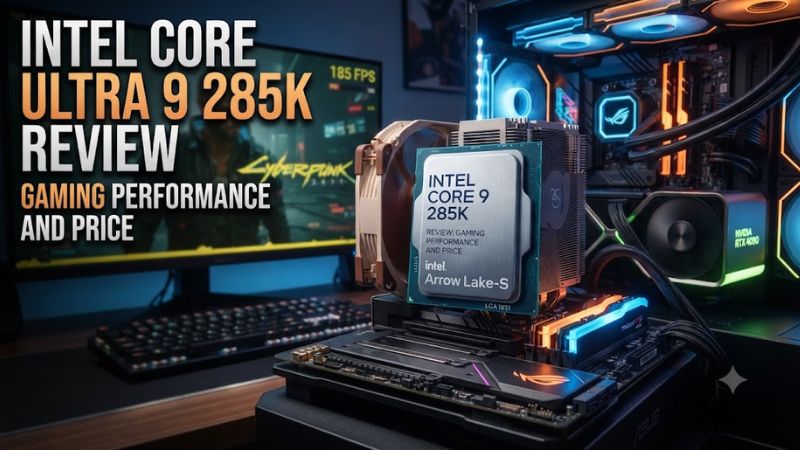
Gaming performance should lead the decision
For a gaming-focused build, the benchmark gap matters more than the 285K’s large core count. TechSpot’s 14-game comparison placed the Ryzen 7 9850X3D about 40% ahead of the 285K in its medium-quality CPU-focused data, while its Ryzen 9 9950X3D results also showed large gains in several games.
The 285K can still produce high frame rates when paired with a strong graphics card, particularly at 1440p and 4K where GPU limits often reduce CPU differences. However, a buyer prioritizing high-refresh 1080p gaming has more reason to consider an X3D processor, especially when the system is built around a powerful current-generation GPU.
Productivity changes the value equation
The 285K is more interesting when gaming shares the system with rendering, encoding, compiling, or other heavily threaded workloads. It has 8 Performance-cores and 16 Efficient-cores, for 24 cores and 24 threads, alongside 36MB of Intel Smart Cache and up to 5.7GHz turbo frequency.
That combination gives the 285K a broader workload profile than an eight-core gaming-focused CPU. The problem is price: its official boxed recommended customer price was $599, while newer Intel and AMD products have changed the high-end value landscape. A discounted 285K can therefore be more attractive than its original positioning suggests.
Platform compatibility needs careful checking
The Core Ultra 9 285K requires Intel’s LGA1851 socket and DDR5 memory; DDR4 support is not available on this platform. Intel lists 24 PCIe lanes, PCIe 5.0 and 4.0 support, two memory channels, and support for up to DDR5-6400 under its official specification.
A compatible 800-series motherboard is therefore required, and an existing LGA1700 board cannot simply accept the 285K. The K-series processor also ships without an Intel boxed fan heatsink, so the complete build needs a separate CPU cooler and an LGA1851-compatible mounting solution where required.
Price should decide whether it is still sensible
The original intel core ultra 9 285k review: gaming performance and price story was difficult because the launch MSRP positioned the chip against CPUs that were faster in many games. Today, the more important comparison is its actual selling price against the Core Ultra 7 270K Plus and AMD’s X3D lineup.
If the 285K costs close to a newer high-end gaming CPU, there is little reason for a new gaming build to choose it. If a retailer discounts the chip substantially and the buyer also needs strong multicore performance, the calculation becomes more favorable. The motherboard cost should be included because LGA1851 is part of the purchase.
Top Picks for Gaming and High-End Workloads
The table separates the 285K from newer alternatives rather than treating every CPU as an equal-generation product. The 285K belongs to Intel’s original Core Ultra 200S desktop launch, while the Core Ultra 7 270K Plus arrived in 2026 as part of the refreshed 200S Plus range. AMD’s Ryzen 7 9850X3D is also a 2026 gaming-focused release.
| Product | Best For | Key Spec | Compatibility | Watch Out For |
| Intel Core Ultra 7 270K Plus | Best Overall | 24 cores, up to 5.5GHz | LGA1851, DDR5, 800-series | LGA1851 upgrade path |
| AMD Ryzen 7 9850X3D | Best For Gaming | 8 cores/16 threads, 96MB L3 | AM5, DDR5 | Higher power than 9800X3D |
| AMD Ryzen 9 9950X3D | Best For Gaming + Creation | 16 cores/32 threads, 128MB L3 | AM5, DDR5 | Expensive platform |
| Intel Core Ultra 9 285K | Best For Discounted LGA1851 Builds | 24 cores, up to 5.7GHz | LGA1851, DDR5 | Older gaming performance |
Intel Core Ultra 7 270K Plus
The Core Ultra 7 270K Plus is the strongest Intel alternative when a buyer wants a current LGA1851 desktop processor without paying flagship pricing. Intel launched it at a suggested price starting from $299, and independent reviews found a substantial improvement over the original Arrow Lake gaming position.
It retains 24 cores and 24 threads, with up to 5.5GHz boost according to Intel’s current product information. Its weakness is platform longevity: LGA1851 is already a mature platform, so buyers should not assume a long sequence of future desktop upgrades.
AMD Ryzen 7 9850X3D
The Ryzen 7 9850X3D is the stronger choice when gaming is the primary purpose. AMD lists 8 cores, 16 threads, a 5.6GHz maximum boost, 96MB of L3 cache, 120W default TDP, and AM5 compatibility, while independent benchmarks place it clearly ahead of the 285K in CPU-limited gaming.
Its real weakness is value relative to the Ryzen 7 9800X3D because the gaming improvement is modest in many workloads. GamersNexus found it at most about 4% faster than the 9800X3D, while Tom’s Hardware reported roughly 3% overall gaming improvement, making the older X3D chip potentially attractive when discounted.
AMD Ryzen 9 9950X3D
The Ryzen 9 9950X3D is better suited to someone who wants high-end gaming alongside serious creation workloads. AMD lists 16 cores, 32 threads, up to 5.7GHz boost, 128MB of L3 cache, a 170W default TDP, and AM5 compatibility, giving it a broader workload profile than the 9850X3D.
Its main weakness is cost, although AMD’s current direct-store listing shows a $699 MSRP. TechSpot’s gaming results put the 9950X3D well ahead of the 285K across multiple titles, while its productivity capability makes it a more complete high-end option for mixed workloads.
Intel Core Ultra 9 285K
The 285K remains technically impressive as an LGA1851 processor, with 24 cores, 24 threads, 36MB of L3 cache, 40MB of L2 cache, and up to 5.7GHz boost. Intel also rates it for 125W Processor Base Power and 250W Maximum Turbo Power, although actual application and gaming consumption varies by workload.
The major weakness is gaming value rather than a lack of raw CPU resources. TechSpot found inconsistent game performance, including results behind the previous-generation Core i9-14900K, while later comparisons continued to show substantial gaps against AMD’s X3D processors. For a new build, the 285K should therefore be bought only when its price reflects that disadvantage.
FAQ
The short answer to the intel core ultra 9 285k review: gaming performance and price question is that it remains a capable processor but is difficult to recommend for a new gaming-focused build when newer alternatives offer better performance or value. Its strongest case is a discounted system where multicore work matters as much as gaming.
Is the Intel Core Ultra 9 285K good for gaming?
The Intel Core Ultra 9 285K is capable for gaming, but it is not a leading choice for a new high-end gaming PC in 2026. Independent testing showed inconsistent results across games, with the CPU sometimes matching previous-generation Intel parts and sometimes falling substantially behind AMD X3D processors.
The exact experience depends on resolution, graphics settings, GPU, memory configuration, and the game engine. At higher resolutions, the graphics card can become the main limit, reducing the practical difference between CPUs. At CPU-limited settings, however, newer X3D models have a clearer advantage.
Is the Core Ultra 9 285K worth its price?
The Core Ultra 9 285K is worth considering only when its current street price is meaningfully below newer high-end alternatives. Its original $599 boxed recommended price was difficult to justify for gaming because independent reviews found weaker gaming performance than competing processors.
The 285K becomes more reasonable for users who already own an LGA1851 motherboard or who find a discounted bundle that reduces platform cost. New buyers should compare the complete CPU, motherboard, and memory package rather than looking at CPU price alone.
What motherboard does the 285K require?
The Core Ultra 9 285K requires an LGA1851 motherboard using an Intel 800-series chipset, and the platform uses DDR5 memory rather than DDR4. Intel specifies 24 CPU PCIe lanes with PCIe 5.0 and PCIe 4.0 support, plus two memory channels.
Compatibility also affects cooling because the 285K is a K-series desktop processor and does not include a boxed Intel heatsink. A separate cooler is therefore required, and buyers should confirm that its mounting hardware supports LGA1851 before completing the build.
Should you buy the 285K or a newer CPU?
You should generally choose a newer CPU for a new gaming system unless the 285K is heavily discounted or you specifically need an LGA1851 configuration. Intel’s Core Ultra 7 270K Plus offers a newer 200S Plus design at a much lower launch price, while AMD’s 9850X3D targets gaming directly.
For gaming plus demanding productivity, the Ryzen 9 9950X3D is another strong alternative because it combines 16 cores and 32 threads with 3D V-Cache. The 285K still makes sense when its platform and price are compelling, but its launch-era gaming positioning is no longer competitive enough to justify paying a premium.
Final Thoughts
The intel core ultra 9 285k review: gaming performance and price conclusion is straightforward: its 24-core architecture remains useful, but its gaming results and aging platform make it a conditional purchase in 2026. Buy it for a strong discount or an existing LGA1851 system; otherwise, newer CPUs offer a clearer route for gaming and upgrades.