🛒 Best Price Today on Amazon
Prime members get fast, free shipping on everything above, plus member-only deals. New members get a 30-day free trial — cancel anytime.
The ryzen 7 7800x3d review: gaming performance and price question is still relevant because this Zen 4 gaming CPU now sells well below its launch price while newer X3D models dominate the high end. Its 8 cores, 16 threads and 96MB L3 cache remain attractive, but today’s buyer must weigh the lower price against newer AM5 options.
How to Choose a Gaming CPU for the 7800X3D
The right choice depends on four things: gaming speed, street price, platform compatibility and workload balance. The 7800X3D remains compelling when gaming is the priority and its price is substantially below newer X3D chips. The Ryzen 7 9800X3D or 9850X3D makes more sense when higher CPU-limited frame rates justify spending more.
Gaming performance
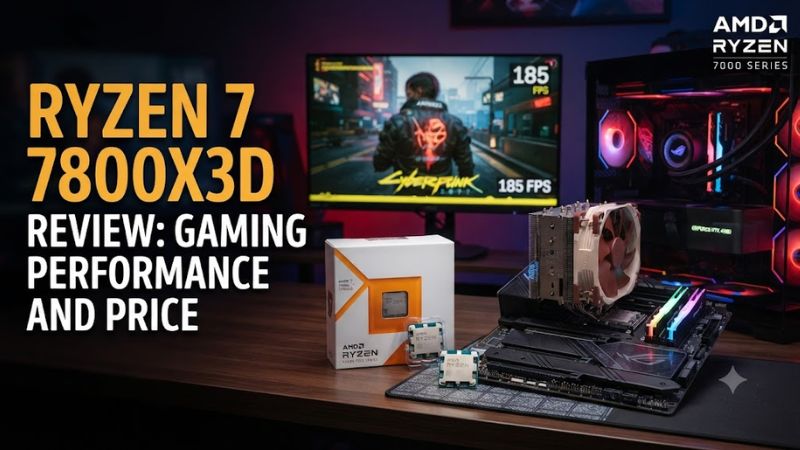
Gaming performance is the main reason to consider the 7800X3D, because its 96MB L3 cache can benefit CPU-limited games without requiring a dual-CCD design. TechSpot’s 12-game average used an RTX 4090 at 1080p and found the 7800X3D 3% ahead of the Core i9-13900K, while individual results varied considerably by game.
A newer comparison from TechSpot gives useful context for this ryzen 7 7800x3d review: with an RTX 5090, DDR5-6000 CL30 and updated BIOS, the 9800X3D averaged 8% faster across 12 games at both medium and ultra settings. That makes the 7800X3D slower, but not automatically poor value when its price is substantially lower.
Price and value
The current US retail price is the strongest argument for the 7800X3D. A recent price tracker recorded a $327 in-stock listing, with a 90-day median of $389, while separate retailer records showed lower OEM listings. Because prices move frequently, the practical target is the current retail price rather than the original $449 launch MSRP.
For this ryzen 7 7800x3d review, value improves when the chip costs roughly $100 less than a 9800X3D. The 9800X3D was recently around $449, while the 9850X3D was around $484 at the cheapest tracked US listings. Those premiums buy newer CPU architecture and additional gaming headroom, not a completely different gaming experience.
Platform compatibility
Compatibility is straightforward but requires an AM5 system: the 7800X3D uses the AM5 socket, supports DDR5 only, and provides PCIe 5.0 connectivity. AMD lists support across A620, B650, B650E, X670, X670E, B840, B850, X870 and X870E chipsets, although motherboard BIOS support should still be checked before installation.
The CPU has a 120W default TDP and a maximum operating temperature of 89°C, while AMD does not include a boxed cooler. A capable AM5-compatible cooler is therefore part of the platform cost. No DDR4 motherboard can be reused, so an older AM4 build needs a motherboard and DDR5 memory alongside the processor.
Workload and longevity
The 7800X3D is more specialized for gaming than for heavily threaded production work. TechSpot recorded it behind the Ryzen 7 7700X in Cinebench R23 all-core performance and substantially behind higher-core processors in workloads such as Blender, showing why a creator-focused buyer should not judge it from gaming results alone.
For a new gaming PC, however, AM5 remains useful because AMD’s desktop platform supports DDR5 and PCIe 5.0 and continues to receive newer Ryzen generations. The 7800X3D itself is Zen 4 rather than the current Zen 5 generation, so its strongest longevity argument is its gaming performance per dollar rather than being the newest architecture.
Top Picks for Gaming CPUs
The table below separates the 7800X3D from newer AM5 alternatives using current pricing evidence and published benchmark data. The 7800X3D is the value-oriented choice when discounted, while newer X3D parts target buyers who want more CPU headroom and are comfortable paying for it.
| Product | Best For | Key Spec | Compatibility | Watch Out For |
| AMD Ryzen 7 7800X3D | Best Overall Value | 8C/16T, 96MB L3 | AM5, DDR5, PCIe 5.0 | Older Zen 4 architecture |
| AMD Ryzen 7 9800X3D | Best For High-End Gaming | 8C/16T, Zen 5 | AM5, DDR5 | Higher price |
| AMD Ryzen 7 9850X3D | Best For Maximum Gaming Speed | 8C/16T, up to 5.6GHz | AM5, DDR5 | Higher power and price |
| AMD Ryzen 7 9700X | Best For Balanced Value | 8C/16T, up to 5.5GHz | AM5, DDR5 | No 3D V-Cache |
AMD Ryzen 7 7800X3D
The AMD Ryzen 7 7800X3D is the best overall value here when its street price stays close to the low-$300 range. AMD specifies 8 cores, 16 threads, a 4.2GHz base clock, up to 5GHz boost and 96MB of L3 cache. It also supports EXPO, Precision Boost Overdrive and Curve Optimizer on AM5.
The main weakness is its age relative to current X3D processors. TechSpot’s newer 12-game comparison put the 9800X3D 8% ahead on average, while GamersNexus found the 9850X3D 15–24% ahead depending on workload. Buyers should therefore skip the 7800X3D when its price approaches newer X3D models.
AMD Ryzen 7 9800X3D
The Ryzen 7 9800X3D is the better choice for a high-end gaming build when the additional price is acceptable. It moves to Zen 5 while retaining the 8-core, 16-thread X3D formula, and TechSpot’s updated 12-game data places it 8% ahead of the 7800X3D at both medium and ultra settings.
Its weakness is value rather than capability: recent US tracking put the 9800X3D at about $449, versus roughly $327 for the cheapest tracked 7800X3D listing. A buyer should not choose the 9800X3D simply because it is newer if the saved money could instead fund a stronger GPU, particularly for 1440p or 4K gaming.
AMD Ryzen 7 9850X3D
The Ryzen 7 9850X3D is the pick for buyers who want AMD’s current top single-CCD gaming CPU. AMD lists Zen 5 architecture, 8 cores, 16 threads, a 4.7GHz base clock, up to 5.6GHz boost, 96MB L3 cache and a 120W default TDP, with AM5 and DDR5 support.
The real weakness is its limited advantage over the 9800X3D relative to its cost. Tom’s Hardware described it as only marginally faster while drawing more power, and GamersNexus found gains of up to 4% over the 9800X3D in its gaming data. Recent US listings put it around $484 or more, so budget-focused buyers should look elsewhere.
AMD Ryzen 7 9700X
The Ryzen 7 9700X suits buyers who want eight Zen 5 cores without paying for an X3D model. It uses AM5 and DDR5, reaches up to 5.5GHz, and current US price tracking places its typical recent retail price around $339, with lower individual listings recorded. That makes it a useful alternative when gaming and general desktop work both matter.
Its weakness is the absence of 3D V-Cache, which makes it less attractive for CPU-limited gaming than an X3D processor at a similar total system budget. A buyer focused mainly on high-refresh gaming should choose the 7800X3D when its price is clearly lower, while a mixed-use buyer can reasonably prefer the 9700X.
FAQ
Is the Ryzen 7 7800X3D still good for gaming?
Yes, the Ryzen 7 7800X3D remains a strong gaming CPU when its price is substantially below newer X3D models. TechSpot’s 12-game RTX 4090 test at 1080p placed it 3% ahead of the Core i9-13900K on average, although individual games ranged from major gains to little difference.
The important qualification is that newer X3D chips are faster. TechSpot’s later RTX 5090 comparison found the 9800X3D 8% ahead across 12 games at medium and ultra settings, so the 7800X3D makes the most sense when its lower purchase price matters more than the last increment of CPU performance.
What motherboard and RAM does the Ryzen 7 7800X3D need?
The Ryzen 7 7800X3D requires an AM5 motherboard and DDR5 memory, and it cannot use DDR4. AMD lists compatibility with A620, B650, B650E, X670, X670E, B840, B850, X870 and X870E chipsets, with BIOS support still worth checking for the specific board and processor combination.
AMD rates official memory support at DDR5-5200 for two-module configurations, while EXPO allows compatible memory kits to operate beyond the base specification. The processor also supports PCIe 5.0, so the platform can accommodate current high-speed storage and graphics interfaces where the motherboard provides them.
Is the Ryzen 7 7800X3D worth buying in 2026?
Yes, it is worth considering in 2026 when its retail price stays around the low-$300 range and the system is primarily for gaming. Recent US tracking showed a $327 in-stock price, while the 9800X3D was around $449, creating a meaningful gap that can instead go toward a graphics card or other components.
The decision changes when the price gap narrows. The 9800X3D averaged 8% faster in TechSpot’s updated 12-game comparison, while the 9850X3D adds only a small amount beyond the 9800X3D. At those higher prices, the older chip should be selected for its discount rather than its position in AMD’s lineup.
Does the Ryzen 7 7800X3D need liquid cooling?
No, the Ryzen 7 7800X3D does not inherently require liquid cooling, but it does require a separate CPU cooler because AMD does not include one with the boxed processor. AMD specifies a 120W default TDP and an 89°C maximum operating temperature for the chip.
A suitable AM5-compatible air cooler can therefore be considered for a normal gaming build, while stronger cooling can make sense for sustained heavy workloads or quieter operating targets. The key requirement is adequate AM5 compatibility and thermal capacity rather than a specific cooler type.
Final Thoughts
The ryzen 7 7800x3d review: gaming performance and price verdict is favorable when the CPU is clearly cheaper than newer X3D alternatives. Its 8-core design, 96MB L3 cache and AM5 compatibility still make it a strong gaming option, but buyers should compare the live price against the 9800X3D before choosing the older Zen 4 part.