🛒 Best Price Today on Amazon
Prime members get fast, free shipping on everything above, plus member-only deals. New members get a 30-day free trial — cancel anytime.
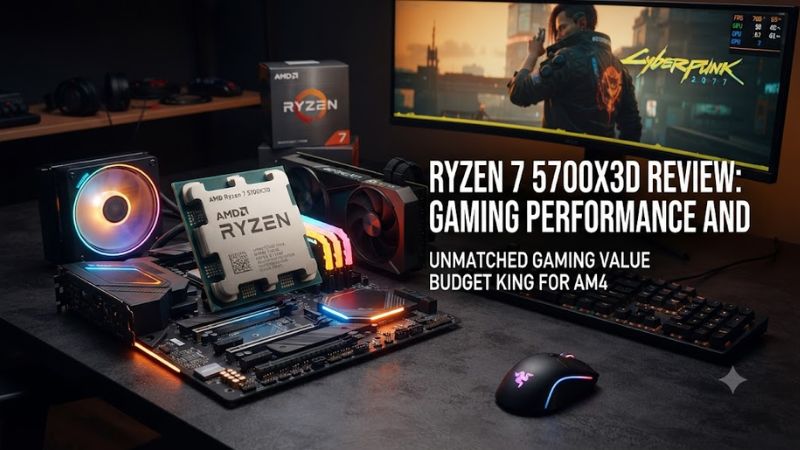
Ryzen 7 5700x3d review: gaming performance and price still makes sense for one specific buyer: an AM4 owner who wants more gaming speed without replacing the motherboard and DDR4 memory. AMD lists 8-core/16-thread, 96MB L3 cache, AM4 support and a 105W default TDP, but the chip has no integrated graphics.
How to Choose an AM4 Gaming CPU
Choosing this class of processor comes down to four checks: your motherboard socket, your DDR4 memory, your graphics-card, and the price gap to a new AM5 build. The 5700X3D fits AM4 boards using supported chipsets, while current Ryzen 9000 options require AM5 and DDR5, so platform-cost matters as much as CPU speed.
Check AM4 compatibility before buying
The 5700X3D uses Socket AM4 and AMD lists X570/X470/B550/B450/A520 chipsets as supported. BIOS support can still depend on the board-maker, so verify the exact board-CPU-list before ordering. A compatible board lets you reuse DDR4 without replacing the memory platform. Check BIOS support before installing.
For existing AM4 gaming-PCs, this is the strongest reason to consider the Ryzen 7 5700X3D review: gaming performance and price still favor a targeted CPU upgrade. AMD specifies DDR4-memory, PCIe 4.0 connectivity and a discrete-graphics requirement, so the core platform can stay intact while the larger cache helps selected games.
Match the CPU to your graphics card
CPU gains are easiest to see at lower resolutions or a fast GPU, because a GPU-limited game can hide processor differences. The Ryzen 7 5700X3D review: gaming performance and price is therefore most useful for high-refresh systems where CPU-limits are visible, rather than for every 1440p or 4K configuration. This matters most with a fast GPU.
That makes the chip more attractive for high-refresh 1080p gaming than for a slower graphics-card aimed at visually heavy 1440p or 4K play. Benchmark-results vary by title, so use the workload and GPU class you actually have rather than treating one average as a universal frame-rate promise. GPU-limits remain decisive.
Compare upgrade cost with AM5
AMD’s Ryzen 5 9600X is a Zen 5 AM5 processor with 6-core/12-thread, a 5.4GHz maximum boost and 65W TDP. It also requires DDR5 and an AM5-platform, so its CPU-price alone misses platform cost. That makes the 5700X3D more compelling for an existing AM4 system. AMD also lists PCIe 5.0 and integrated Radeon graphics.
A new-build is different. Current Ryzen 9000 desktop processors use AM5, DDR5 and PCIe 5.0, while the 5700X3D stays on AM4 and PCIe 4.0. If you are buying motherboard/DDR4-memory anyway, the older socket loses its main advantage and should face newer-CPUs on total-system-cost. Platform-costs decide value.
Factor in cooling and power
The 5700X3D has a 105W default TDP and AMD does not include a boxed cooler. Tom’s Hardware found it relatively easy to cool compared with higher-power competitors, but a suitable aftermarket-cooler is still part of the build-budget. Case airflow also matters because the chip can run warmer than lower-power AM4 parts.
Do not treat the TDP number as a direct wall-power figure. It is a processor specification, not a measurement of total system power-consumption. For a gaming build, pair the CPU with a cooler appropriate to the case and motherboard setup, then compare actual power measurements from the same benchmark source when available.
Top Picks for AM4 and Modern Gaming
These four choices cover the practical decision around this CPU: the 5700X3D for AM4-upgrades, the Ryzen 5 9600X for lower-cost modern-builds, the Ryzen 7 9700X for balanced Zen 5 performance, and the Ryzen 7 9850X3D for maximum gaming speed. They use different sockets and memory, so they are not drop-in substitutes.
| Product | Best For | Key Spec | Compatibility | Watch Out For |
| Ryzen 7 5700X3D | Best For AM4 Upgrades | 8-core/16-thread, 96MB L3 | AM4, DDR4 | Legacy platform, no iGPU |
| Ryzen 5 9600X | Best Value New Build | 6-core/12-thread, 65W | AM5, DDR5 | Needs new platform |
| Ryzen 7 9700X | Best For Balanced Builds | 8-core/16-thread, 65W | AM5, DDR5 | 32MB L3 |
| Ryzen 7 9850X3D | Best For Maximum Gaming | 8-core/16-thread, 96MB L3 | AM5, DDR5 | High platform cost |
Ryzen 7 5700X3D: Best For AM4 upgrades
The 5700X3D is the sensible pick when the motherboard/DDR4/OS are already in place. Its 8-core/16-thread layout, 3.0GHz base-clock, up to 4.1GHz boost and 96MB L3 cache give games a large cache-pool without forcing an AM5-platform change, which is the core value case.
Its weakness is age and pricing. AMD launched it at $249 SEP, but recent Newegg data showed about $329 for a tray part, while TechSpot recorded $329 recently. At that level, avoid it for a new-PC if an AM5 system fits the budget better. That pricing weakens first-build platform-preservation economics substantially.
Ryzen 5 9600X: Best Value New Build
The Ryzen 5 9600X is a newer Zen 5 option for new-build buyers. AMD specifies 6-core/12-thread, up to 5.4GHz boost, 32MB L3 cache, 65W TDP, AM5 and DDR5. Its role in a Ryzen 7 5700X3D review: gaming performance and price comparison is to show the cost of moving to a modern platform. It includes basic Radeon graphics.
Its weakness is platform cost rather than CPU capability. You need an AM5 motherboard and DDR5-memory, and the CPU ships without a cooler. AMD’s US store recently showed a $220 price but marked the listing out of stock, so availability can change and should be checked before purchase.
Ryzen 7 9700X: Best For balanced builds
The 9700X offers 8-core/16-thread on Zen 5, with a 5.5GHz maximum boost, 32MB L3 cache and 65W default TDP. AMD lists AM5, DDR5 and PCIe 5.0 support, plus integrated Radeon graphics. It is a broader all-purpose choice than the older AM4 processor. AMD also supports EXPO and Precision Boost Overdrive.
The trade-off is value versus X3D CPUs. The 9700X has substantially less L3 cache than current X3D CPUs, and current gaming charts place X3D processors higher in CPU-limited tests. Choose it when mixed gaming and productivity matter more than chasing the highest possible frame-rate. Its 65W rating also suits efficiency-focused builds.
Ryzen 7 9850X3D: Best For maximum gaming
The 9850X3D is the current high-end comparison point for a new-gaming-PC. For a Ryzen 7 5700X3D review: gaming performance and price, it shows the cost of moving up. AMD lists 8-core/16-thread, up to 5.6GHz boost, 96MB L3 cache, 120W TDP, AM5 and DDR5. Tom’s 2026 gaming index ranks it first.
Its real weakness is value. GamersNexus found the 9850X3D at best 4% ahead of the 9800X3D in its gaming-results, while Tom’s Hardware reported only a small lead with higher power-use. Tom’s 5700X3D data put it 9% behind the 5800X3D at 1080p. The 9850X3D suits top-end FPS-focused buyers.
FAQ
The FAQ focuses on four buying questions that matter most: whether the chip is still fast enough, whether its current-price makes sense, what memory and socket it needs, and whether a new PC should use AM4 at all. The answers keep the upgrade case separate from a fresh-build recommendation.
Is the Ryzen 7 5700X3D still good for gaming?
Yes, the 5700X3D remains a strong gaming-upgrade for an existing AM4 system, especially when the Ryzen 7 5700X3D review: gaming performance and price question is about avoiding a motherboard and DDR4 replacement. Reviews consistently show gains in cache-sensitive games, while Zen 3 limits productivity-performance.
PC Gamer found a 24% average gain over the Ryzen 5 5600X at 1080p and 21% at 1440p in its selected-game-set. Results depend on title/GPU/settings; those figures describe that review’s workload rather than a universal uplift. Its review also found some games where the cache advantage was small.
Is the Ryzen 7 5700X3D worth its current price?
The 5700X3D is worth considering at a reasonable AM4 upgrade-price, but the Ryzen 7 5700X3D review: gaming performance and price case weakens when its street-price approaches modern AM5 CPUs. AMD’s launch SEP was $249, while recent retail tracking has placed listings around $329, so the platform you already own matters.
If your AM4 board/DDR4 kit are paid for, avoiding a motherboard and memory-replacement can keep the upgrade economical. For a new-PC, compare the complete CPU/motherboard/RAM/cooler cost against a Ryzen 9000 setup rather than comparing processor prices alone. This is especially important when old AM4 stock carries a premium.
Does the Ryzen 7 5700X3D need DDR5 or AM5?
No, the 5700X3D uses Socket AM4 and DDR4-memory, so it does not require an AM5 motherboard or DDR5. AMD lists support for X570/X470/B550/B450/A520 chipsets, although the specific board still needs appropriate firmware support. Check the motherboard-vendor CPU list before installing it.
It also supports PCIe 4.0 and requires a discrete-graphics card because it has no integrated GPU. That combination makes it a straightforward upgrade-path for many AM4 gaming systems, provided the motherboard-BIOS and power-delivery are suitable. AMD lists a 105W default TDP for the chip.
Should you buy it for a new gaming PC?
For a new gaming-PC, the 5700X3D is usually the less attractive route unless an unusually low CPU or platform-price changes the calculation. Current AM5 processors offer newer architecture, DDR5-memory and PCIe 5.0, while AMD continues to position Ryzen 9000 and X3D parts as its modern desktop gaming platform.
The 5700X3D still makes sense when you already own a compatible AM4 motherboard, DDR4-memory and a suitable cooler, because the upgrade can target the CPU rather than the whole platform. For a new-build, compare the entire system and choose the platform that leaves more room for future CPU upgrades.
Final Thoughts
The Ryzen 7 5700X3D review: gaming performance and price points to a clear conclusion: it remains a capable AM4 gaming upgrade, not a modern-platform recommendation. Its 8-core/16-thread design and large L3 cache still help CPU-limited games, but today’s pricing can make AM5 the smarter starting point for a new PC.