🛒 Best Price Today on Amazon
Prime members get fast, free shipping on everything above, plus member-only deals. New members get a 30-day free trial — cancel anytime.
The ryzen 5 5500 review: gaming performance and price question is mainly about whether this inexpensive AM4 chip still makes sense in 2026. Its six Zen 3 cores remain capable for budget gaming, but 16MB of L3 cache, PCIe 3.0 and DDR4 limit its appeal against newer platforms.
How to Choose a Budget Gaming CPU
The right choice depends on four things: your existing motherboard, memory, graphics card and total upgrade budget. For an existing AM4 system, the Ryzen 5 5500 remains easy to understand, while newer AM4 and AM5 chips offer better platform features. Current prices also matter because the 5500 is now competing with recently released budget processors.
Check Socket Compatibility First
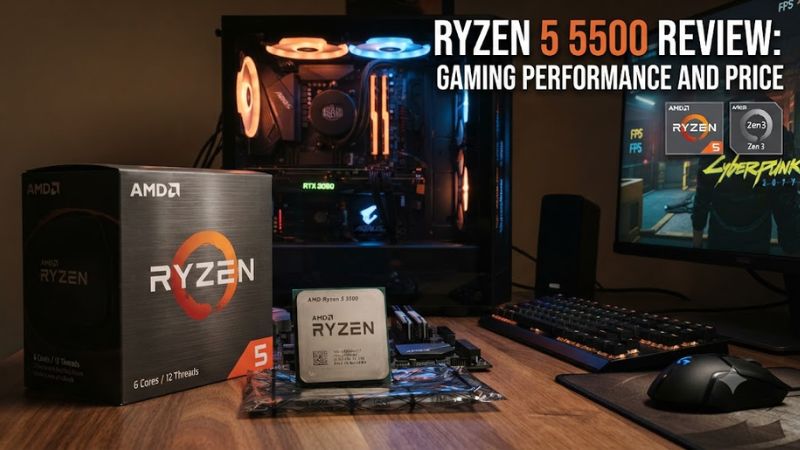
The Ryzen 5 5500 uses the AM4 socket and supports DDR4 memory, so it can fit an existing AM4 build without replacing the memory platform. AMD lists support across A520, B350, B450, B550, X370, X470 and X570 chipsets, although motherboard CPU support should still be checked before purchase.
For a new build, this platform limitation is more important than the core count. The Ryzen 5 5500 cannot use DDR5 and exposes PCIe 3.0, while newer AM5 processors move to DDR5 and PCIe 5.0. The ryzen 5 5500 review: gaming performance and price therefore makes the most sense for an existing AM4 owner.
Match the CPU to Your GPU
At 1080p, a faster processor can matter more when paired with a powerful graphics card and high-refresh display. TechSpot’s 21-game comparison found the Ryzen 5 5500 was 14% slower than the Ryzen 5 5600 at 1080p with a Radeon RX 6950 XT, while GPU-limited games showed smaller differences.
At 1440p, graphics-card limits usually reduce CPU performance gaps, particularly with demanding visual settings. Tom’s Hardware also found the Ryzen 5 5500 at 83.2% of its Core i5-12400 reference result in its 1080p gaming suite, while the same processors moved closer together at higher resolution.
Consider Memory and Expansion
AMD specifies dual-channel DDR4 support up to DDR4-3200 for the Ryzen 5 5500, with four-module configurations carrying lower official memory-speed limits. The processor also provides 24 PCIe lanes, with PCIe 3.0 as the supported generation, making motherboard and storage configuration relevant to a new purchase.
That PCIe limitation is a genuine weakness rather than a benchmark footnote. The ryzen 5 5500 review: gaming performance and price should account for users pairing the CPU with newer NVMe storage or graphics cards because those components can offer more bandwidth than the processor platform can provide.
Compare the Whole Platform Cost
A cheap CPU can stop being cheap after adding a motherboard, memory and cooler. The Ryzen 5 5500 includes AMD’s Wraith Stealth cooler and has a 65W default TDP, so an existing AM4 owner can often avoid several additional purchases when upgrading an older compatible system.
For a fresh PC, AM5 can make more sense if the price difference fits the budget. AMD’s Ryzen 5 7500 uses six cores and 12 threads with DDR5 and PCIe 5.0, while the Ryzen 5 9600 moves to Zen 5 with 32MB of L3 cache. Those features make the newer platform easier to justify for a longer-lived build.
Top Picks for the Ryzen 5 5500 Buyer
The table below puts the Ryzen 5 5500 against current budget-oriented choices rather than treating the older chip as a new-generation processor. The 5500 itself is still available around $99 in recent U.S. retail observations, while the Ryzen 5 5500F launched at the same suggested price with PCIe 4.0.
| Product | Best For | Key Spec | Compatibility | Watch Out For |
| AMD Ryzen 5 5500F | Best Overall AM4 value | 6C/12T, 4.4GHz boost | AM4, DDR4, PCIe 4.0 | Still an older AM4 platform |
| AMD Ryzen 5 5500 | Best Value upgrade | 6C/12T, 4.2GHz boost | AM4, DDR4, PCIe 3.0 | 16MB L3 cache |
| AMD Ryzen 5 7500 | Best AM5 budget choice | 6C/12T, up to 5.0GHz | AM5, DDR5, PCIe 5.0 | Requires a new platform |
| Intel Core Ultra 5 225F | Best Intel alternative | 10 cores, up to 4.9GHz | LGA1851, DDR5, PCIe 5.0/4.0 | Requires DDR5 and new motherboard |
AMD Ryzen 5 5500F
The Ryzen 5 5500F is the strongest direct alternative for an AM4 owner because it keeps DDR4 compatibility while adding PCIe 4.0 and a 4.4GHz maximum boost clock. AMD positions it as a six-core, 12-thread Zen 3 processor, and its $99 suggested U.S. price places it directly beside the older Ryzen 5 5500.
The weakness is that the 5500F does not transform the underlying AM4 platform into a modern system. The ryzen 5 5500 review: gaming performance and price remains relevant when the existing motherboard and DDR4 memory are already paid for, but a fresh build should compare the complete AM4 cost against AM5 rather than CPU prices alone.
AMD Ryzen 5 5500
The Ryzen 5 5500 is most attractive to an existing AM4 owner who can buy it near its current low retail pricing and wants six cores without replacing DDR4 memory. AMD specifies six cores, 12 threads, a 3.6GHz base clock, up to 4.2GHz boost, 16MB L3 cache and a 65W default TDP.
Its biggest weakness is the reduced cache and PCIe 3.0 interface compared with the Ryzen 5 5600 and newer alternatives. TechSpot’s 21-game results showed a 14% average deficit versus the 5600 at 1080p with an RX 6950 XT, although the difference narrowed in GPU-limited games.
AMD Ryzen 5 7500
The Ryzen 5 7500 is the more compelling choice for a new AMD system when the budget can accommodate AM5. It provides six cores and 12 threads, boosts to 5.0GHz, carries 32MB of L3 cache, uses DDR5 and supports PCIe 5.0. AMD also includes integrated Radeon graphics, which is useful for basic display output or troubleshooting.
The drawback is the platform cost because an AM5 build needs a compatible motherboard and DDR5 memory. A buyer who already owns a functioning AM4 board and DDR4 kit may spend substantially more for the complete transition, so the ryzen 5 5500 review: gaming performance and price still favors the older chip for narrowly targeted upgrades.
Intel Core Ultra 5 225F
The Core Ultra 5 225F is a current-generation Intel option with 10 cores, comprising six performance cores and four efficiency cores, plus 20MB of Smart Cache and a maximum turbo frequency of 4.9GHz. It uses LGA1851, supports DDR5-6400 and provides PCIe 5.0 and PCIe 4.0 connectivity.
Its main weakness is platform compatibility because an AM4 owner cannot reuse the existing motherboard or DDR4 memory. Recent U.S. listings have placed the 225F around the mid-$100 range, so its total build cost needs to include the LGA1851 board and DDR5 rather than comparing processor prices alone.
FAQ
The Ryzen 5 5500 remains a usable budget gaming processor, but whether it is worth buying depends heavily on whether the buyer already owns compatible AM4 hardware. The most important distinction is between an inexpensive upgrade and a completely new PC, because the same CPU can make sense in one situation and poor financial sense in another.
Is the Ryzen 5 5500 good for gaming?
Yes, the Ryzen 5 5500 is still capable of 1080p gaming when paired with an appropriate graphics card. Its six Zen 3 cores and 12 threads provide a solid baseline, while TechSpot’s 21-game testing showed performance close to Ryzen 5 3600 levels and a 14% average gap to the Ryzen 5 5600 in a CPU-limited 1080p configuration.
The main caveat is that high-refresh gaming with a powerful GPU exposes its limitations sooner. Tom’s Hardware placed the Ryzen 5 5500 at 83.2% of its Core i5-12400 reference result in its 1080p gaming suite, while higher resolutions reduced the differences as GPU load increased.
Is the Ryzen 5 5500 worth buying in 2026?
It can be worth buying in 2026 when an existing AM4 system needs an inexpensive six-core upgrade and the processor is priced around its recent $99 U.S. retail level. That price is close to the newer Ryzen 5 5500F, however, which adds PCIe 4.0 and a higher boost clock for the same suggested price.
For a new gaming PC, the calculation is less favorable because AM5 processors such as the Ryzen 5 7500 provide DDR5, PCIe 5.0 and a newer platform. The ryzen 5 5500 review: gaming performance and price therefore points toward an upgrade role rather than making the 5500 the default choice for every new system.
Does the Ryzen 5 5500 support DDR5?
No, the Ryzen 5 5500 supports DDR4 rather than DDR5, with AMD specifying dual-channel memory and official support up to DDR4-3200 under its listed configurations. The processor also uses the AM4 socket, so DDR5 memory cannot simply be substituted into an existing Ryzen 5 5500 system.
This makes the processor attractive for builders who already own suitable DDR4 memory but less appealing for someone purchasing every component from scratch. Moving to Ryzen 5 7500 or Ryzen 5 9600 means adopting AM5 and DDR5, while also gaining PCIe 5.0 platform support.
Does the Ryzen 5 5500 have integrated graphics?
No, the Ryzen 5 5500 requires a discrete graphics card because AMD lists no integrated graphics capability for the processor. This matters for both gaming and troubleshooting because a monitor connected to the motherboard’s video outputs will not receive a display signal from the CPU itself.
That limitation also separates it from processors such as the Ryzen 5 7500, which includes basic Radeon graphics. For a gaming PC that already has a discrete GPU, the missing iGPU is less important, but the ryzen 5 5500 review: gaming performance and price should still flag it as a compatibility requirement before purchase.
Final Thoughts
The ryzen 5 5500 review: gaming performance and price points to a narrow but still useful role in 2026: an inexpensive AM4 upgrade for DDR4 systems. Its six cores remain relevant, but 16MB L3 cache and PCIe 3.0 make the newer Ryzen 5 5500F or an AM5 processor more attractive for many new builds.