🛒 Best Price Today on Amazon
Prime members get fast, free shipping on everything above, plus member-only deals. New members get a 30-day free trial — cancel anytime.
For glasses wearers, best prescription lens inserts for vr headsets depend mainly on the headset model, prescription range, lens design and installation method. Current options for Meta Quest 3, Quest 3S and PSVR2 range from low-cost single-vision inserts to magnetic systems and ZEISS-equipped options.
How to Choose Prescription Lens Inserts for VR Headsets
The right insert is determined first by headset compatibility, then by the prescription it accepts, optical configuration and how easily it can be removed. Quest 3 and Quest 3S use different insert designs, while PSVR2 requires its own frame shape. Checking the exact headset before ordering prevents a physically incompatible lens from being selected.
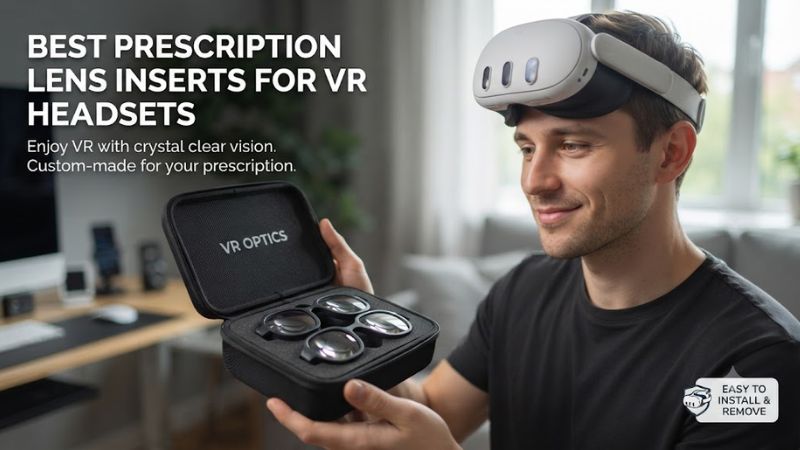
Match the headset before comparing lenses
Compatibility is the first filter when choosing the best prescription lens inserts for VR headsets because similar-looking Meta headsets do not necessarily share inserts. VR Optician lists separate Quest 3 and Quest 3S products, while HONSVR explicitly states that its Quest 3 model does not fit Quest 3S.
For Quest 3, VR Optician, Zenni and Reloptix each offer dedicated inserts. Quest 3S has separate products from VR Optician, HONSVR and Reloptix. PSVR2 likewise needs a dedicated optical frame, with Reloptix and VR Wave currently listing PSVR2 prescription options.
Check the prescription format and range
The best prescription lens inserts for VR headsets should match the distance prescription used for VR rather than a reading prescription. HONSVR recommends the distance prescription, while VR Optician specifically asks for the far-distance prescription for its Quest products. Prism support also varies, so complex prescriptions deserve confirmation before ordering.
Prescription limits can differ substantially between brands. Zenni’s Quest 3 insert accepts SPH from -10.00 to +6.00 and CYL from -6.00 to +6.00, while Reloptix lists broader options for Quest 3, including higher spherical and cylindrical ranges with additional charges for some prescriptions.
Compare lens material and coatings
Optical design matters because the insert sits between the headset display optics and the user’s eyes. VR Optician offers ZEISS lenses with options including anti-reflection, scratch resistance, Clean Coat, BlueProtect and a contrast-enhancing tint. Zenni’s Quest 3 prescription model uses 1.67 Hi-Index lenses with anti-scratch and anti-reflective treatment.
Coatings should match how the headset is used rather than being treated as mandatory upgrades. Anti-reflective treatment can reduce unwanted reflections, while anti-fog or oil-resistant options address different cleaning and condensation concerns. Zenni offers anti-fog and oil-resistant choices, while VR Optician lists several optical coating upgrades.
Choose snap-in or magnetic installation
Installation is another useful distinction when comparing prescription lens inserts for VR headsets. Zenni’s Quest 3 inserts align with the headset lenses and click into position, while Reloptix uses magnetic bases and removable frames. Magnetic designs can be useful when a headset is shared or when inserts need frequent removal for cleaning.
A removable design can also make storage easier, but every extra frame or adapter is another component to keep track of. Reloptix includes a hard case with its Quest 3 and PSVR2 prescription kits, while Zenni includes a case and cleaning cloth with its Quest 3 prescription option.
Top Picks for Prescription VR Lens Inserts
These four picks cover different current headset requirements rather than treating every VR lens as interchangeable. Prices are current listings checked on October 2, 2026 and can change. The table separates compatibility, key optical details and practical limitations so buyers can match the insert to their existing headset and prescription.
| Product | Best For | Key Spec | Compatibility | Watch Out For |
| VR Optician Quest 3 | Best Overall | ZEISS lens options; $79 base | Meta Quest 3 | Upgrades cost extra |
| Zenni Quest 3 | Best Value | 1.67 Hi-Index; $49.99 | Meta Quest 3 | Single-vision distance only |
| Reloptix PSVR2 Prescription Kit | Best For PSVR2 | Magnetic; anti-glare; wide Rx support | PlayStation VR2 | Some high prescriptions add cost |
| HONSVR Quest 2/3S | Best For Quest 3S | High-index; $49.95 | Quest 3S, Quest 2 | Not compatible with Quest 3 |
VR Optician Quest 3: Best Overall
VR Optician is a strong choice for buyers who want a dedicated Quest 3 insert with multiple optical upgrades. Its listed Quest 3 model costs $79 before shipping and includes ZEISS lens options, with scratch-resistant, anti-reflection and Clean Coat choices available. Production is listed at one to five days before shipping.
The limitation is price flexibility: the $79 listing is the starting configuration, while options such as ZEISS BlueProtect and contrast-enhancing gaming tint add cost. Buyers seeking the lowest upfront price should compare the included features carefully. It should also be avoided if the headset is a Quest 3S, because VR Optician lists the models separately.
Zenni Quest 3: Best Value
Zenni’s Quest 3 prescription insert is listed at $49.99 and includes single-vision lenses, anti-scratch and anti-reflective coatings, a carrying case and cloth. Its published prescription range is -10.00 to +6.00 SPH and -6.00 to +6.00 CYL, giving buyers clear limits before entering an order.
The main weakness is its narrower product scope: Zenni specifies single-vision distance lenses rather than progressive or reading lenses. The insert is also designed specifically for Quest 3. Buyers using Quest 3S, PSVR2 or a prescription outside the published range should select a dedicated alternative rather than assuming the frame will transfer.
Reloptix PSVR2 Prescription Kit: Best For PSVR2
Reloptix’s PSVR2 prescription kit uses magnetic bases and removable lens frames with premium anti-glare coatings, a hard case and a limited lifetime warranty. The company lists mid- and high-index lens selections and supports higher prescriptions that may require special-order processing.
The trade-off is cost and production time for uncommon prescriptions. Reloptix lists additional charges for higher SPH and CYL ranges, while special orders can take five to six weeks. That makes the kit more suitable for PSVR2 owners who need broader prescription support than for buyers seeking the shortest or cheapest route.
HONSVR Quest 2/3S: Best For Quest 3S
HONSVR offers a dedicated Quest 2 and Quest 3S prescription insert listed at $49.95, with high-index lenses, anti-glare and scratch-resistant coatings included. The company states that this design also fits Quest 1, Rift S and Oculus Go, while explicitly excluding Quest 3 compatibility.
Its weakness is the need to choose the correct family before ordering, especially because HONSVR sells a separate Quest 3 design at the same listed base price and a magnetic Quest 3 version at $56.95. Buyers with Quest 3 should therefore not select the Quest 2/3S product simply because the price is lower.
FAQ
Prescription inserts are easier to compare once headset compatibility, prescription type, optical coatings and attachment method are separated. The four questions below address the practical issues most likely to affect a purchase, including whether inserts replace glasses, which prescription to submit, whether Quest models share lenses and how much buyers should expect to spend.
Are prescription lens inserts better than wearing glasses in VR?
Prescription lens inserts are generally more convenient than wearing ordinary glasses inside a headset because they place the corrective optics directly in front of the headset’s display lenses. They also avoid fitting a second frame between the face and facial interface, although comfort still depends on the headset and insert design.
The advantage is particularly relevant when glasses press against the nose or interfere with headset positioning. Inserts also create a separate optical surface between the user’s glasses-free eyes and the headset lenses. However, they are dedicated accessories, so changing to another headset usually requires another compatible insert.
Which prescription should I use for VR lens inserts?
You should normally use your distance prescription rather than a reading or computer prescription for VR inserts. HONSVR states that VR/AR typically uses a far focal distance, and VR Optician likewise asks customers for their far-distance prescription on its Quest products.
Users with prism, unusually high prescriptions or other specialized corrections should confirm support with the manufacturer before purchasing. Reloptix states that some high prescriptions require special-order processing, while HONSVR says it can handle prism prescriptions through a custom quote rather than the standard ordering form.
Will Quest 3 prescription inserts fit Quest 3S?
Quest 3 prescription inserts will not necessarily fit Quest 3S, and manufacturers currently list separate products for the two headsets. VR Optician explicitly marks its Quest 3 insert as incompatible with Quest 3S, while HONSVR similarly separates its Quest 3 and Quest 3S products.
This distinction matters because the Quest 3 and Quest 3S use different optical systems and physical lens areas. Before ordering, buyers should match the exact headset name shown in the insert’s compatibility list. A Quest 2/3S product should not be selected for Quest 3 merely because both belong to the same Meta Quest family.
How much do prescription VR lens inserts cost?
Current prescription inserts commonly span roughly $50 to $80 at the base configuration among the products compared here. Zenni lists its Quest 3 prescription model at $49.99, HONSVR lists its Quest 3 and Quest 3S models at $49.95, while VR Optician lists its Quest 3 model at $79.
Higher prices can result from magnetic systems, specialized coatings, high-index options or uncommon prescriptions. Reloptix, for example, adds charges for some higher SPH and CYL ranges. Shipping, rush processing and optional coatings can also change the final checkout price, so the advertised starting price should not be treated as the final total.
Final Thoughts
The best prescription lens inserts for VR headsets depend on the exact headset and prescription rather than one universal design. Quest 3 buyers can compare VR Optician and Zenni, while Quest 3S and PSVR2 owners need dedicated products. Check compatibility, prescription limits, coatings and attachment style before ordering.