🛒 Best Price Today on Amazon
Prime members get fast, free shipping on everything above, plus member-only deals. New members get a 30-day free trial — cancel anytime.
Small cases turn GPU selection into a compatibility problem as much as a performance choice. The best low profile graphics card for small cases needs the right half-height bracket, card length, slot clearance, PSU capacity, and power connector. Current RTX 50-series LP models make 1080p gaming practical, but their 8GB memory and external power needs still matter.
How to Choose a Low Profile Graphics Card
For a compact gaming PC, check four things first: physical clearance, PSU and connector capacity, PCIe compatibility, and the performance target you actually need. A modern RTX 5060 LP suits stronger 1080p systems, while RTX 5050 LP models target lower power and cost. Neither replaces checking the exact case specification.
Check the Case Clearance First
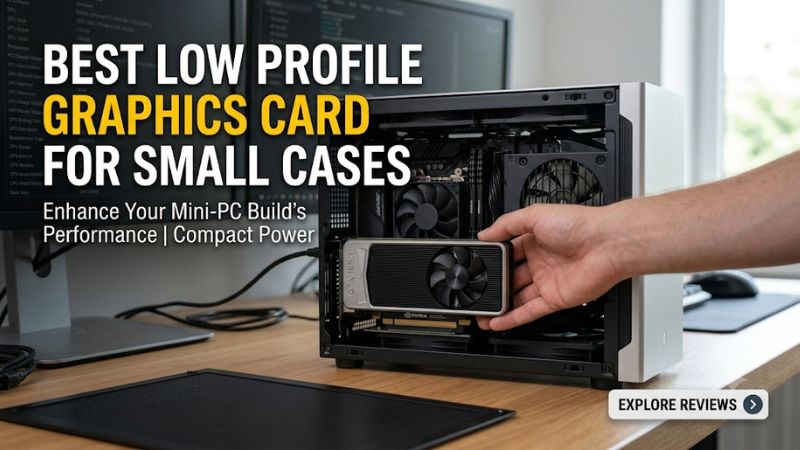
A low-profile bracket alone does not mean a card fits every small case. The card still needs enough length, two-slot expansion clearance, and room around its power connector. Gigabyte’s RTX 5060 OC Low Profile is 182 mm long, 69 mm high, and two slots wide, so the chassis must accommodate all three dimensions.
For anyone searching for the best low profile graphics card for small cases, physical clearance should come before benchmark results. A 182 mm card cannot fit a chassis limited to 170 mm, regardless of GPU performance. Also check whether the case requires a half-height bracket and whether the second expansion slot remains accessible after installation.
Match the PSU and Power Connector
Modern low-profile gaming cards are not necessarily slot-powered. The Gigabyte RTX 5050 OC Low Profile uses up to 130W and one 8-pin connector, while the RTX 5060 OC Low Profile reaches 145W and also requires one 8-pin connector. Both manufacturers specify a 550W recommended system PSU for these models.
That requirement changes which card fits an OEM upgrade. A proprietary office-PC power supply may lack the required PCIe cable even when its nominal wattage appears sufficient. In that situation, an externally powered RTX 50-series LP card is not a drop-in assumption. Confirm the PSU model, available connector, and case wiring before buying.
Match PCIe and Operating-System Support
Both RTX 5050 and RTX 5060 LP cards use PCI Express 5.0 x8 interfaces, while the physical connector is x16-shaped. They can therefore fit a compatible PCIe x16 graphics slot, but the platform still needs an appropriate motherboard, firmware, and power arrangement. ZOTAC lists Windows 11 support for its RTX 5050 LP.
For the best low profile graphics card for small cases, PCIe generation is less important than the complete platform. An older desktop can physically accept a newer card while still having firmware, power, or CPU limitations. Check the motherboard’s graphics slot, BIOS support, operating system, and CPU pairing rather than treating PCIe 5.0 as a requirement for every system.
Set a Realistic 1080p Target
The RTX 5060 LP has substantially more graphics hardware than the RTX 5050 LP, with 3,840 CUDA cores and 8GB GDDR7 versus 2,560 CUDA cores and 8GB GDDR6. Notebookcheck’s RTX 5060 LP results include 1080p Ultra testing without DLSS or Frame Generation, providing a useful independent reference for compact-card performance.
That does not mean every game should run at Ultra settings in a small case. Notebookcheck reports the RTX 5060 LP at 101.7 fps in Cyberpunk 2077 at 1920×1080 Ultra with FSR disabled on its Ryzen 7 9800X3D platform. More demanding games can require lower settings, and the 8GB framebuffer remains a consideration.
Top Picks for Small Cases
The current low-profile RTX 50-series selection is concentrated around the RTX 5050 and RTX 5060, with several board partners using similar dimensions and power requirements. The table therefore focuses on four current-generation retail cards rather than mixing newer products with older RX 6400 or RTX 3050 models. Manufacturer specifications remain the primary compatibility reference.
| Product | Best For | Key Spec | Compatibility | Watch Out For |
| GIGABYTE GeForce RTX 5060 OC Low Profile 8G | Best Overall | 8GB GDDR7, 145W | 182mm, 2-slot, 1×8-pin, 550W recommended | 8GB VRAM and external power |
| ZOTAC GAMING GeForce RTX 5060 Low Profile | Best For Compact RTX 5060 Builds | 8GB GDDR7, 145W | 182.5mm, 2-slot, 1×8-pin, 550W recommended | Two-slot width and 8-pin cable |
| GIGABYTE GeForce RTX 5050 OC Low Profile 8G | Best Value | 8GB GDDR6, 130W | 182mm, 2-slot, 1×8-pin, 550W recommended | Still needs external power |
| ZOTAC GAMING GeForce RTX 5050 Low Profile | Best For OEM-to-Custom Builds | 8GB GDDR6, 130W | 182.5mm, 2-slot, 1×8-pin, 550W recommended | Windows 11 listed by manufacturer |
GIGABYTE GeForce RTX 5060 OC Low Profile 8G
The Gigabyte RTX 5060 OC Low Profile is the straightforward choice for buyers who want current-generation compact gaming performance. It carries 8GB GDDR7, a 128-bit memory interface, 3,840 CUDA cores, and a 2,512 MHz boost clock. Its 182 mm length and included low-profile bracket suit many SFF layouts.
Its weakness is the platform requirement rather than the GPU silicon. The card consumes 145W, uses one 8-pin connector, occupies two slots, and has a 550W recommended system PSU. It should not be selected for an OEM system whose PSU lacks that connector or whose chassis cannot accept a two-slot 182 mm card.
ZOTAC GAMING GeForce RTX 5060 Low Profile
ZOTAC’s RTX 5060 LP targets builders who want the same GPU class in a compact board. It uses 8GB GDDR7, a 128-bit bus, 3,840 CUDA cores, and a 2,497 MHz boost clock. Its published dimensions are 182.5 × 69 × 38.2 mm, with a half-height bracket supplied in the package.
For the best low profile graphics card for small cases, this model is worth considering when its particular dimensions and availability suit the chassis. The real limitation is shared with other RTX 5060 LP cards: 8GB of VRAM can become restrictive in some demanding games. Notebookcheck specifically observed memory limitations in several modern titles at 1080p.
GIGABYTE GeForce RTX 5050 OC Low Profile 8G
The Gigabyte RTX 5050 OC Low Profile targets buyers who want Blackwell features without moving to the RTX 5060. It has 8GB GDDR6, a 128-bit memory interface, 2,560 CUDA cores, and a 2,587 MHz boost clock. The card measures 182 × 69 × 36 mm and uses a two-slot layout.
Its main weakness is that its 130W board power still requires one 8-pin connector and a 550W recommended PSU. TechSpot’s desktop RTX 5050 results averaged 66 fps across 18 games at 1080p, although that figure represents the standard RTX 5050 rather than this exact low-profile board. The result should therefore be treated as GPU-class context, not an LP-card benchmark.
ZOTAC GAMING GeForce RTX 5050 Low Profile
ZOTAC’s RTX 5050 LP provides another current-generation option for compact systems, with 8GB GDDR6, 2,560 CUDA cores, a 2,572 MHz boost clock, and a PCIe 5.0 x8 interface. Its 182.5 × 69 × 38.2 mm body occupies two slots and includes a half-height bracket.
The card should not be confused with a slot-powered upgrade. ZOTAC lists 130W maximum power consumption, one 8-pin input, and a 550W recommended PSU, while its published operating-system support specifies Windows 11. Buyers with proprietary OEM power supplies should confirm those requirements before choosing it.
FAQ
The four practical answers are: RTX 5060 LP cards target stronger 1080p gaming, RTX 5050 LP cards target a lower performance tier, both current models require an 8-pin connector, and exact case dimensions must be checked before purchase. The current LP market is unusually concentrated around these RTX 50-series options.
What Makes a GPU Low Profile?
A low-profile graphics card uses a half-height bracket and compact PCB arrangement intended for slim or small-form-factor desktop cases. The bracket height is only one part of compatibility, because card length, slot width, cooler thickness, motherboard clearance, and PSU cabling can still prevent installation.
For the best low profile graphics card for small cases, the exact board dimensions matter more than the generic GPU name. Two cards using the same graphics processor can have different coolers, connector positions, and physical measurements, so buyers should use the manufacturer’s dimensions for the specific SKU.
Is an RTX 5060 LP Good for 1080p Gaming?
Independent Notebookcheck results show the ZOTAC RTX 5060 Low Profile producing 101.7 fps in Cyberpunk 2077 at 1920×1080 Ultra with FSR disabled, using a Ryzen 7 9800X3D test platform. Its broader results also show that demanding newer games can require reduced settings.
The benchmark is useful as a reference point, not a universal frame-rate promise. CPU performance, memory configuration, drivers, game patches, cooling, and graphics settings affect results. The same review notes that 8GB GDDR7 can become limiting in some modern games, particularly when higher-quality assets and demanding rendering features increase memory use.
Can These Cards Run Without an 8-Pin Connector?
The current RTX 5050 and RTX 5060 low-profile models covered here cannot be treated as slot-powered cards. Gigabyte specifies one 8-pin connector for both its RTX 5050 OC LP and RTX 5060 OC LP, while ZOTAC lists the same connector requirement on its corresponding models.
That makes older OEM systems a special compatibility case. A Dell, HP, Lenovo, or similar slim desktop may have adequate physical clearance but still lack a suitable PCIe power lead. In such systems, verify the PSU and proprietary wiring before buying; do not assume an adapter makes every OEM power supply appropriate.
Is 8GB VRAM Enough for a Small Gaming PC?
Eight gigabytes remains the memory capacity of both current RTX 5050 and RTX 5060 low-profile models, but the two GPUs use different memory technologies. The RTX 5050 uses GDDR6, while the RTX 5060 uses GDDR7. Both have a 128-bit memory interface.
For 1080p gaming, 8GB can be workable, but it is not a reason to ignore individual game requirements. Notebookcheck documented situations where the RTX 5060’s 8GB capacity became restrictive in demanding titles, so buyers planning long-term use should consider texture settings and the specific games they play.
Final Thoughts
The best low profile graphics card for small cases depends on whether the system can supply the card and fit its two-slot, roughly 182 mm footprint. RTX 5060 LP models provide the higher current-generation performance tier, while RTX 5050 LP cards reduce the GPU tier but retain 8GB memory and Blackwell features.