Selecting the best oled gaming monitor upgrades your PC setup with near-instant response times and deep contrast ratios. Modern panel designs deliver high refresh rates across both QD-OLED and WOLED technologies. These high-end displays require capable graphics hardware to maintain smooth frame rates in modern gaming titles.
How to Choose an OLED Gaming Monitor
Choosing a modern gaming display involves analyzing panel technology, peak HDR brightness, refresh speed, and physical interface support. Gamers must carefully match monitor resolution with GPU rendering capabilities to maintain high framerates during play. Evaluating built-in pixel maintenance features ensures long-term display reliability.
Panel Tech and Subpixel Layout
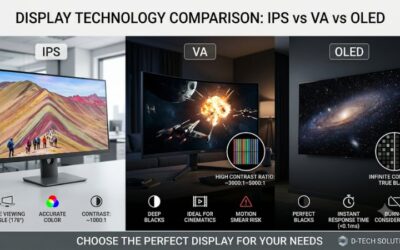
Buying the best oled gaming monitor means choosing between Quantum Dot OLED and White OLED panel structures. QD-OLED displays produce vibrant color volumes across high brightness ranges, while WOLED panels use a white subpixel to enhance efficiency. Subpixel layouts impact desktop text clarity depending on operating system font rendering.
Third-generation QD-OLED screens improve triangular subpixel arrangements to reduce visible color fringing around desktop text. Gamers focusing on immersive single-player titles benefit from QD-OLED color volume, seen in premium options like the ASUS ROG Swift PG32UCDM. WOLED screens remain ideal for users who play in brightly lit room environments.
Resolution and GPU Performance Requirements
Running a display at 3840×2160 resolution demands substantial graphics card rendering capacity from modern gaming systems. Finding the best oled gaming monitor for 4K gaming requires an NVIDIA RTX 4080 Super or AMD Radeon RX 7900 XTX to reach high refresh rates. Demanding games with ray tracing enabled quickly strain available video memory buffers.
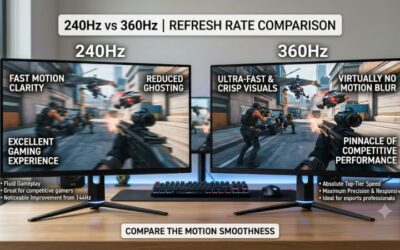
Lowering resolution to 2560×1440 provides an ideal balance for competitive players using mid-tier graphics hardware options. Mid-range GPUs like the RTX 4070 Ti Super easily drive 1440p panels at frame rates exceeding 240Hz. Choosing lower resolutions preserves system responsiveness without requiring expensive top-tier graphics hardware upgrades.
Interface Compatibility and Cable Bandwidth
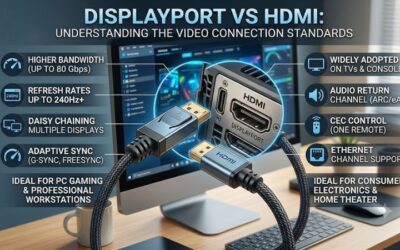
Connecting modern high-refresh displays requires understanding DisplayPort 1.4 and HDMI 2.1 bandwidth thresholds on host hardware. Reaching 4K at 240Hz relies on Display Stream Compression via DisplayPort 1.4 or uncompressed HDMI 2.1 video links. Legacy GPUs lacking compression support cannot output native refresh rates at maximum resolution settings.
Port specifications vary between individual models, as seen on the Alienware AW2725DF where HDMI 2.1 ports cap output at 144Hz. Players using DisplayPort 1.4 cables achieve full 360Hz native operation without bandwidth bottlenecks. Verifying GPU output standards before buying prevents artificial performance limits on high-end hardware configurations.
HDR Brightness and Cooling Systems
Achieving high HDR brightness across self-lit pixels requires effective passive thermal management inside the display chassis. Premium monitor models incorporate custom heatsinks or graphene layers to dissipate heat without noisy active fans. Efficient thermal management protects sensitive panel components during extended high-intensity gaming sessions.
Value-focused monitors like the MSI MAG 271QPX QD-OLED feature passive thermal designs to reduce total component costs. Panel brightness reaches 1,000 nits in small peak areas during High Dynamic Range content playback. Integrated firmware routines regularly execute background pixel refresh cycles to maintain screen luminance uniformity over time.
Top Picks for OLED Gaming Displays
Selecting the best oled gaming monitor requires matching display specifications against specific gaming genres and budget limits. The following comparison highlights key technical metrics, system connectivity requirements, and hardware limitations for current top models. Each display targets a distinct performance tier for custom PC gaming setups.
| Product | Best For | Key Spec | Compatibility | Watch Out For |
| ASUS ROG Swift OLED PG32UCDM | Best Overall | 31.5″ 4K 240Hz QD-OLED | DisplayPort 1.4 DSC / HDMI 2.1 | High power draw in HDR |
| MSI MAG 271QPX QD-OLED | Best Value | 26.5″ 1440p 360Hz QD-OLED | DisplayPort 1.4 / HDMI 2.1 | Fixed firmware on base models |
| LG UltraGear 32GS95UE | Best Dual-Mode | 31.5″ 4K 240Hz / FHD 480Hz WOLED | DisplayPort 1.4 DSC / HDMI 2.1 | Matte coating cuts glass clarity |
| Dell Alienware AW2725DF | Best Competitive | 26.7″ 1440p 360Hz QD-OLED | DisplayPort 1.4 (360Hz) / HDMI 2.1 (144Hz) | HDMI port limited to 144Hz |
ASUS ROG Swift OLED PG32UCDM
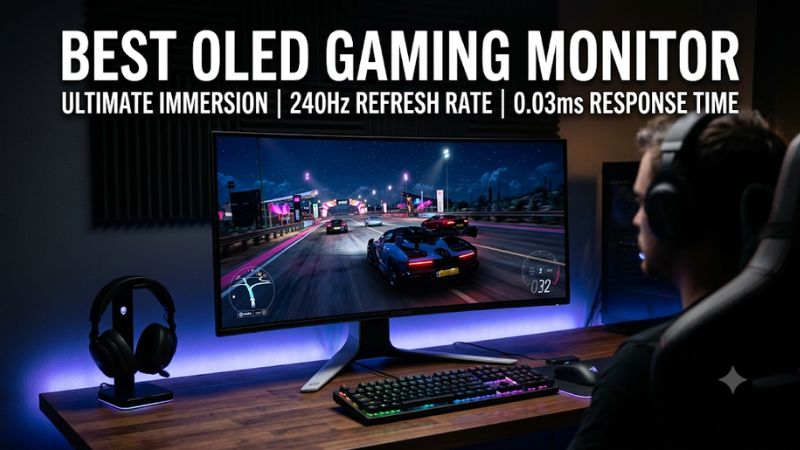
The ASUS ROG Swift OLED PG32UCDM stands as the best oled gaming monitor for enthusiast gamers wanting detailed 4K visuals. This 31.5-inch QD-OLED panel features a 3840×2160 resolution running at 240Hz with a fast 0.03ms GTG response time. A custom heatsink and graphene film manage heat dissipation without requiring an internal cooling fan unit.
Connectivity includes DisplayPort 1.4 with DSC, HDMI 2.1, and a USB-C port supporting 90W power delivery output. Bright ambient lighting causes dark shades to appear slightly elevated due to ambient light reflection on QD-OLED surfaces. Gamers with mid-range graphics cards should avoid this monitor due to demanding native 4K rendering loads.
MSI MAG 271QPX QD-OLED
The MSI MAG 271QPX QD-OLED offers exceptional value for high-refresh 1440p competitive gaming performance setups. Featuring a 26.5-inch 2560×1440 QD-OLED panel operating at 360Hz, this display provides rapid frame transitions and motion clarity. Identifying the best oled gaming monitor on a budget leads directly to this impressive performance tier.
Passive cooling using graphene sheets keeps operating temperatures controlled during high brightness output gaming scenes. A key limitation is that early MAG models lack user-accessible USB firmware updates, locking in factory software settings. Buyers needing full KVM switches or high USB-C power delivery should consider alternate monitor models.
LG UltraGear 32GS95UE
The LG UltraGear 32GS95UE provides flexibility with its hardware-level Dual-Mode refresh rate technology switch feature. Players can instantly toggle between native 4K at 240Hz for immersive titles and 1080p at 480Hz for eSports play. The 31.5-inch WOLED panel delivers vibrant contrast alongside dynamic sound from physical panel vibrations.
The matte anti-glare screen coating diffuses reflections in bright rooms but slightly reduces perceived picture sharpness. DisplayPort 1.4 DSC and HDMI 2.1 inputs ensure broad compatibility across modern graphics cards and gaming consoles. Players who exclusively play single-player games at fixed 4K will find cheaper single-mode options.
Dell Alienware AW2725DF
The Dell Alienware AW2725DF delivers smooth visuals tailored specifically for fast-paced competitive PC gaming sessions. Its 26.7-inch QD-OLED display operates at 2560×1440 resolution with an extremely high 360Hz refresh rate. AMD FreeSync Premium Pro and VESA AdaptiveSync certifications eliminate screen tearing during intense multiplayer gaming.
Connectivity features two DisplayPort 1.4 slots and one HDMI 2.1 port, though HDMI caps refresh rates at 144Hz output. This HDMI restriction makes the unit suboptimal for gamers connecting high-framerate consoles or dual PCs via HDMI lines. Desktop PC players using DisplayPort will benefit from full 360Hz refresh rates and rapid responses.
Frequently Asked Questions
Understanding display specifications, panel longevity, and hardware compatibility helps buyers select the ideal monitor for their system. Finding the best oled gaming monitor requires evaluating key technical factors like pixel maintenance, refresh rates, and subpixel structures. Review these common hardware queries before making a purchase.
Do OLED Monitors Experience Permanent Image Retention During Daily Gaming?
Modern OLED gaming monitors rarely experience permanent image burn-in under normal gaming workloads due to automated protection routines. Integrated algorithms execute pixel refresh cycles when the display enters standby mode after several hours of continuous operation. Passive thermal management keeps internal panel temperatures safely controlled.
Manufacturers like Dell and ASUS include three-year warranties covering burn-in coverage to reassure prospective buyers. Avoiding static bright desktop elements and configuring Windows auto-hide taskbars further reduces panel degradation risks. Enabling automated pixel maintenance ensures consistent brightness levels over years of heavy daily use.
Does 4K Resolution Require DisplayPort 2.1 for High Refresh Rates?
High refresh 4K OLED displays do not strictly require DisplayPort 2.1 because DisplayPort 1.4 with DSC handles full 240Hz signal output. Display Stream Compression operates without visual image degradation to transmit 3840×2160 video signals at high frame rates. Graphics cards supporting DSC technology include NVIDIA RTX 30 and 40 series GPUs.
Full HDMI 2.1 connections provide another uncompressed pathway for 4K at 240Hz on modern PC platforms and console hardware. Utilizing certified Ultra High Speed HDMI cables prevents signal dropping or flickering under high bandwidth demands. Displays function within hardware specifications when paired with current-generation display cables.
Is Text Clarity on QD-OLED Panels Worse Than LCD Monitors?
Text clarity on modern third-generation QD-OLED panels is comparable to standard LCDs thanks to refined subpixel layouts. Earlier panel generations exhibited color fringing around high-contrast text edges due to triangular subpixel arrangements. Current displays alter subpixel geometry to enhance desktop readability within the Windows OS.
Configuring ClearType settings inside Windows operating systems helps optimize text rendering across custom panel layouts. High pixel density screens like 32-inch 4K panels naturally render text sharper regardless of subpixel orientation. Desktop users benefit from clear text while retaining superior OLED contrast ratios during active gameplay.
What Graphics Card Power Level Is Needed for High Refresh OLEDs?
Driving a 1440p 360Hz or 4K 240Hz display requires mid-range to high-end graphics cards like the RTX 4070 Ti Super or RTX 4080. Pushing higher frame rates ensures players fully utilize native high refresh rate ceilings in fast games. Competitive shooters like Valorant achieve 360 FPS even on mid-range modern GPUs at 1440p settings.
Demanding single-player titles at 4K resolution rely on upscaling technologies like NVIDIA DLSS 3 or AMD FSR 3 to reach high framerates. System builders should verify system power supply wattage and PCIe connector clearance when upgrading GPUs alongside monitor investments. Balanced hardware configurations maximize panel performance capabilities.
Final Thoughts
Choosing the best oled gaming monitor comes down to matching your primary gaming genres with proper screen resolution and refresh rate specifications. High-end 4K options offer rich visual fidelity, while 1440p 360Hz models serve competitive gamers. Pair your chosen panel with compatible GPU connectivity to experience top display performance.