Shopping for a gaming laptop under $800 in 2026 means navigating a market flooded with listings that use the word “gaming” loosely. Many budget machines pair a capable CPU with integrated graphics, which is fine for esports titles and everyday multitasking but won’t deliver high frame rates in demanding AAA games. The challenge is separating genuinely good value from spec sheets designed to look impressive at a glance.
This guide breaks down what actually matters at this price point — CPU generation, RAM capacity and type, storage speed, and display quality — and reviews the strongest budget-friendly options currently available. Every pick below is realistically within an $800 budget, and we’ve been clear about what each machine can and can’t handle so you can match the hardware to the games you actually play.
As an Amazon Associate we earn from qualifying purchases at no extra cost to you. Product prices and availability are accurate as of the date shown and are subject to change.





⚡ Save on Your Next PC — Amazon Prime
Prime members get fast free shipping on the systems above, plus early access to Prime Day & Black Friday PC deals. New members get a 30-day free trial.
Watch: Best Gaming Laptop Under $800 — Video Review
How to Choose Gaming Laptop Under $800
- Set realistic GPU expectations: Most laptops in this bracket rely on integrated graphics such as AMD’s Radeon RX Vega 8. That’s genuinely capable in esports titles like Valorant, CS2, League of Legends, and Rocket League at 1080p with tuned settings, but modern AAA games will require significant compromises. If discrete graphics are non-negotiable, expect to stretch closer to the top of the budget.
- Prioritise RAM capacity and type: 16GB is the practical floor for gaming in 2026, and 24GB of DDR5 is a meaningful upgrade — especially on integrated-graphics systems, where system memory doubles as video memory. Faster DDR5 directly improves iGPU frame rates, so it’s one of the highest-impact specs at this price.
- Check the CPU generation, not just the clock speed: “Up to 4.9GHz” tells you less than the actual chip. A modern 8-core, 16-thread Ryzen 7 will comfortably outperform an older quad-core with a similar advertised boost clock. Be cautious of listings that describe only a generic “Core processor” without naming the exact model.
- Insist on NVMe SSD storage: 512GB NVMe is the sweet spot — fast enough for quick load times and large enough for a handful of modern installs. Avoid eMMC or SATA-based storage entirely. Also check whether the laptop has a spare M.2 slot, since adding a second drive later is the cheapest meaningful upgrade you can make.
- Don’t overlook the display and cooling: A 1920×1080 IPS panel gives you accurate colours and usable viewing angles; cheaper TN panels wash out badly off-axis. Equally important is sustained cooling — a laptop that boosts high for thirty seconds then throttles hard is worse for gaming than one with a lower but steadier clock.
The Best Picks Reviewed
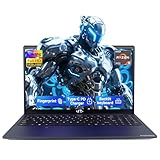
KAIGERR 2026 Gaming Laptop (Ryzen 7 H255, 24GB DDR5)
This is the most complete package on the list: an 8-core/16-thread Ryzen 7 H255 boosting to 4.9GHz, 24GB of DDR5, and Radeon RX Vega 8 graphics on a roomy 16-inch panel. The extra DDR5 capacity is doing real work here, since integrated graphics scale directly with memory bandwidth, and the backlit keyboard and Wi-Fi 6 round out a genuinely well-specified budget machine.
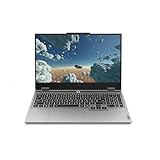
Gaming Laptop, Ryzen 7 H255 with 24GB DDR5
Effectively the same silicon as our top pick in a more conventional chassis, this configuration pairs the Ryzen 7 H255 with 24GB of DDR5 and a 512GB NVMe SSD. It’s a strong choice if you prefer a smaller footprint and want to put every dollar into the components that affect performance rather than screen size.
NIMO 15.6″ IPS FHD Light Gaming Laptop (Ryzen 5 6600H)
The Ryzen 5 6600H is a proper H-series mobile chip rather than a low-power U-series part, which means higher sustained clocks under gaming loads and noticeably better performance in CPU-bound titles. Paired with a 15.6-inch IPS FHD display, it’s the pick for buyers who care about panel quality and consistent frame pacing over headline specs.
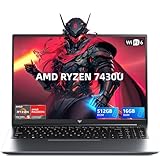
Light Gaming Laptop (Ryzen 7 7430U, 16GB RAM)
The Ryzen 7 7430U is a low-power eight-core chip, so this is best understood as a highly portable machine that handles esports and older titles rather than a dedicated gaming system. Where it earns its place is battery life and thermals — it stays quiet and cool in a way that H-series laptops simply don’t, making it a sensible dual-purpose choice for students.
Tunhail 15.6″ Laptop (16GB RAM, 512GB SSD)
A straightforward 15.6-inch FHD machine with 16GB of RAM, 512GB of storage, and Windows 11 Pro preinstalled, which is a genuinely useful inclusion if you need BitLocker or Remote Desktop. Treat it as a capable all-rounder for lighter gaming and productivity rather than a performance-first pick, and confirm the exact CPU model before ordering.
Frequently Asked Questions
Can you actually game on a laptop under $800 in 2026?
Yes, with realistic expectations. Esports titles — Valorant, CS2, Fortnite, League of Legends, Overwatch 2 — run well at 1080p on modern integrated graphics like Radeon RX Vega 8. Recent AAA releases are a different story and will typically need reduced settings, lower resolution scaling, or upscaling to stay playable.
Is 16GB of RAM enough, or should I pay more for 24GB?
16GB is workable, but 24GB of DDR5 is worth the modest premium on integrated-graphics laptops specifically. Because the iGPU carves its video memory out of system RAM, having more of it — and faster DDR5 rather than DDR4 — translates into measurably better frame rates rather than just smoother multitasking.
What’s the difference between a Ryzen U-series and H-series chip?
U-series processors (like the 7430U) are tuned for low power draw, favouring battery life and quiet operation. H-series chips (like the 6600H and H255) run at higher sustained power limits, delivering better performance under load at the cost of heat, fan noise, and battery life. For gaming, H-series is the stronger choice.
Can I upgrade these laptops later?
It varies by model, but many budget 15.6- and 16-inch chassis include a free M.2 slot and accessible SODIMM memory. Adding a second SSD or more RAM is usually the cheapest way to extend a laptop’s useful life, so it’s worth confirming upgradeability in the product listing before you buy.
Final Thoughts
For most buyers, the KAIGERR 2026 Gaming Laptop is the strongest all-round value here, combining an 8-core Ryzen 7 H255, 24GB of DDR5, and a larger 16-inch display in one package. If you want the same core performance in a more compact form, the Ryzen 7 H255 with 24GB DDR5 configuration delivers nearly identical results, while the NIMO 15.6″ Ryzen 5 6600H is the best choice if display quality and steady, sustained gaming performance matter more to you than raw specification numbers.