🛒 Best Price Today on Amazon
Prime members get fast, free shipping on everything above, plus member-only deals. New members get a 30-day free trial — cancel anytime.
A TDP rating on a CPU cooler is the maker’s estimate of how much heat, in watts, the cooler is meant to handle, but it is not a measured guarantee, and it is not the same thing as the power your processor actually draws. Treat it as a rough sizing hint and compare it with the processor’s real power limits, not just the TDP number printed on the chip box.
What TDP Stands For
TDP means thermal design power. It started as a guideline for engineers: the amount of heat a cooling system should be able to remove so a chip stays within its temperature limits at a typical sustained workload. It is expressed in watts because the heat a chip gives off is close to the electrical power it consumes. For a CPU, the TDP is a label chosen by the chip maker. For a cooler, it is a figure chosen by the cooler maker.

be quiet! Pure Rock 3 LX Black AMD and Intel Air CPU Cooler, 190W TDP, ARGB | Silent 120mm PWM ARGB Fan, 4 High Performance 6mm Heatpipes, HDT Technology, High RAM/VRM Compatibility, Easy Installation
Included for 'What Is TDP Rating on a Cooler? What It Means for Gaming PCs' because the listing specifies 190W TDP and ARGB, details this guide uses to compare options.
View on Amazon
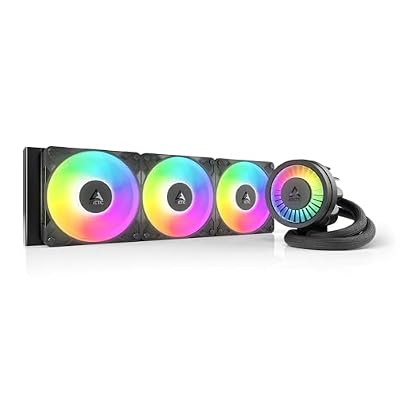
ID-COOLING FX360 LCD 360mm AIO CPU Cooler, 1.48" Customizable LCD Display | 350W TDP, Triple Low Noise ARGB Fans 27.2dB(A) Max. ,supports Intel LGALGA1851/1700/1200/115X and AMD AM5/AM4.
Included for 'What Is TDP Rating on a Cooler? What It Means for Gaming PCs' because the listing specifies 1.48" Customizable LCD Display and 350W TDP, details this guide uses to compare options.
View on Amazon
ID-COOLING FROZN A410 Black CPU Cooler, 220W TDP, 152mm Height | 4×6mm heat pipes, 120mm FDB fan, supports Intel LGA1851/1700/1200/115X and AMD AM5/AM4.
Included for 'What Is TDP Rating on a Cooler? What It Means for Gaming PCs' because the listing specifies 220W TDP and 152mm Height, details this guide uses to compare options.
View on AmazonThere is no single industry test for either one. That is why the numbers are useful as a ballpark and unreliable as an exact specification.
CPU TDP and Cooler TDP Are Different Things
A processor’s TDP does not equal its maximum power draw. Public tech documentation and reviewers show that stock behavior can go well beyond the label. On AMD Ryzen chips, the socket power limit called PPT is higher than the stated TDP. For example, AMD documents a 65W TDP class with a stock power limit of 88W, and a 105W TDP class with a limit of 142W. On Intel chips, the base power and the maximum turbo power are listed separately, and the maximum turbo power can be well above the base figure. Puget Systems, in its Ryzen 9000 analysis, notes that AMD uses TDP as a guide to which cooler suffices, which is not the same as how cooler makers usually mean watts.
Cooler makers also do not agree on how to rate their products. Noctua, for example, has stated it no longer publishes a TDP capability figure for its coolers, because the rating depends on so many conditions. Other makers still print numbers, and those numbers are the maker’s own estimate.
How Cooler TDP Works in Practice
Cooling performance depends on several factors at once: heatsink surface area, number and shape of heat pipes, fan speed and airflow, contact with the processor’s lid, the thermal paste, case airflow and the room temperature. A cooler rated for a given wattage may meet that figure only with its fan at full speed, and then the noise can be high. The same cooler at quieter fan speeds can handle less heat.
A processor spreads its heat over a small area. Chips with chiplet layouts or high boost clocks can reach high temperatures even when the total power looks modest, because the heat is concentrated. A cooler with a generous rating can still allow a hot spot to rise quickly. That is why reviewers measure temperatures and noise rather than rely on the label.
How to Check and Use the Numbers on Your Own PC
- Find the processor’s real power limit. Look up the maker’s product page for your chip. For Intel, note the base power and maximum turbo power. For AMD, find the stock power limit if the maker lists it, or the TDP class and the PPT behavior that reviewers report.
- Find the cooler’s rated capacity. Look at the cooler maker’s product page or manual. Note whether it lists watts, and whether the maker states the test conditions.
- Compare against peak, not base. A cooler rated near the chip’s base TDP may be undersized for sustained all-core loads. Some sources suggest leaving 10 to 20 percent headroom above the peak power, which is a rule of thumb rather than a standard.
- Measure after you build. Use a monitoring tool such as HWiNFO to watch package power and temperature during a game or a stress test. This shows what your actual combination does.
- Check motherboard settings. Many boards ship with power limits relaxed beyond the chip maker’s defaults, which raises heat output. The BIOS may offer a way to set a stock limit. Changing power limits can void warranties and cause instability, so make small conservative changes and follow your motherboard manual.
Quick-Reference Table
| Term | What it means | Use it for |
|---|---|---|
| CPU TDP | Maker’s thermal class label for the chip | Rough guide only |
| Intel base power | Power at base clocks under a defined load | Idle-to-light sustained sizing |
| Intel maximum turbo power | Highest sustained boost power the maker lists | Cooler and PSU sizing |
| AMD PPT | Socket power limit for the CPU | Cooler and PSU sizing |
| Cooler TDP rating | Cooler maker’s own heat handling estimate | Rough comparison within one brand |
| Package power reading | What your CPU draws right now | Real measurement on your system |
| Temperature and noise | Result of the whole cooling setup | The final judge |
Common Misconceptions
- “A cooler with a higher TDP is always better.” Not necessarily. Noise, mounting quality, case fit and airflow matter, and ratings come from different test methods.
- “My CPU will never use more than its TDP.” Boost behavior regularly exceeds the label for periods or for the whole load, depending on the chip and board settings.
- “A cooler matched exactly to the TDP is enough.” A cooler matched to the label has no headroom for boost or a warm room.
- “TDP equals the power supply requirement.” The power supply must cover the entire system, particularly the graphics card, and the CPU’s peak figure is what matters.
- “All cooler TDP numbers can be compared across brands.” They cannot, because there is no shared test.
When to Care and When to Ignore It
Care about cooler ratings if you are building with a high-boost processor, planning an overclock, working in a small case, or aiming for a quiet system. In those situations a cooler with spare capacity lets the fans run slowly. Care also if you reuse an old cooler on a new, hotter processor.
You can mostly ignore the number if you run a modest chip with a sensible mid-range cooler, play at settings that keep the CPU well below its limit, or buy from a cooler maker that publishes a compatibility list for your exact processor. In that case, the maker’s compatibility guidance is more useful than a single watt figure.
Safety and Installation Notes
Switch off and unplug the PC before touching a cooler. Mount the cooler as the maker’s manual describes, with even pressure, and do not overtighten. Check that the cooler supports your socket, such as AM5 or LGA 1851 for recent platforms, and that it fits your case and memory heights. Modifying power limits in the BIOS is at your own risk.
Frequently Asked Questions
Is cooler TDP the same as CPU TDP?
No. CPU TDP is a label from the chip maker, while cooler TDP is the cooler maker’s estimate of heat it can handle. They are measured differently and should be treated as approximate guides.
What TDP cooler do I need for my processor?
Start from the processor’s maximum turbo power or stock power limit, not the base TDP. Choose a cooler whose maker lists it as suitable for your chip and leaves headroom. Then confirm with temperature readings.
Why did Noctua stop listing TDP ratings?
The company has said that such a single figure is misleading because cooling depends on conditions that vary by system. It lists CPU compatibility instead.
Does a higher TDP mean a louder cooler?
Not directly. Larger coolers can often move heat at lower fan speeds, so they can be quieter at the same load, but this depends on fan and heatsink design.
Will a lower-rated cooler damage my CPU?
Modern processors slow down or shut down when they get too hot to protect themselves. An undersized cooler mostly leads to throttling, lower performance and noise, rather than damage.
Do liquid coolers use TDP ratings too?
Some do, mainly through radiator size. The same caution applies, so look at the maker’s compatibility notes and real temperature reports.