🛒 Best Price Today on Amazon
Prime members get fast, free shipping on everything above, plus member-only deals. New members get a 30-day free trial — cancel anytime.
Evaluating the rog ally vs legion go market requires looking at screen size, controller ergonomics, and power draw. Both handheld devices rely on the AMD Ryzen Z1 Extreme processor with Zen 4 architecture and RDNA 3 graphics. Windows 11 allows full access to major game launchers across both compact mobile platforms.
How to Choose Handheld Gaming PCs
Choosing between modern handheld PCs demands evaluating display features, total weight, control options, and storage upgrades. Screen technology alters image quality and motion smoothness, while device weight impacts comfort. Memory speeds and expansion support determine long-term usability in any rog ally vs legion go comparison.
Display Resolution and Variable Refresh Rate
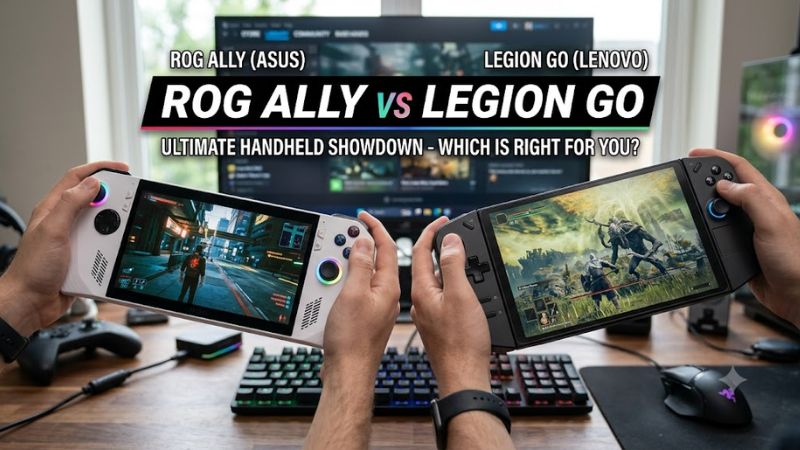
Display specifications represent a major point of differentiation when examining rog ally vs legion go display options. The Asus unit uses a 7-inch 1080p panel running at 120Hz with AMD FreeSync Premium variable refresh rate. In contrast, the Lenovo model features an 8.8-inch 1600p IPS panel operating at 144Hz without variable refresh rate.
Variable refresh rate reduces visual tearing when frame rates fluctuate below target display limits. Running games at native 1600p resolution requires significantly more graphical power from the integrated RDNA 3 graphics engine. Gamers who prioritize screen real estate often favor larger displays over smaller variable refresh panels.
Weight and Long Session Ergonomics
Physical dimension and total mass directly affect handling comfort during extended gaming sessions. Weighing 608 grams, the compact Asus chassis remains significantly lighter than the 854-gram Lenovo counterpart in a physical rog ally vs legion go comparison. Portable gaming hardware requires a balance between screen size and wrist strain.
Larger handheld devices provide wider grip spacing but increase fatigue during unassisted handheld play. Built-in kickstands allow heavy devices to rest on flat surfaces, relieving physical load from your hands. Buyers wanting a traditional console feel without resting accessories typically select lighter chassis designs for daily transport.
Controller Versatility and Extra Inputs
Control layouts shape how players navigate complex strategy titles and competitive shooters. Standard Xbox-style thumbsticks and rear back buttons handle typical action games across modern platforms. Detachable controllers add specialized functionality, including mouse emulation modes with dedicated optical sensors on selected right grips.
Integrated trackpads offer precise cursor navigation inside Windows 11 desktop environments without external mice. Hall Effect analog sticks utilize magnetic sensors to prevent mechanical drift over extended usage. Fixed controller designs offer rigid build integrity, whereas modular systems grant flexible tabletop play setups.
System Memory Speed and SSD Expandability
System RAM speed impacts integrated GPU performance because system memory serves as video memory. Fast LPDDR5X memory running at 7500 MT/s provides extra bandwidth compared to standard LPDDR5 memory at 6400 MT/s. Modern games require at least 16GB of shared system memory to maintain smooth textures at native display resolutions.
Internal storage expansion options vary across standard M.2 NVMe form factors in mobile chassis designs. Compact M.2 2230 drives offer simple replacements, while M.2 2242 drives provide alternative physical dimensions. Checking drive slot compatibility prevents mounting conflicts when installing larger capacity PCIe 4.0 solid state drives.
Top Picks for Handheld Gaming PCs
Selecting the optimal handheld gaming PC involves comparing hardware specifications, port selection, and chassis size against your budget. The following overview details leading models for players considering a rog ally vs legion go purchase. Each entry outlines target users, hardware features, and practical hardware limitations.
| Product | Best For | Key Spec | Compatibility | Watch Out For |
| Asus ROG Ally Z1 Extreme | Overall Balance | 7-in 1080p 120Hz VRR, 16GB LPDDR5 | Windows 11 Home, M.2 2230 | MicroSD slot heat sensitivity |
| Lenovo Legion Go | Display & Versatility | 8.8-in 1600p 144Hz, 16GB LPDDR5X | Windows 11 Home, M.2 2242 | Heavy 854g total weight |
| Valve Steam Deck OLED | Battery & Value | 7.4-in 800p 90Hz OLED, 16GB LPDDR5 | SteamOS 3, M.2 2230 | Native Windows game limits |
| Asus ROG Ally X | RAM & Battery Capacity | 7-in 1080p 120Hz VRR, 24GB LPDDR5X | Windows 11 Home, M.2 2280 | Higher retail price point |
Asus ROG Ally Z1 Extreme
The Asus ROG Ally Z1 Extreme targets gamers seeking maximum frame stability in a lightweight chassis. Powered by an 8-core AMD Ryzen Z1 Extreme chip and 16GB LPDDR5-6400 RAM, it includes a 7-inch 1080p 120Hz VRR IPS screen. In benchmarks by Notebookcheck at 1080p medium settings, it achieved 48 FPS average in Cyberpunk 2077 at 25W TDP.
A primary weakness involves thermal stress near the UHS-II microSD card reader under heavy power loads. The 40Wh battery limits mobile runtime to roughly 90 minutes during high wattage gaming sessions. Users requiring multi-hour unplugged play without external battery packs should look at higher capacity options on the market.
Lenovo Legion Go
The Lenovo Legion Go suits enthusiasts wanting a massive screen and detachable controller inputs. Featuring an 8.8-inch 1600p 144Hz IPS display and 16GB LPDDR5X-7500 RAM, this unit utilizes the AMD Z1 Extreme chip. In benchmarks by Digital Foundry at 1200p medium settings, it delivered 42 FPS average in Shadow of the Tomb Raider at 30W TDP.
Its primary disadvantage is the 854-gram weight, which causes wrist fatigue without using the rear kickstand. The absence of variable refresh rate support can cause visible tearing when frame rates drop below 60 FPS. Buyers seeking a compact travel companion should choose lighter handheld alternatives for single-handed use.
Valve Steam Deck OLED
The Valve Steam Deck OLED appeals to PC gamers desiring rich color output and long battery runtime. Equipped with a custom 6nm AMD APU, 16GB LPDDR5-6400 RAM, and a 7.4-inch 90Hz HDR OLED panel, it delivers deep contrast levels. In benchmarks by Eurogamer at 800p medium settings, it averaged 52 FPS in Control using its 50Wh battery unit.
Running Linux-based SteamOS means certain Windows games with intrusive anti-cheat software will not launch natively. The 1280×800 resolution panel provides lower text clarity compared to full high definition screens. Gamers wanting non-Steam launchers without manual configuration should select a dedicated Windows 11 handheld.
Asus ROG Ally X
The Asus ROG Ally X serves power users who demand expanded memory capacity and doubled battery life. Upgraded with 24GB LPDDR5X-7500 memory, an 80Wh battery, and a standard M.2 2280 NVMe slot, it retains the Z1 Extreme APU. In benchmarks by Tom’s Hardware at 1080p medium settings, it sustained 54 FPS in Forza Horizon 5 at 25W TDP.
The notable downside is its higher retail price compared to earlier handheld generation models. While weighing 678 grams, it adds 70 grams over the original Ally chassis while offering dual USB-C ports including USB4 support. Budget-conscious shoppers may find the premium price tag steep for incremental graphics improvements.
Frequently Asked Questions
Understanding hardware specs, operating systems, and physical dimensions resolves common questions before making a purchase. The following responses address essential technical details that arise during rog ally vs legion go buying decisions. Each answer provides practical guidance on performance, compatibility, and upgrades.
Which device offers better frame rate stability during gaming?
The Asus ROG Ally offers superior frame rate smoothness due to its variable refresh rate display panel. This FreeSync technology matches display refresh rates to GPU frame output between 48Hz and 120Hz, hiding minor stuttering. This performance advantage differs in typical rog ally vs legion go game testing across variable workloads.
The Lenovo Legion Go lacks hardware variable refresh rate support on its 144Hz screen panel. When frame rates drop below display refresh targets, users may notice visual tearing or uneven frame delivery. Setting in-game frame rate caps or lowering render resolutions helps stabilize motion output on fixed refresh displays.
Can you detach controllers on both handheld systems?
Only the Lenovo Legion Go features detachable side controllers similar to modular console pads. The right controller converts into a vertical FPS mouse using an optical sensor on its base plate and bundled plastic dock. The Asus chassis utilizes built-in non-detachable controls integrated into the main body structure.
Fixed controller bodies eliminate loose attachment points and flex along side grip seams over time. Detachable options provide tabletop flexibility, allowing you to position the display screen on a desk while holding controls comfortably. Choosing between these designs depends on whether modular desktop setup modes match your play style.
Do these handheld devices support full Windows 11 software?
Both the Asus and Lenovo handheld devices run standard Windows 11 Home software out of the box. Users can install Xbox Game Pass, Epic Games Store, Steam, and GOG directly without specialized workarounds. Full Windows 11 operating system support allows desktop web browsing and third-party utility installation.
Navigating Windows 11 on touchscreens requires custom control overlay software from device manufacturers. Asus uses Armoury Crate SE, while Lenovo uses Legion Space to manage system power profiles and control bindings. Regular Windows updates keep security definitions current across both handheld computer platforms.
What SSD sizes are compatible with each device?
The Asus ROG Ally uses M.2 2230 NVMe SSDs, whereas the Lenovo Legion Go uses M.2 2242 drives. Installing alternative form factor drives requires specialized aftermarket adapters that may void manufacturer warranties. Both handheld systems support PCIe 4.0 expansion speeds for rapid game loading times.
Upgrading internal storage involves removing rear casing screws and disconnecting the internal battery cable. MicroSD expansion slots on both models offer secondary storage without opening device enclosures. UHS-II microSD cards reach transfer rates up to 312 MB/s for quick media access and extra library space.
Final Thoughts
Choosing the right handheld gaming PC comes down to display preference, physical weight, and variable refresh rate support. The Asus ROG Ally delivers smooth gameplay with VRR in a compact chassis, while the Lenovo Legion Go offers a massive screen and modular controls. Evaluate your travel needs when deciding on a rog ally vs legion go purchase today.