🛒 Best Price Today on Amazon
Prime members get fast, free shipping on everything above, plus member-only deals. New members get a 30-day free trial — cancel anytime.
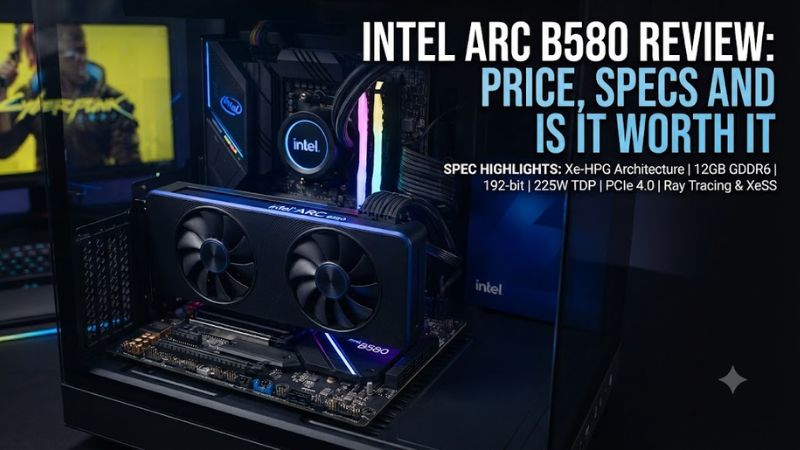
The Intel Arc B580 review: price, specs and is it worth it question comes down to affordable 1440p gaming, memory capacity, and driver compatibility. Intel’s Battlemage graphics card launched at a $249 MSRP, with 12GB of GDDR6 memory and a 190W board-power rating. Its value remains compelling, but actual retail prices and game performance matter before buying.
How to Choose a Budget Gaming Graphics Card
The right graphics card depends on your target resolution, preferred games, power supply, and the price available at checkout. The Arc B580 is particularly interesting for players who want more than 8GB of video memory without moving into a more expensive category. Independent reviews show that its advantage varies by game, settings, and resolution, so a single average cannot describe every experience.
Choose a Card for Your Gaming Resolution
For 1080p gaming, the B580 provides enough graphics capability for many demanding games at high settings, although frame rates depend on the game engine and processor. Its 12GB memory capacity also offers room for detailed textures. Competitive games with low graphics settings may instead benefit more from a faster CPU or a graphics card with better performance in the specific game.
For 1440p, the B580 becomes more interesting because its memory capacity and bandwidth can help in demanding titles. Tom’s Hardware reported an approximately 10% rasterization advantage over the GeForce RTX 4060 at 1440p Ultra across its test suite. That result applies to the review’s selected games and configuration, rather than every title or future release.
Consider the Price Beyond MSRP
Intel introduced the B580 at $249, positioning it as a budget-oriented discrete graphics card. However, launch pricing is not the same as a current retail quote. Stock, board-partner models, local taxes, and retailer promotions can all change the final cost, so compare actual listings rather than assuming every card remains available at its original price.
A sensible purchase also accounts for the complete PC budget. A new graphics card may require a better power supply or a larger case, and those expenses can narrow the gap between competing models. If the B580 is significantly above its original MSRP, compare newer alternatives and discounted previous-generation cards before deciding that its memory capacity makes it the better deal.
Check Platform and Power Compatibility
The reference Arc B580 uses a PCI Express 4.0 x8 interface, a single eight-pin power connector, and a 190W total board-power rating. Intel specifies a minimum 600W power supply for its reference card. Check the particular manufacturer’s specifications because cooler dimensions, connector placement, and power requirements can vary between partner models.
Intel recommends a full-size PCIe 3.0 or newer slot and enabling Resizable BAR for the intended performance. The card is compatible with supported Windows 10 64-bit 22H2-or-newer systems, Windows 11 64-bit, and Ubuntu 22.04 or newer according to Intel’s desktop quick-start guidance. Confirm motherboard firmware support and available case clearance before purchasing.
Match the Card to Your Preferred Features
The B580 supports hardware ray tracing, Intel XeSS upscaling, DirectX 12 Ultimate, and hardware encoding and decoding for AV1, H.264, and H.265. These features make it useful beyond conventional rasterized gaming, including video playback and recording. However, feature availability does not mean that performance matches competing GPUs in every application or ray-traced game.
NVIDIA’s DLSS ecosystem and software support may matter more to players who prioritize particular upscaling modes, creator applications, or ray-tracing performance. AMD cards can also be attractive depending on game support and sale pricing. Choose according to the games and applications you actually use, not the number of supported technologies listed on a product page.
Top Picks: Where the Arc B580 Fits
The Intel Arc B580 is a strong candidate for a budget gaming PC, but its value depends on real-world performance and the CPU in the system. The comparisons below use manufacturer specifications and independent review data, not direct testing by PC Gaming Universe. Benchmark results are meaningful only when resolution, graphics settings, drivers, and the rest of the system are considered together.
Best Overall: Intel Arc B580
The B580 is the most straightforward choice for a buyer who prioritizes 12GB of VRAM and affordable 1440p gaming. Intel specifies 20 Xe-cores, a 2,670MHz graphics clock, 456GB/s of memory bandwidth, and 190W total board power. Its 192-bit memory interface gives it a useful advantage over several competing cards with narrower memory configurations.
Its main weakness is inconsistent performance across games, including some CPU-limited scenarios. TechSpot’s follow-up analysis found that pairing the card with a Ryzen 5 5600 reduced its average performance across a 12-game suite by 18% compared with the Ryzen 7 9800X3D configuration. Buyers with older processors should consider those findings before upgrading.
Best Value Alternative: NVIDIA GeForce RTX 4060
The RTX 4060 is worth comparing when its actual retail price is close to the B580’s. Its 8GB VRAM capacity can constrain demanding games at higher settings, but NVIDIA’s DLSS ecosystem, broad software support, and competitive efficiency can make it a more practical choice for some systems. Its appeal is not limited to average frame rates.
The limitation is memory capacity, particularly when playing newer games with high-resolution textures. In TechSpot’s 50-game comparison, the B580 performed about 5% faster on average at 1440p, while the two cards were nearly even at 1080p. Those results came from a Ryzen 7 9800X3D system and should not be treated as universal outcomes.
Best For Budget 1080p: AMD Radeon RX 7600
The Radeon RX 7600 remains relevant when discounts make it cheaper than the B580. Its 8GB of VRAM is adequate for many 1080p games, especially when using sensible texture settings. Buyers who primarily play competitive titles should compare performance in their actual game library instead of relying exclusively on demanding AAA benchmarks.
Its weakness becomes more apparent in games where memory capacity affects performance at high settings. TechSpot’s 12-game comparison found the B580 ahead by 8% at 1080p and 21% at 1440p on average. These figures describe that particular review suite, and individual games can produce substantially different results.
Best For More VRAM: AMD Radeon RX 7600 XT
The RX 7600 XT is another option for players who want additional video memory. Its 16GB capacity can be helpful for texture-heavy games and some creative workloads, although extra memory does not automatically produce higher frame rates. Buyers should weigh its price premium against its performance in the games they play.
The trade-off is that a larger memory buffer does not always translate into a faster GPU. In Tom’s Hardware’s comparison, the B580 led the RX 7600 XT by around 4% at 1440p Ultra in rasterized gaming. Before choosing either card, compare the exact board model, cooler size, power requirements, and local retail price.
| Product | Best For | Key Spec | Compatibility | Watch Out For |
| Intel Arc B580 | Overall budget gaming | 12GB GDDR6; 190W | PCIe slot; 8-pin power; ReBAR recommended | Driver and CPU overhead differences |
| NVIDIA RTX 4060 | NVIDIA features and efficiency | 8GB GDDR6 | Check model-specific PSU and connector | VRAM limits in demanding games |
| AMD Radeon RX 7600 | Discounted 1080p builds | 8GB GDDR6 | Check model-specific PSU and connector | High-resolution texture limits |
| AMD Radeon RX 7600 XT | Larger memory capacity | 16GB GDDR6 | Check model-specific PSU and connector | Higher cost may not improve every game |
Benchmark Results: What the Numbers Mean
Tom’s Hardware’s Arc B580 review used a 17-game rasterization suite, reporting approximately 10% higher performance than the RTX 4060 at 1440p Ultra and roughly 3% at 1080p Ultra. The test settings were Ultra for both resolutions, and the source was Tom’s Hardware’s published game suite. These are aggregate comparisons, not guaranteed frame rates in an individual title.
CPU choice is another important consideration. TechSpot’s follow-up comparison found that the B580 lost 18% of its average performance when moving from a Ryzen 7 9800X3D to a Ryzen 5 5600 across its 12-game suite. That comparison used the same game set and review methodology to examine CPU overhead. It illustrates why buyers should assess the processor alongside the graphics card.
Who Should Buy the Intel Arc B580?
The B580 is a sensible candidate for gamers building a budget PC around 1080p or 1440p, particularly those who value 12GB of memory and can buy the card near its intended price tier. It also offers AV1 hardware encoding, which may interest people who record gameplay or produce video content. Confirm application support before choosing it for a creator-focused system.
It is less compelling for buyers who need predictable performance across a specific collection of older games, rely heavily on ray tracing, or have a CPU that exposes Arc’s overhead limitations. It is also not an ideal purchase at an inflated price simply because its memory capacity looks attractive. Compare current alternatives and independent results for the exact games you play.
FAQ
Is the Intel Arc B580 worth buying in 2026?
Yes, the Intel Arc B580 can be worth buying in 2026 if its retail price is competitive and your PC meets Intel’s platform recommendations. Its 12GB of GDDR6 memory, 1440p rasterization performance, and $249 launch MSRP made it an attractive budget option. However, the launch MSRP is not a verified current selling price, and newer alternatives or discounts may change the value comparison.
How much VRAM does the Intel Arc B580 have?
The Intel Arc B580 has 12GB of GDDR6 memory connected through a 192-bit interface. Intel lists memory bandwidth at 456GB/s and memory speed at 19Gbps. This capacity can help in games that exceed an 8GB graphics card’s available memory, but performance still depends on the GPU, game engine, settings, and driver support.
What power supply does the Intel Arc B580 require?
Intel specifies a minimum 600W power supply and one eight-pin power connector for its reference B580 card. Its total board-power rating is 190W, and its PCI Express interface uses PCIe 4.0 x8. Check the manufacturer’s requirements for your exact card model, available PSU cables, case clearance, and motherboard support before installation.
Does the Intel Arc B580 support ray tracing and XeSS?
Yes, the Intel Arc B580 supports hardware ray tracing and Intel XeSS upscaling. However, its ray-tracing performance varies by game and can trail competing graphics cards in demanding workloads. XeSS support also depends on the game, and upscaling quality and frame-rate gains vary with resolution, preset, and implementation.
Final Thoughts
The Intel Arc B580 review: price, specs and is it worth it verdict is favorable for budget gamers who want 12GB of VRAM and capable 1440p performance. Its weaknesses include inconsistent game performance, CPU overhead in some scenarios, and less competitive ray tracing in certain titles. Buy it when the price and your system make sense, not on specifications alone.