🛒 Best Price Today on Amazon
Prime members get fast, free shipping on everything above, plus member-only deals. New members get a 30-day free trial — cancel anytime.
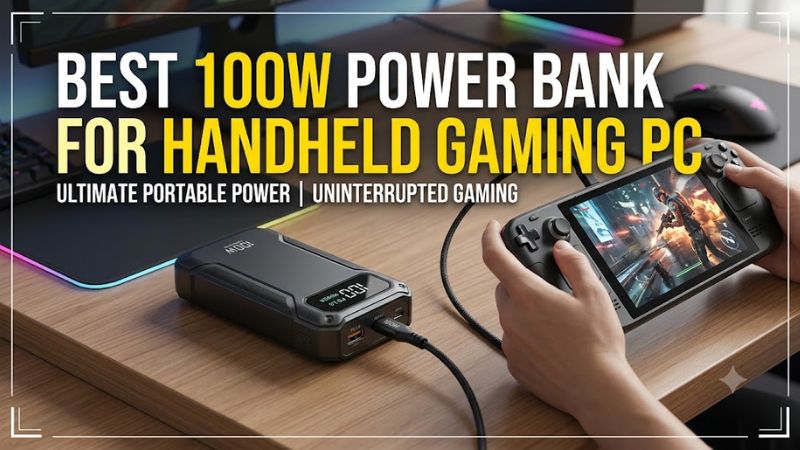
Choosing the best 100w power bank for handheld gaming pc use means balancing USB-C charging speed, battery capacity, portability, and device compatibility. UGREEN Nexode, Baseus Blade, and Anker’s 25,000mAh power bank stand out for their documented output specifications and practical capacity, but each suits a different type of gaming setup.
How to Choose a 100W Power Bank for Handheld Gaming
A 100W power bank provides more charging headroom than most handheld gaming PCs require, but that does not automatically make every model suitable. The important factors are single-port USB-C Power Delivery output, stored energy in watt-hours, charging compatibility, and physical size. Understanding these specifications helps avoid buying an expensive battery that cannot keep your handheld powered during demanding games.
1. Check USB-C Power Delivery Output
USB-C Power Delivery (PD) is the most important specification when choosing a portable charger for a gaming handheld. A power bank advertised as 100W should deliver that output through an individual USB-C port, rather than relying on its combined output across several connections.
Different handhelds have different charging requirements. The Steam Deck uses a 45W USB-C power supply, while the ASUS ROG Ally and Lenovo Legion Go use 65W adapters. A 100W-capable power bank provides additional headroom, although the handheld only draws the power its charging system supports.
2. Compare Battery Capacity in Watt-Hours
Milliamp-hours (mAh) are commonly displayed on power bank packaging, but watt-hours (Wh) provide a more useful comparison of stored energy. Battery voltage affects the relationship between these measurements, so two power banks with similar mAh ratings do not necessarily hold identical amounts of energy.
For handheld gaming, 20,000mAh models typically offer a useful balance between capacity and portability. A 25,000mAh model can provide additional energy for longer trips, although it usually weighs more. Remember that conversion losses mean the energy delivered to your handheld will be lower than the battery’s rated capacity.
3. Consider Weight, Dimensions, and Ports
A large power bank can extend gaming sessions, but portability matters when carrying a handheld, protective case, charging cable, and other accessories. Slim designs fit more easily into laptop bags, while thicker models may be better suited to a backpack or travel compartment.
Port selection also affects convenience. Two USB-C ports let you charge a handheld and another device without constantly switching cables. However, check the power distribution specifications because connecting multiple devices can reduce the output available to each port.
4. Check Charging Standards and Airline Restrictions
A power bank must support compatible USB-C PD charging profiles to deliver its advertised output to a handheld. A 100W rating alone does not establish compatibility with every device or charging mode. Use a suitable USB-C-to-USB-C cable rated for the required power, preferably the manufacturer’s supplied cable.
Travel requirements also matter. The FAA permits power banks rated up to 100Wh in carry-on baggage, while batteries between 101Wh and 160Wh require airline approval. Power banks must not go in checked baggage. Always check the airline’s individual requirements before traveling.
Top 100W Power Banks for Handheld Gaming PCs
The strongest choices are not necessarily the power banks with the largest advertised wattage. A good handheld charging solution needs sufficient single-port output, useful energy capacity, and a manageable carrying weight. The following three models have documented specifications that make them relevant to Steam Deck, ROG Ally, and other USB-C-powered gaming handhelds.
1. UGREEN Nexode 20,000mAh 100W – Best Overall
The UGREEN Nexode 20,000mAh 100W is a strong all-around choice for handheld owners who want high USB-C output without carrying a particularly large battery. Its 72Wh capacity and 420g weight provide a practical combination of stored energy and portability for everyday gaming and travel.
Its USB-C1 port supports up to 100W output, while USB-C2 supports up to 30W. The additional USB-A port supports up to 22.5W. This arrangement makes the bank useful for charging a handheld alongside a phone or smaller accessory, although the available output is shared when multiple devices are connected.
The main advantage is its relatively compact capacity-to-weight balance. The 65W maximum input also supports faster recharging than many basic portable chargers. However, its 20,000mAh capacity is smaller than the 25,000mAh alternatives, and the secondary USB-C port cannot independently provide 100W.
Choose this model if you primarily use a Steam Deck, ROG Ally, or Legion Go and want a portable charging solution with additional device compatibility. Consider a larger alternative if you regularly travel for extended periods without access to wall outlets.
2. Anker Laptop Power Bank 25K, 165W – Best for Longer Trips
The Anker Laptop Power Bank 25K is a higher-capacity option for users who want to charge a gaming handheld and other electronics during longer trips. Although its combined output reaches 165W rather than 100W, each USB-C port supports up to 100W, making it suitable for this category.
Its main specifications include 25,000mAh capacity, approximately 90Wh of stored energy, three USB-C connections, and one USB-A connection. It also includes built-in USB-C cables, including a retractable cable, and a display that provides charging information. These features reduce the number of separate accessories needed when traveling.
The additional capacity is useful when gaming away from a wall outlet, while the individual 100W USB-C outputs provide flexibility across different devices. Its main disadvantage is weight: approximately 595g makes it noticeably heavier than the UGREEN Nexode. Its larger physical size may also be inconvenient for compact handheld carrying cases.
Choose this power bank if you regularly travel with a handheld, smartphone, and laptop. Steam Deck owners who only need occasional additional charging may find its extra capacity and weight unnecessary.
3. Baseus Blade 20,000mAh 100W – Best Slim Design
The Baseus Blade 100W is designed for users who prefer a flatter power bank that can fit alongside a handheld or laptop inside a travel bag. Its 20,000mAh battery provides 74Wh of rated energy, while its USB-C output supports up to 100W through a single port.
Its connection layout includes two USB-C ports and two USB-A ports, providing flexibility for charging several accessories. Baseus also specifies a maximum 65W USB-C input, which allows the power bank to recharge faster when paired with a compatible wall charger. The digital display provides a convenient way to monitor remaining battery capacity and charging information.
Its biggest strength is the slim profile, measuring approximately 16.2 × 13.4 × 1.8cm. However, the original Blade weighs approximately 506g, so its flat construction does not make it particularly lightweight. It also has less total energy capacity than Anker’s 25,000mAh model.
Choose the Baseus Blade if you want a flat charging solution that fits naturally into a laptop bag. If minimizing weight or maximizing battery capacity matters more, the UGREEN or Anker alternatives may be more appropriate.
Comparison Table: Which Power Bank Should You Choose?
| Product | Best For | Key Spec | Compatibility | Watch Out For |
| UGREEN Nexode 20K 100W | Best overall | 72Wh, 100W USB-C1, 420g | USB-C PD handhelds | Smaller capacity |
| Anker Laptop Power Bank 25K | Longer trips | 90Wh, 100W per USB-C port, 595g | USB-C PD handhelds and laptops | Heavier design |
| Baseus Blade 20K 100W | Slim portability | 74Wh, 100W USB-C, 506g | USB-C PD handhelds | Relatively wide body |
Specifications reflect manufacturer-published information. Combined output and individual port output are different ratings.
Which One Offers the Best Value?
The UGREEN Nexode is the most balanced choice if your priority is charging a handheld without carrying unnecessary bulk. Its 72Wh capacity is sufficient for meaningful additional charging, and its 420g weight is lower than the other two options.
The Anker model makes more sense when capacity and multi-device charging are important. Its 90Wh rating also remains below the FAA’s standard 100Wh threshold for spare batteries, although individual airline restrictions still apply.
The Baseus Blade occupies a different position. Its flat construction and four charging connections make it convenient for people who already carry a laptop bag. The choice ultimately depends on whether capacity, weight, or physical design matters most.
FAQ
1. Is a 100W Power Bank Enough for a Steam Deck?
Yes, a 100W USB-C PD power bank provides more than enough maximum output for the Steam Deck’s 45W charging requirement. The Steam Deck does not consume the full 100W simply because the power bank supports it. Instead, the device negotiates an appropriate charging rate through USB-C Power Delivery.
A suitable power bank can charge the Steam Deck while you play, although actual battery charging speed depends on game workload, battery condition, and power consumption. A compatible USB-C cable is also necessary to achieve the expected charging rate.
2. Can a 100W Power Bank Run an ROG Ally While Gaming?
Yes, a compatible 100W USB-C PD power bank can supply sufficient charging power for many ROG Ally configurations. The standard ROG Ally uses a 65W USB-C adapter, so a 100W-capable bank provides additional output headroom.
However, the actual charging behavior depends on the operating mode and power consumption. Demanding games and higher-performance settings can increase energy use, potentially slowing battery charging. Check the power bank’s single-port output rather than relying on its advertised combined wattage.
3. How Many Hours of Gaming Can a 20,000mAh Power Bank Provide?
A 20,000mAh power bank rated at approximately 72–74Wh can provide a meaningful additional gaming session, but exact runtime depends on the handheld’s battery size and power consumption.
For example, the Steam Deck OLED has a 50Wh internal battery, while the original ROG Ally has a 40Wh battery. Conversion losses reduce the energy available from an external power bank, so a 72Wh model cannot deliver 72Wh directly to the handheld. Screen brightness, game settings, processor load, and battery condition also influence the result.
4. Can You Take a 100W Power Bank on an Airplane?
Yes, provided its battery capacity is within the airline’s permitted watt-hour limits. The important specification is Wh, not the 100W output rating printed on the packaging.
Under FAA guidance, power banks up to 100Wh can generally travel in carry-on baggage without airline approval. Models between 101Wh and 160Wh require airline approval, while larger batteries are generally prohibited. Keep power banks in your cabin baggage and check your airline’s additional restrictions before departure.
Final Thoughts
The best 100w power bank for handheld gaming pc use depends on how much additional battery capacity you need and how often you travel. UGREEN offers the strongest overall balance, Anker suits longer trips, and Baseus provides a slim alternative. Check your handheld’s charging requirements and the power bank’s Wh rating before purchasing.