Quick Answer
The Rode NT-USB Mini is the compact USB microphone to buy if you want clean, broadcast-style voice for gaming, streaming or podcasting with almost no setup: a cardioid condenser capsule, an in-built pop filter and zero-latency headphone monitoring cover the things that actually shape your sound. It skips an on-mic gain knob and mute button, so levels live in your software instead. For a small desk and a single speaker, it remains the benchmark in its class.
Introduction
Choosing a first standalone microphone usually comes down to one uncomfortable trade: the mics that sound the most professional tend to demand interfaces, gain staging and patience, while the truly plug-and-play models often cut corners on monitoring or build. The Rode NT-USB Mini built its reputation by refusing that trade, packing a proper condenser capsule and a headphone amplifier into a body barely taller than a coffee mug.
This review is for gamers tired of headset microphones, new streamers and podcasters recording one voice at a desk, and anyone joining calls all day who wants to sound clear without running a studio. Every microphone covered here was selected from its Amazon product page, using the listing’s own specifications and stated features, and each one is a compact USB condenser aimed at the same desk-bound job.
Quick Picks
As an Amazon Associate we earn from qualifying purchases.
| Product | Best for | Key spec from title |
|---|---|---|
| Rode NT-USB Mini | Most desk setups wanting monitoring | Studio-quality condenser USB microphone |
| HyperX SoloCast | Hi-res recording with tap-to-mute | 24-bit/96 kHz USB condenser, cardioid |
| Razer Seiren Mini | Noisy rooms and tight desks | Supercardioid pickup pattern, 14mm capsule |
| Blue Yeti Nano | Solo and two-person recording | Premium dual-pattern USB microphone |
How to Choose
Pickup pattern decides how much of your room gets recorded
A cardioid microphone listens mainly to what sits in front of it and rejects sound from behind, which is why every model here leads with it. Supercardioid, as on the Razer Seiren Mini, narrows that window further and suits untreated rooms with keyboards and fans nearby. The Blue Yeti Nano adds an omnidirectional mode that hears in every direction for two people sharing one mic. Decide based on your space first: a quiet room rewards cardioid clarity, while a shared or noisy room pushes you toward a tighter pattern and closer placement.
Headphone monitoring is the feature that separates these mics
Zero-latency monitoring lets you hear your own voice through headphones plugged into the microphone itself, with no echo or delay, so you catch mumbling, pops and drifting distance before your audience does. The NT-USB Mini and the Yeti Nano both provide a 3.5mm headphone output; the SoloCast and Seiren Mini leave it out entirely, which means you monitor through your computer with a slight delay or not at all. If you game with headphones on for hours, treat a headphone jack on the mic as close to mandatory rather than a bonus.
Bit depth and sample rate matter less than placement
All four microphones record at 48 kHz, the standard for video and streaming, and three of them capture at 24-bit, which gives editing headroom for compression and noise reduction later. The HyperX SoloCast goes further with 24-bit/96 kHz recording, useful if you process vocals heavily or record instruments. The Seiren Mini records at 16-bit, perfectly serviceable for live voice chat where nothing gets edited. In practice, speaking six inches from the capsule improves any of these microphones more than a higher sample rate ever will, so do not pay for numbers before fixing distance.
Controls and mounting decide how the mic lives on your desk
Think about the small interactions you repeat daily. A tap-to-mute sensor, like the SoloCast’s, prevents coughs and doorbells reaching your stream; a physical volume dial, like the NT-USB Mini’s headphone knob, gets used constantly. None of these microphones offers an on-mic gain control, so input level is set in your operating system or app. Mounting matters too: each includes a desk stand, and each can move to a boom arm later, but the NT-USB Mini’s magnetic detachable stand makes that swap, and everyday repositioning, noticeably quicker.
The 4 Best Options
Rode NT-USB Mini

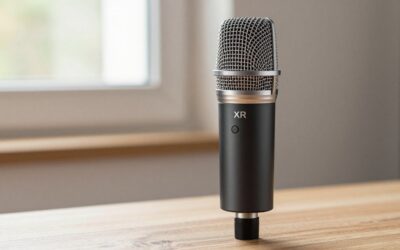
The NT-USB Mini earns its top spot by doing the unglamorous things properly. Its electret condenser capsule has a smooth, flat-ish response that flatters speech without the harsh top end cheaper USB mics often add, and the in-built pop filter softens plosives before they hit the recording. The headphone amplifier is genuinely useful, with a precision level control and switchable zero-latency monitoring, and the in-built DSP unlocked through the free RØDE Connect software adds a noise gate, compressor and APHEX processing for streamers who want a produced sound without learning a digital audio workstation.
Specs
- Electret condenser capsule, cardioid polar pattern
- Frequency response: 20Hz – 20kHz
- Recording resolution: 24-bit / 48 kHz
- Max SPL: 121dB
- USB-C output, class-compliant, no drivers needed
- 3.5mm headphone output with volume control and zero-latency monitoring
- In-built pop filter and in-built DSP via RØDE Connect
- Detachable magnetic desk stand with 360-degree swing mount
- Includes SC20 USB-C to USB-A cable and thread mount adaptor
- Model NTUSBMINI, weight 585 g
Best for: Gamers, streamers and podcasters who want one compact mic that monitors properly and grows with free software processing.
Watch out for: There is no mute button and no gain knob on the microphone, so muting and input level are handled in your apps.
ASIN: B084P1CXFD
HyperX SoloCast

The SoloCast is the minimalist alternative: a small cardioid condenser with one party trick, a tap-to-mute sensor on top with an LED status indicator, which streamers genuinely use mid-game. Its headline specification is hi-res 24-bit/96 kHz recording, the highest resolution in this group, delivered over a USB-C connection to PC, PlayStation or Mac. The flexible stand tilts toward your mouth and the mount accepts standard threads for a boom arm. What you give up is monitoring: there is no headphone output at all, so you cannot hear yourself without delay through the mic.
Specs
- Condenser capsule, cardioid polar pattern
- Recording resolution: 24-bit / 96 kHz
- Tap-to-mute sensor with LED status indicator
- USB-C connection, plug and play
- Compatible with PC, PS4, PS5 and Mac
- Adjustable stand with built-in 3/8-inch and 5/8-inch mount threads
- Customisable via HyperX NGENUITY software
- Includes USB Type-C to USB-A cable (2 m)
- Model HMIS1X-XX-BK/G, weight 261 g
Best for: Streamers who want tap-to-mute and hi-res recording in the smallest, simplest package.
Watch out for: No headphone jack means no zero-latency monitoring of your own voice.
ASIN: B08KFL3SFV
Razer Seiren Mini

Razer’s entry takes the opposite approach to the Rode: instead of adding features, it tightens the pickup. The supercardioid pattern focuses on a narrow cone in front of the 14mm condenser capsule, rejecting keyboard clatter and room echo from the sides better than a standard cardioid at the same distance, which makes it a smart pick for untreated bedrooms and shared spaces. A built-in shockmount calms desk bumps, and the heavy-duty tilting stand detaches for boom arm use. The compromises are real, though: recording is 16-bit, there is no headphone output, and there are no controls on the microphone whatsoever.
Specs
- 14mm condenser capsule, supercardioid polar pattern
- Frequency response: 20Hz – 20kHz
- Recording resolution: 48 kHz / 16-bit
- Max SPL: 110dB
- Built-in shockmount to dampen knocks and bumps
- Heavy-duty tilting stand, detachable for 5/8-inch boom arms
- USB plug and play for PC, Mac and PS4
- Includes support rod, desk stand base and Micro USB to USB cable
- Height on stand: 162.5 mm
Best for: Gamers and streamers in noisy or echo-prone rooms who need maximum background rejection.
Watch out for: No mute control, no headphone monitoring and 16-bit recording; everything is adjusted in software.
ASIN: B08HH3FTYT
Blue Yeti Nano

The Yeti Nano is the flexible option in this group and the only one offering two pickup patterns: cardioid for solo work and omnidirectional for two people across a table or a group call around one microphone. It matches the Rode on 24-bit/48 kHz recording and includes a headphone output with no-latency monitoring, plus an onboard button that combines volume control and mute, something the NT-USB Mini notably lacks. Support for Blue VOICE software adds broadcast effects and voice modulation. It is a bigger, more traditional desktop microphone than the other three, so it asks for more desk space in return for that versatility.
Specs
- Dual-capsule condenser design, cardioid and omnidirectional patterns
- Recording resolution: 24-bit / 48 kHz
- Headphone output with no-latency monitoring
- Onboard volume and mute control
- Blue VOICE software support for effects and processing
- Plug and play for PC and Mac
- Includes desktop stand and USB cable
- Model 988-000088 (Shadow Grey)
Best for: Podcasters and callers who sometimes record solo and sometimes share the mic with a second person.
Watch out for: The omnidirectional mode captures the whole room, and the body is bulkier than the compact minis.
ASIN: B07DTTGZ7M
Which One Fits Your Situation
You game and stream from a small desk
Pick the Rode NT-USB Mini. It occupies almost no space, the magnetic stand lifts off in a second when you need the desk back, and the headphone output means your monitoring setup stays simple. Its cardioid capsule and built-in pop filter handle close-up gaming voice chat and commentary without extra accessories, and RØDE Connect’s noise gate helps when the room is not silent.
Your room is noisy and completely untreated
Start with the Razer Seiren Mini, whose supercardioid pattern rejects more side noise than the cardioid models, provided you can position it close to your mouth. If you also need headphone monitoring, choose the NT-USB Mini instead and lean on its software noise gate. Either way, distance matters more than the microphone: six inches away beats any specification on this page.
You record conversations, not just yourself
The Blue Yeti Nano is the only sensible choice here because its omnidirectional pattern hears a second person sitting opposite without either of you leaning into a cardioid mic’s narrow sweet spot. For interviews, co-hosted podcasts and family calls around one desk, that flexibility outweighs the Nano’s larger footprint, and you keep cardioid mode for solo sessions.
You edit and process your voice afterwards
The HyperX SoloCast’s 24-bit/96 kHz recording gives the most headroom for compression, EQ and noise reduction in post-production, and its tap-to-mute keeps accidents out of the raw file. The NT-USB Mini runs it close with 24-bit recording plus its DSP chain, so choose the SoloCast for resolution and the Rode for live monitoring while you record.
Common Mistakes
- Sitting too far from the microphone: every mic here sounds thin and roomy past arm’s length, whatever its specifications promise.
- Buying on sample rate alone: 96 kHz recording cannot fix bad placement, echo or a loud room.
- Forgetting the mute path: the NT-USB Mini and Seiren Mini have no mute control, so set a push-to-mute hotkey in your app before going live.
- Leaving the mic on a hard desk beside a mechanical keyboard without a shockmount or stand isolation, then blaming the capsule for the thumps.
- Recording two people into a cardioid-only microphone and expecting both voices to sound equally present.
Frequently Asked Questions
Is the Rode NT-USB Mini good for gaming and Discord?
Yes. It is class-compliant, so Discord, TeamSpeak and every major game launcher recognise it the moment it is plugged in, with no drivers to install. The cardioid pattern focuses on your voice rather than your keyboard, and the headphone output lets you monitor yourself during long sessions. Set the input level in your system sound settings once and it simply stays out of the way.
Does the NT-USB Mini need software or drivers?
No software is required for basic use: plug the USB-C cable into a PC, Mac or compatible tablet and it works immediately. The free RØDE Connect application is optional but worthwhile, because it unlocks the microphone’s built-in DSP, including a noise gate, a compressor and APHEX Aural Exciter and Big Bottom processing, and it can record several compatible RØDE microphones at once for multi-person podcasts.
Can you hear yourself through the NT-USB Mini while recording?
Yes, and this is one of its strongest features. The 3.5mm headphone output on the microphone provides zero-latency monitoring, meaning your voice reaches your headphones instantly with no echo, and a dedicated knob controls the monitoring level. That direct feedback helps you keep a consistent distance from the capsule and catch problems like pops or clipping while they happen, not after the recording ends.
Rode NT-USB Mini or HyperX SoloCast: which should you buy?
Choose the NT-USB Mini if headphone monitoring, a built-in pop filter and software DSP matter to you, because the SoloCast offers none of those. Choose the SoloCast if you value a tap-to-mute sensor and 24-bit/96 kHz recording in a lighter, simpler microphone and you never monitor your own voice. For most desk setups, the Rode’s monitoring alone justifies picking it, but streamers who mute constantly may prefer the HyperX.