🛒 Best Price Today on Amazon
Prime members get fast, free shipping on everything above, plus member-only deals. New members get a 30-day free trial — cancel anytime.
The best dynamic XLR microphones for streaming in 2026 are the Shure SM7B for broadcast-style voice, the Shure SM7dB if you want that sound without buying a separate inline booster, and the Rode PodMic for a lower-cost path to the same end-address dynamic sound; but the right pick depends just as much on whether your audio interface has enough clean gain. Dynamic mics reject keyboard and room noise better than condensers, yet many of them are quiet, and pairing one with a weak preamp is the most common reason streamers end up with a hissy voice track.
This guide explains the gain math, maps microphones to interfaces, and compares the main options for streaming and podcasting.
Why Dynamic XLR Mics Suit Streaming
A dynamic capsule needs a loud, close source to produce a strong signal. That sounds like a weakness, but for streaming it is the main benefit: your voice at 5–10 cm dominates, while mechanical keyboard clicks at 40 cm and a PC fan at 1 m fall away. An XLR mic for streaming also separates the microphone from the converter, so you can upgrade the interface later or add a hardware mixer without changing mics.
The Gain Problem, Worked Out
Mic sensitivity tells you how much voltage the mic produces at a reference sound pressure of 94 dB SPL. Normal speech at 5–10 cm from the capsule often measures roughly 80–88 dB SPL, so the mic produces less than its rated sensitivity during a stream.
| Microphone | Sensitivity (dBV/Pa) | Approx. output at 84 dB SPL | Gain needed to reach about -10 dBV |
|---|---|---|---|
| Shure SM7B | -59 | -69 dBV | ~59 dB |
| Electro-Voice RE20 | -57 | -67 dBV | ~57 dB |
| Rode PodMic | -57 | -67 dBV | ~57 dB |
| Shure SM58 | -54.5 | -64.5 dBV | ~54.5 dB |
| Audio-Technica AT2040 | -53 | -63 dBV | ~53 dB |
Around -10 dBV is a reasonable working level that puts typical speech near -18 to -12 dBFS on most interfaces, leaving room for laughs and shouts without clipping. Interface preamps tend to get noisy in their top 10 dB of range. If an interface offers 56 dB of maximum gain, running an SM7B near that ceiling will work but adds audible hiss under quiet passages. The practical rule: choose an interface with at least 10 dB more gain than the table shows, or add an inline booster.
Interface and booster pairings
| Signal chain | Approx. clean gain available | Works well with |
|---|---|---|
| Entry interface with ~56 dB gain | ~46 dB clean | AT2040, SM58 at close distance |
| Interface with ~69 dB gain (e.g. Focusrite Scarlett Solo 4th Gen) | ~59 dB clean | PodMic, RE20, SM7B at close distance |
| Entry interface plus inline booster (+25 dB, e.g. Cloudlifter CL-1) | ~70 dB clean | Any dynamic, including SM7B |
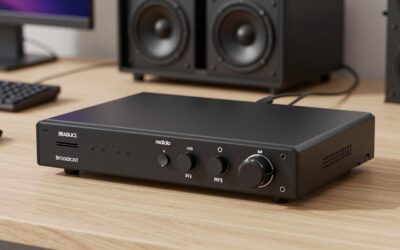
| Shure SM7dB with built-in preamp (+18 or +28 dB) | Built-in boost covers the shortfall | Pairs with almost any interface |
| Streaming mixer with 60+ dB preamps (e.g. Rodecaster class) | ~60 dB clean | Most dynamics |
Inline boosters and the SM7dB’s built-in preamp need 48 V phantom power from the interface. Phantom power is safe for dynamic mics, but turn it off if you connect a passive dynamic directly without a booster to avoid unnecessary pops when plugging in.
Microphone Comparison
| Microphone | Character | Who it suits | Typical price range |
|---|---|---|---|
| Shure SM7B | Smooth, warm broadcast voice; strong rejection | Serious streamers, podcasters with a strong preamp or booster | Usually $380–$420 |
| Shure SM7dB | SM7B sound with active preamp | Anyone with an entry interface who wants SM7B sound | Usually $480–$520 |
| Electro-Voice RE20 | Very even off-axis response, low proximity effect | Streamers who move around the mic | Usually $430–$470 |
| Rode PodMic | Rich, slightly bright; built-in pop filter | Value broadcast microphone setups | Usually $90–$110 |
| Shure MV7+ | USB-C and XLR hybrid, onboard DSP via USB | Streamers starting on USB and moving to XLR later | Usually $250–$280 |
| Shure SM58 | Mid-forward, very durable | Tight budgets, shared or loud rooms | Usually $90–$110 |
| Audio-Technica AT2040 | Clear, slightly brighter, hotter output | Entry interfaces without a booster | Usually $90–$110 |
Dynamic Mic for Podcasting vs Streaming
The same dynamic mic for podcasting works for streaming, but the priorities shift slightly:
- Podcasting: several voices in one room means rejection of other speakers matters, and consistent tone across hosts helps editing. SM7B, RE20 and PodMic are common because they sound similar across voices.
- Streaming: one voice, a loud keyboard and game audio from speakers. Tight pickup and close placement matter more than perfect tonal neutrality, which is why the SM58 and AT2040 punch above their price for streamers.
- Mobility: if you lean back and forward, an RE20’s low proximity effect keeps your voice more consistent than mics whose bass rises sharply up close.
Setup Values for Clean Stream Audio
- Distance: 5–8 cm, slightly off-axis to reduce plosives.
- Gain: set so normal talking peaks at around -18 to -12 dBFS and loud laughs stay below -6 dBFS.
- High-pass filter: 80–100 Hz in OBS or interface software removes desk thumps and fan rumble.
- Noise gate: open around -45 dB, close around -50 dB; with a dynamic mic at close range you often need very little gating.
- Compressor: ratio 3:1, threshold so you see 3–6 dB of reduction on normal speech, 5 ms attack, 60 ms release.
- Limiter: -1 dB ceiling as a safety net for shouts.
Bottom Line
Pick the microphone for your voice and room, then confirm your chain can supply roughly 60 dB of clean gain. If it cannot, budget for an inline booster or choose the SM7dB or a hotter mic like the AT2040. Get that pairing right and a dynamic XLR setup will sound far cleaner on stream than its price suggests.