🛒 Best Price Today on Amazon
Prime members get fast, free shipping on everything above, plus member-only deals. New members get a 30-day free trial — cancel anytime.
The radeon rx 7900 xt review: price, specs and is it worth it question comes down to current pricing, 4K gaming performance, and whether its 20GB of VRAM outweighs newer alternatives. AMD’s RDNA 3 graphics card remains a capable option for demanding games, but its value depends on the price of competing GPUs and your priorities for ray tracing, power consumption, and upscaling.
How to Choose a Radeon Graphics Card for Gaming
Choosing a graphics card requires balancing native rendering speed, ray tracing, memory capacity, and purchase price. The RX 7900 XT is particularly attractive for high-resolution gaming, but newer products may offer better efficiency or software features. Compare actual retail prices rather than relying on launch prices, and check independent results for the games and resolution you use most.
Native 1440p and 4K Performance
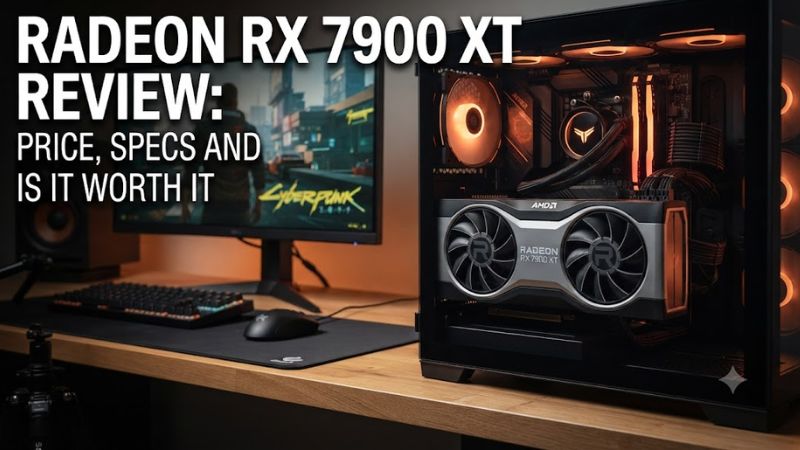
The Radeon RX 7900 XT has 84 compute units, 5,376 stream processors, and a boost clock of up to 2,400 MHz. Its 20GB of GDDR6 memory and 320-bit interface provide substantial bandwidth for high-resolution textures. These specifications suit demanding 1440p gaming and make native 4K gaming practical when settings are adjusted to the title.
Independent benchmarks help put those specifications into context. In TechSpot’s 16-game review, the card averaged strong results across several demanding titles, although performance varied considerably by game. The review used a Ryzen 7 5800X3D system with 32GB of DDR4-3200 memory and tested at 1440p and 4K. Its results are historical measurements, not guarantees for current games or drivers.
Ray Tracing and Upscaling Support
Ray tracing is an important consideration when comparing AMD and NVIDIA graphics cards. The RX 7900 XT supports hardware-accelerated ray tracing, but its performance in demanding ray-traced games can trail competing NVIDIA GPUs. Gamers who prioritize cinematic lighting should compare results with ray tracing enabled rather than relying exclusively on conventional rasterization benchmarks.
AMD FidelityFX Super Resolution can improve frame rates by rendering at a lower internal resolution and reconstructing the output. Support and image quality depend on the game and FSR version. NVIDIA’s DLSS features may be more appealing to players who prioritize supported upscaling and frame-generation options, so check compatibility with your preferred games before choosing a GPU.
Memory Capacity and Long-Term Use
The 20GB VRAM capacity is a notable strength of the RX 7900 XT. Large texture packs, demanding 4K games, and certain creative applications can benefit from additional graphics memory. However, memory capacity alone does not determine performance: GPU architecture, memory bandwidth, processing power, and game optimization also affect frame rates.
For a gaming PC intended to last several years, the RX 7900 XT offers more VRAM than many competing cards with 12GB or 16GB. That advantage matters most when a game actually uses the extra memory. Buyers should avoid paying a substantial premium for capacity they will not need, especially when a newer GPU delivers better performance or efficiency at a similar price.
Power Supply and Case Compatibility
AMD specifies a typical board power of 315W and recommends a power supply rated at least 750W for its reference RX 7900 XT configuration. The reference card uses two 8-pin PCIe power connectors, although individual partner models can differ. Check the specific card’s connector requirements, dimensions, and cooling design before ordering.
The card uses a standard PCIe graphics interface and can work in compatible desktop motherboards with PCIe x16 slots; a newer motherboard platform is not mandatory. Ensure the case has sufficient clearance and airflow, and connect the required power cables directly from a suitable PSU. A well-balanced CPU is also important if you want high frame rates at 1080p or 1440p.
Top Picks: RX 7900 XT and Its Alternatives
The right choice depends on the price gap between the RX 7900 XT and competing models. AMD’s original suggested price was $899, but that figure is not a reliable guide to today’s retail market. TechSpot’s September 2026 price-history listing reported a current price of $1,150, illustrating why buyers should verify live listings before deciding whether this older GPU represents good value.
| Product | Best For | Key Spec | Compatibility | Watch Out For |
| AMD Radeon RX 7900 XT | High-resolution rasterization | 20GB GDDR6 | PCIe x16; two 8-pin connectors on reference model | Value depends heavily on current price |
| AMD Radeon RX 9070 XT | Newer AMD alternative | 16GB GDDR6 | Compatible desktop PCIe platform; check board dimensions and PSU | Less VRAM than the RX 7900 XT |
| AMD Radeon RX 7900 XTX | Higher-end rasterization | 24GB GDDR6 | PCIe x16; check partner-model power and clearance | Higher power demand and purchase cost |
| NVIDIA GeForce RTX 5070 Ti | Ray tracing and NVIDIA features | 16GB GDDR7 | Compatible PCIe desktop platform; verify PSU and connector requirements | Price premium can reduce value |
AMD Radeon RX 7900 XT: Best for 4K Rasterization
The RX 7900 XT is a sensible option for players who want high-resolution gaming performance and generous VRAM without necessarily relying on intensive ray tracing. Its 20GB memory capacity provides flexibility for demanding textures, while DisplayPort 2.1 and HDMI 2.1 support modern display configurations. The reference specification lists 315W typical board power.
Its weakness is value at an inflated retail price. Buyers should compare it against the RX 9070 XT and RX 7900 XTX before committing. The RX 7900 XT is most appealing when discounted enough to compensate for its older architecture and weaker ray-tracing performance. It is less compelling for buyers who prioritize the latest upscaling technologies.
AMD Radeon RX 9070 XT: Best Newer AMD Alternative
The RX 9070 XT is worth considering for buyers who prefer a newer AMD graphics architecture. AMD lists 16GB of GDDR6 memory and a suggested launch price of $599. Its RDNA 4 generation introduces support for FSR 4’s machine-learning-based upscaling on supported games, giving it a software advantage over the older RX 7900 XT in compatible titles.
The trade-off is its smaller VRAM capacity, which may matter in particular memory-heavy workloads. Its actual gaming performance and price should be checked against independent benchmarks rather than inferred from the generation number. For a new gaming build, it deserves serious consideration when its retail price is substantially below that of the RX 7900 XT.
AMD Radeon RX 7900 XTX: Best for More VRAM
The RX 7900 XTX is the higher-tier RDNA 3 alternative, with 24GB of GDDR6 memory, 96 compute units, and a 384-bit memory interface. TechSpot’s original 16-game comparison found it faster than the RX 7900 XT on average at both 1440p and 4K. This makes it worth comparing whenever the two cards have similar prices.
The main drawback is power consumption: AMD specifies 355W typical board power for the reference XTX. It also uses the older RDNA 3 architecture, so a newer card may offer better features for some workloads. Buy the XTX when its additional performance and memory justify the price difference, not simply because it occupies a higher position in AMD’s product lineup.
NVIDIA GeForce RTX 5070 Ti: Best for NVIDIA Features
The RTX 5070 Ti offers 16GB of GDDR7 memory and access to NVIDIA’s current-generation DLSS feature set. It is worth considering for players who frequently use ray tracing or rely on NVIDIA-specific software and creator applications. Its strengths are different from the RX 7900 XT’s emphasis on conventional rendering performance and larger memory capacity.
The important caveat is price. A more expensive RTX 5070 Ti is not automatically the better gaming purchase, and performance varies by title and settings. Compare native rendering, ray tracing, upscaling quality, and total system cost. Confirm the exact board’s power connector, PSU recommendation, and case clearance before purchasing.
Frequently Asked Questions
Is the Radeon RX 7900 XT worth buying in 2026?
The Radeon RX 7900 XT is worth buying in 2026 if its current price is competitive with newer GPUs and you value its 20GB of VRAM. Its original $899 suggested price is historical, not a current buying target. Compare available offers with the RX 9070 XT, RX 7900 XTX, and RTX 5070 Ti before deciding.
Can the RX 7900 XT run games at 4K?
Yes, the RX 7900 XT can run many games at 4K, although demanding titles may require reduced settings or upscaling. In TechSpot’s review, it averaged about 60 FPS in Cyberpunk 2077 at 4K using the High preset without ray tracing or upscaling. Results depend on the game, driver, and system configuration.
What power supply does the RX 7900 XT require?
AMD recommends at least a 750W power supply for its reference RX 7900 XT configuration, which has typical board power of 315W and uses two 8-pin PCIe power connectors. Factory-overclocked partner cards may have different requirements, so check the manufacturer’s specifications and allow adequate power headroom for the CPU and other components.
Is the RX 7900 XT better than the RTX 5070 Ti?
Neither card is better in every workload: the RX 7900 XT has more VRAM, while the RTX 5070 Ti offers newer NVIDIA features and may perform better in ray-traced games. Compare independent benchmarks at your preferred resolution, including upscaling and ray tracing where relevant, then factor in local prices and power requirements.
Final Thoughts
The radeon rx 7900 xt review: price, specs and is it worth it verdict depends on the deal available today. Its 20GB of VRAM and strong conventional rendering performance remain attractive, but ray tracing, power consumption, and newer alternatives limit its appeal. Check current prices and game-specific benchmarks before buying, especially if the RX 9070 XT costs less.