🛒 Best Price Today on Amazon
Prime members get fast, free shipping on everything above, plus member-only deals. New members get a 30-day free trial — cancel anytime.
As of October 6, 2026, DDR5 RAM prices 2026 remain elevated, with major trackers showing sharp recent increases and large differences between capacities and speed tiers. The practical answer is to compare like-for-like kits, check platform support first, and avoid paying extra for capacity or speed your PC cannot use.
Quick answer: Our top pick in 2026 is the Setting — our #1 rated choice. See the full ranked comparison, alternatives and buying advice below.
What DDR5 RAM Pricing Really Comes Down To
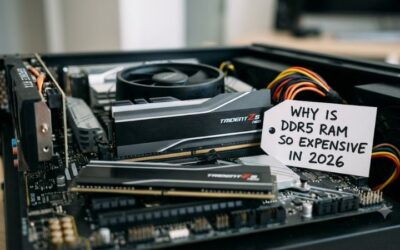
The main issue is not simply that memory costs more; it is that pricing varies substantially by capacity, speed, latency, and retailer. Current trackers also use different product pools, so their figures should be treated as market indicators rather than interchangeable price tags. TrendForce attributes continuing memory pressure to strong AI-server demand and constrained supply.
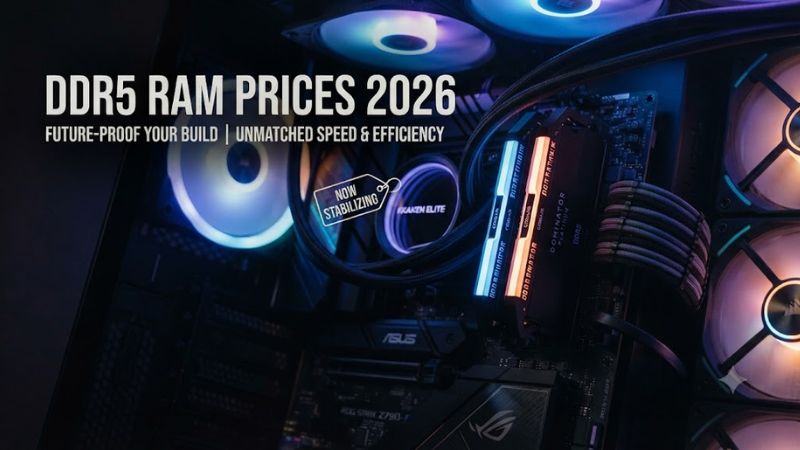
Capacity Changes the Price Equation
For DDR5 RAM prices 2026, capacity is the first variable to separate. A 32GB kit remains a common gaming target, while 64GB makes more sense for heavier creation, virtual machines, or workloads that regularly exceed 32GB. Current RamTrend data lists median prices of $430 for 32GB DDR5-6000 and $820 for 64GB DDR5-6000, illustrating how capacity can dominate the bill.
Capacity should also be judged against your upgrade path. A 2x16GB kit uses two DIMM slots, while a 2x32GB kit uses the same two-slot arrangement at a higher capacity. That can matter on boards with four slots because leaving two slots free preserves an easier expansion route than filling every slot immediately.
Speed Is Not the Same as Value
DDR5-6000 is currently a prominent desktop segment, but paying for a higher-rated kit does not automatically make sense. RamTrend’s October 6 snapshot puts 2x16GB DDR5-6000 below its 2x16GB DDR5-5600 median, showing why buyers should compare actual listings instead of assuming faster memory always costs more.
Platform support determines how useful a rated speed can be. AMD’s Ryzen 7 9800X3D officially lists DDR5 and native maximum speeds of DDR5-5600 for supported two-DIMM configurations, while AMD EXPO supports memory overclocking on compatible AM5 systems. Intel’s Core Ultra desktop Series 2 lists DDR5-6400 support under specified one-DIMM-per-channel conditions.
Latency Matters Alongside MT/s
A higher MT/s rating is only one part of memory performance. CAS latency, commonly shown as CL, describes timing in memory cycles, so comparing DDR5-6000 CL30 with DDR5-6000 CL36 is more useful than comparing speed labels alone. The difference should be considered alongside the price premium rather than treated as a reason to spend automatically.
For gaming systems, the sensible comparison is often between two kits with the same capacity and similar speed but different timings. If a lower-latency kit costs substantially more, check independent performance data for your CPU and workload before paying the difference. Price trackers show the market price; they do not establish a universal gaming performance advantage.
Compatibility Comes Before Any Deal
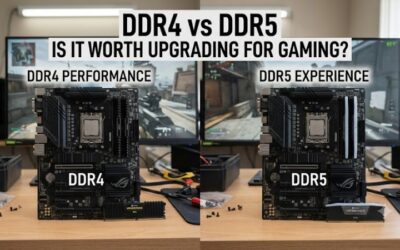
DDR5 RAM prices 2026 only matter after the memory is confirmed compatible with the motherboard. DDR5 and DDR4 use different physical and electrical specifications and cannot be installed interchangeably. Crucial also notes that desktop DDR5 modules normally use 288-pin DIMMs, while laptop DDR5 uses a different form factor.
For desktop gaming PCs, check the motherboard’s memory type, DIMM capacity limits, supported module configurations, and QVL where appropriate. AMD’s EXPO compatibility list provides platform-specific memory information, while Intel publishes processor memory support separately. Do not assume that a kit’s advertised XMP or EXPO profile will operate at its rated setting on every motherboard.
How to Read DDR5 RAM Prices Today
The useful approach is to compare identical capacity and speed categories, then account for latency and platform support. Current data shows why a single “average DDR5 price” can be misleading: RAMList reports a $625.85 median for its 32GB DDR5 basket, while RamTrend reports $430 for 2x16GB DDR5-6000. Those datasets track different pools, so neither figure should be treated as a universal retail price.
| Setting | Where to Check | Effect | Risk |
| Capacity | Retailer listing and motherboard manual | Sets usable memory headroom | Paying for capacity you do not need |
| Speed | CPU and motherboard specifications | Changes memory bandwidth | Rated speed may require a memory profile |
| Latency | Kit specification | Helps compare similar-speed kits | Lower CL can carry a large premium |
| Platform | Motherboard QVL and CPU specifications | Confirms DDR5 compatibility | Incorrect DDR generation or DIMM type |
Compare 32GB Kits on Equal Terms
When comparing DDR5 RAM prices 2026, start with 32GB kits that use the same 2x16GB configuration. RamTrend’s October 6 data shows a median of $430 for DDR5-6000 2x16GB, versus $498 for DDR5-5600 2x16GB and $400 for DDR5-5200 2x16GB. These figures demonstrate that market pricing can move independently of the simple speed hierarchy.
The next comparison should be timing and compatibility. If two 32GB kits have similar prices and one has a memory profile suited to your motherboard, that can be the more practical purchase. If your system already has enough memory, however, a price drop alone is not a reason to add another kit.
Treat 64GB as a Workload Decision
A 64GB kit makes sense when your applications can use it, not simply because higher capacity sounds safer. RamTrend lists a median of $820 for 2x32GB DDR5-6000 as of October 6, substantially above its 32GB equivalent. That makes capacity planning especially important while the market remains expensive.
Check actual memory usage in Windows before upgrading. Gaming alongside browsers and background applications may benefit from additional headroom, while ordinary workloads may not. If a system consistently approaches its installed memory limit, moving from 32GB to 64GB can be more meaningful than spending the same money on a faster memory rating.
Watch the Market Without Chasing Every Dip
DDR5 RAM prices 2026 have moved quickly enough that one discounted listing does not necessarily represent the broader market. RAMList reported its DDR5 index up 17.1% over the previous 30 days on October 5, while its 32GB DDR5 median had risen to $625.85. That is a market signal, not a prediction that every kit will follow the same path.
The safer buying method is to establish a target configuration first, then monitor several retailers for that exact capacity, speed, and timing. A temporary price change on an unrelated 64GB or high-speed kit should not change the original requirement. This prevents a market dip from turning into an unnecessary specification upgrade.
Check Platform Limits Before Enabling Profiles
Memory profiles can raise operating speed beyond a processor’s basic specification, but their behavior depends on the CPU, motherboard, BIOS, DIMM configuration, and kit. Intel documents additional limits when multiple DIMMs are installed, while AMD lists different native memory limits by module configuration.
After installing a kit, verify the actual operating speed in BIOS or a system-information utility rather than relying only on the package label. If a profile causes instability, return to the motherboard’s default memory setting and update BIOS only according to the board manufacturer’s documented procedure. Do not treat a rated profile as a requirement for the system to function.
FAQ
Current DDR5 pricing is high enough that buyers need to distinguish market trends from the price of a specific kit. The questions below focus on the practical decisions that matter when planning a gaming PC or memory upgrade in October 2026, including whether to buy now, what capacity makes sense, and how compatibility affects the purchase.
Are DDR5 RAM prices going down in 2026?
DDR5 RAM prices 2026 are not showing a broad decline in the latest tracking data; instead, several current indexes report continued increases. RAMList showed its DDR5 index up 17.1% over 30 days on October 5, while RamTrend’s 32GB DDR5-6000 2x16GB segment was down 8.8% over the same period, illustrating how individual segments can move differently.
The broader industry outlook also remains pressured. TrendForce projected conventional DRAM contract prices to rise 10–15% quarter over quarter in 4Q26, citing AI-server demand and continued supply constraints. That forecast concerns contract pricing rather than the exact retail price of a gaming kit, so it should not be used as a precise prediction for any individual product.
Is 32GB DDR5 enough for gaming in 2026?
32GB remains a practical gaming capacity for a large range of desktop PCs, provided the rest of the system and the games being run do not require more memory. A 2x16GB configuration also gives a dual-DIMM arrangement while leaving additional slots available on many four-slot desktop motherboards.
Moving to 64GB is more appropriate when memory usage repeatedly approaches the 32GB ceiling during gaming, streaming, content creation, development, or other simultaneous workloads. The higher capacity should be purchased for that workload need rather than because current pricing makes large kits appear scarce or desirable.
Can DDR5 RAM work on a DDR4 motherboard?
No, DDR5 RAM cannot operate in a DDR4 motherboard because the generations use different physical and electrical specifications. Crucial specifically states that DDR5 and DDR4 modules are not compatible, including differences in pin configuration and notch placement.
This also means an upgrade from DDR4 to DDR5 normally requires a compatible motherboard and, depending on the platform, a compatible CPU. Intel’s processor lineup includes generations and motherboard variants supporting either DDR4 or DDR5, while current AMD Ryzen 9000 desktop platforms use DDR5. Check the exact motherboard and CPU models before ordering memory.
Should I wait to buy DDR5 RAM in October 2026?
Waiting can make sense if the upgrade is optional, but DDR5 RAM prices 2026 are volatile enough that no source can reliably identify the exact date of a future retail low. Current market trackers disagree on some segments, while TrendForce still expects memory contract prices to rise during 4Q26.
If the PC needs additional memory now, compare several retailers for the exact capacity, speed, timing, and platform profile required. If the existing system has enough RAM and there is no immediate workload reason to upgrade, postponing the purchase avoids paying today’s elevated market prices without relying on a speculative forecast.
Final Thoughts
DDR5 RAM prices 2026 are elevated, but the smartest response is not simply buying the cheapest listing or waiting indefinitely. Define capacity first, compare matching speed and latency, verify DDR5 platform support, and track the exact kit you need. Current market data suggests patience can help when an upgrade is optional, while immediate needs should guide purchases.
Ready to decide? Our #1 pick for 2026 is the Setting.
Live price & availability on Amazon.