🛒 Best Price Today on Amazon
Prime members get fast, free shipping on everything above, plus member-only deals. New members get a 30-day free trial — cancel anytime.
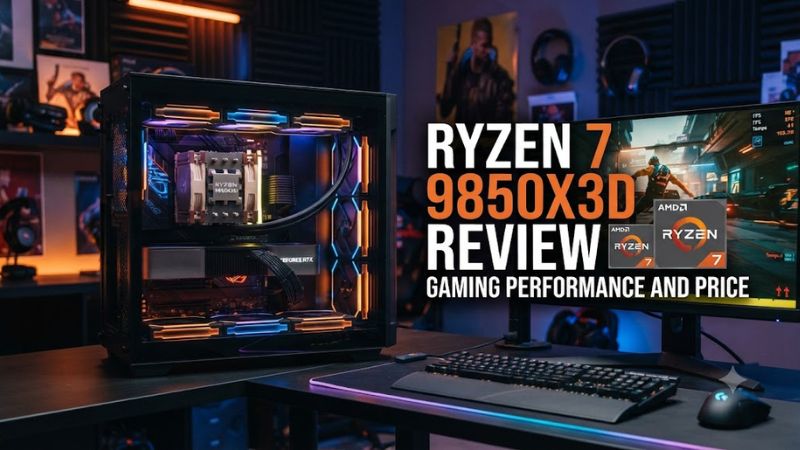
The ryzen 7 9850x3d review: gaming performance and price points to a fast AM5 gaming CPU with eight Zen 5 cores, 16 threads, 96MB L3 cache and a 5.6GHz boost clock. Its $499 launch price sits only $20 above the 9800X3D’s launch MSRP, making the performance gap more important than the headline specification.
How to Choose a High-End Gaming CPU
Choosing among AMD’s current X3D processors comes down to gaming speed, price, workload, and platform compatibility. The Ryzen 7 9850X3D targets buyers who prioritize high-refresh gaming, while larger Ryzen 9 models make more sense when rendering, encoding, or other heavily threaded work matters alongside games.
Gaming Performance
For gaming, the 9850X3D benefits from eight Zen 5 cores, 16 threads and 96MB of L3 cache, with a 5.6GHz maximum boost. TechSpot’s 14-game Medium-quality average placed it about 5% ahead of the 9800X3D, while Tom’s Hardware measured roughly a 3.3% overall lead in its gaming suite.
The gains depend heavily on the game and GPU. PC Gamer recorded 147 versus 142 FPS in Homeworld 3 at 1080p Epic, 252 versus 246 FPS in Metro Exodus Enhanced Edition at 1080p High, and 379 versus 376 FPS in Total War: Warhammer 3 at 1080p High.
Price and Value
The Ryzen 7 9850X3D launched at $499, compared with $479 for the 9800X3D, so the original gap was modest. Current retail pricing changes frequently, however, and the 9800X3D has recently appeared below its launch price, making the older chip potentially more attractive when discounts widen.
A useful buying rule is to compare the actual checkout prices rather than assuming the newer processor is automatically the better value. The 9850X3D makes more sense when its premium remains small and you want maximum gaming performance; a discounted 9800X3D becomes harder to justify against.
Platform Compatibility
The 9850X3D uses AMD’s AM5 socket and DDR5 memory, with PCIe 5.0 connectivity. AMD lists support for A620, B650, B650E, X670, X670E, B840, B850, X870 and X870E chipsets, although motherboard BIOS support should be checked before installation.
This is not an AM4 upgrade because DDR4 is not supported. The processor also has a 120W default TDP and does not include a boxed cooler, so a suitable AM5-compatible cooling solution belongs in the build budget. AMD lists a 95°C maximum operating temperature for the chip.
Memory and Expansion
AMD specifies DDR5 support and a native memory specification of DDR5-5200 for the 9850X3D. Faster memory kits can be used through memory overclocking profiles such as EXPO, but advertised kit speeds are not the same as the processor’s base memory specification.
For a new gaming system, DDR5 is therefore mandatory at the platform level, while motherboard selection should also consider the desired PCIe layout and storage configuration. PCIe 5.0 support comes from the processor, but the exact slot and M.2 capabilities depend on the motherboard model.
Top Picks for AMD Gaming Builds
The Ryzen 7 9850X3D is compelling when the goal is maximum gaming performance from a mainstream eight-core X3D design, but the surrounding lineup changes the value calculation. The table below separates gaming focus, mixed workloads, and price sensitivity so the CPU choice matches the rest of the system.
| Product | Best For | Key Spec | Compatibility | Watch Out For |
| Ryzen 7 9850X3D | Best Overall | 8C/16T, up to 5.6GHz | AM5, DDR5, PCIe 5.0 | Small gain over 9800X3D |
| Ryzen 7 9800X3D | Best Value | 8C/16T, up to 5.2GHz | AM5, DDR5, PCIe 5.0 | Lower peak gaming speed |
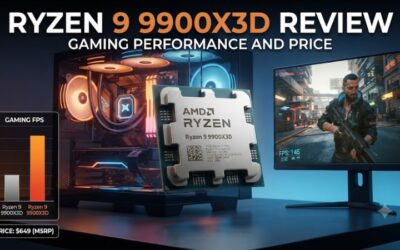
| Ryzen 9 9900X3D | Best for Mixed Builds | 12C/24T, up to 5.5GHz | AM5, DDR5, PCIe 5.0 | Higher cost and dual-CCD design |
| Ryzen 9 9950X3D2 | Best for Heavy Workloads | 16C/32T, 192MB L3 | AM5, DDR5, PCIe 5.0 | $900-class pricing and high power |
Ryzen 7 9850X3D: Best Overall
The 9850X3D combines eight Zen 5 cores and 16 threads with 96MB of L3 cache, a 4.7GHz base clock and up to 5.6GHz boost. Its main advantage over the 9800X3D is the higher maximum boost frequency, while the socket, memory generation and core count remain familiar.
Buy it if you are building a high-end gaming PC and want the faster of AMD’s eight-core X3D options. Its weakness is value: independent reviews generally find only a low-single-digit gaming advantage over the 9800X3D, so owners of the older chip have little reason to replace it for gaming alone.
Ryzen 7 9800X3D: Best Value
The 9800X3D retains eight cores, 16 threads, 96MB of L3 cache and a 120W default TDP, while boosting to 5.2GHz. AMD specifies AM5, DDR5 and PCIe 5.0 support, giving it essentially the same core platform requirements as the newer 9850X3D.
Choose it when the price difference is meaningful or when a discounted processor leaves more budget for the graphics card. A current Newegg promotion has listed the 9800X3D at $429, illustrating why street pricing can change the recommendation even when the 9850X3D remains faster.
Ryzen 9 9900X3D: Best for Mixed Builds
The 9900X3D moves to 12 cores and 24 threads, with a 4.4GHz base clock, up to 5.5GHz boost, 128MB of L3 cache and a 120W default TDP. AMD also gives it AM5, DDR5 and PCIe 5.0 support, making it suitable for systems that combine gaming with heavier threaded applications.
It is the better fit when gaming is important but video work, streaming, compilation or other multicore workloads regularly occupy the same machine. The weakness is that additional cores do not automatically translate into higher gaming performance, so a gaming-only buyer can spend less on an eight-core X3D model.
Ryzen 9 9950X3D2: Best for Heavy Workloads
The 9950X3D2 is AMD’s current halo desktop X3D design, with 16 cores, 32 threads, 192MB of L3 cache, a 5.6GHz maximum boost and a 200W default TDP. It remains an AM5, DDR5 and PCIe 5.0 processor, but AMD recommends liquid cooling for optimal performance.
Its $900 MSRP makes it difficult to justify for a gaming-focused build. Tom’s Hardware found it only 2.7% behind the 9850X3D in gaming, while its larger cache and core count are more relevant to specialized productivity workloads. Buy it for demanding mixed workloads, not simply to chase gaming FPS.
Ryzen 7 9850X3D Review FAQ
The short answer is that the 9850X3D is a very fast gaming CPU, but its value depends on how close its price is to the 9800X3D. Its higher clock can produce measurable gains in CPU-limited games, while GPU-limited 1440p and 4K scenarios can compress the difference between the two chips.
Is the Ryzen 7 9850X3D Worth Buying?
Yes, the Ryzen 7 9850X3D is worth buying for a new high-end gaming PC when its price premium over the 9800X3D is small. Tom’s Hardware found it about 3.3% faster overall in its gaming suite, while TechSpot measured about 4% using its per-game comparison method.
The decision changes when the 9800X3D receives a substantial discount. A lower-priced 9800X3D can deliver nearly the same gaming experience while leaving more money available for a stronger GPU, faster storage or additional memory, depending on the rest of the build.
How Fast Is the Ryzen 7 9850X3D for Gaming?
The Ryzen 7 9850X3D is fastest in CPU-limited gaming scenarios where its higher clock can matter. TechSpot’s 14-game Medium-quality average showed a 5% advantage over the 9800X3D, while its advantage reached 15% against the 7800X3D in that same test methodology.
For a concrete example, PC Gamer recorded 147 FPS versus 142 FPS in Homeworld 3 at 1080p Epic and 252 versus 246 FPS in Metro Exodus Enhanced Edition at 1080p High. Those results come from PC Gamer’s CPU-focused comparisons rather than a universal FPS guarantee for every system.
Does the Ryzen 7 9850X3D Need DDR5?
Yes, the Ryzen 7 9850X3D requires a DDR5-based AM5 platform because AMD specifies DDR5 system memory and AM5 socket compatibility. DDR4 memory from an AM4 system cannot be carried over to this processor, so an upgrade from AM4 requires a compatible motherboard and DDR5 kit.
AMD lists DDR5-5200 as the processor’s native memory specification, while EXPO allows supported memory kits to operate above that baseline. Motherboard firmware, memory configuration and the specific DIMMs still affect achievable settings, so the board vendor’s memory support list is worth checking before purchase.
Should 9800X3D Owners Upgrade?
No, existing 9800X3D owners generally should not upgrade solely for gaming because independent reviews place the 9850X3D’s average advantage in the low single digits. WIRED likewise found only a small gaming difference in its Cyberpunk 2077 comparison and advised against upgrading from an existing 9800X3D system.
For a new build, however, the decision is different because there is no existing CPU to replace. If both chips are close in price, the newer 9850X3D offers the higher maximum boost clock; if the 9800X3D is substantially cheaper, its lower purchase cost can make it the smarter allocation of the same system budget.
Final Thoughts
The ryzen 7 9850x3d review: gaming performance and price shows a technically faster eight-core X3D processor, but not a dramatic generational leap over the 9800X3D. Its $499 launch price and low-single-digit average gaming gains make current retail pricing decisive, especially for buyers balancing CPU cost against GPU spending.