🛒 Best Price Today on Amazon
Prime members get fast, free shipping on everything above, plus member-only deals. New members get a 30-day free trial — cancel anytime.
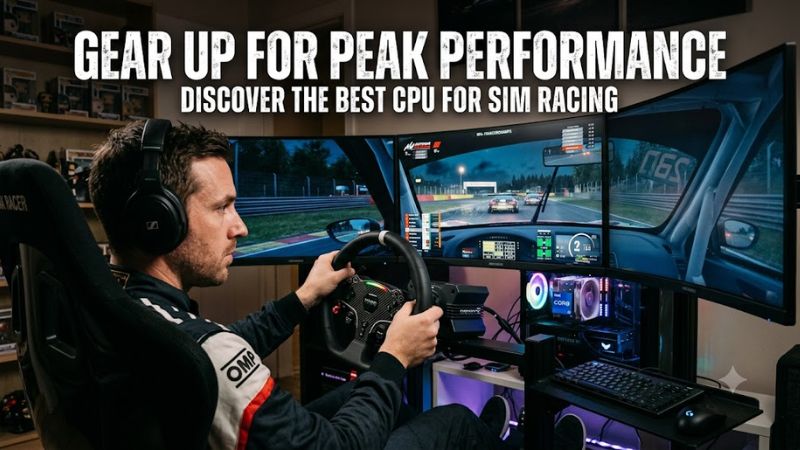
For best cpu for sim racing, the main choice comes down to CPU cache, frame-time demands, simulator type, and platform cost rather than core count alone. The Ryzen 7 9850X3D, 9800X3D, Ryzen 9 9950X3D, and Ryzen 7 9700X cover different build priorities, while iRacing and Assetto Corsa EVO set relatively modest official CPU requirements.
How to Choose a Sim Racing CPU
Cache and Game Engine Demands
The best cpu for sim racing should be selected around the simulator and target display, because large grids, AI, physics calculations, telemetry, and VR can change CPU load substantially. X3D processors add large L3 caches, which can benefit some gaming workloads, but the gain varies by title rather than applying equally to every simulator.
For context, Gamers Nexus compared the Ryzen 7 9850X3D and 9800X3D across gaming workloads using DDR5-6000 and DDR5-4800 configurations. In its 1080p Baldur’s Gate 3 test, both averaged about 165 FPS, illustrating why a higher clock does not automatically produce a large gaming difference.
Cores for Racing and Other Work
Core count matters more when the racing PC also handles recording, streaming, telemetry, browser windows, or demanding productivity software. The Ryzen 9 9950X3D has 16 cores and 32 threads, while the Ryzen 7 9850X3D and 9800X3D have 8 cores and 16 threads, giving buyers distinct options for mixed-use systems.
A dedicated racing machine does not automatically need 16 cores. iRacing currently lists 6 cores for its recommended tier and 8 or more cores for its high-end tier, while Assetto Corsa EVO lists much older six-core-class hardware as recommended. These requirements describe compatibility targets, not expected performance at high-refresh, triple-screen, or VR settings.
Platform Compatibility
Every pick here uses AMD’s AM5 socket and DDR5 memory, with native PCIe 5.0 support. That means an older AM4 motherboard or DDR4 kit cannot be carried directly into these builds. Motherboard CPU-support lists and BIOS requirements should be checked before installation, particularly when upgrading an existing AM5 system.
Cooling also belongs in the platform budget. AMD lists no bundled thermal solution for these processors; the 9850X3D, 9800X3D, and 9950X3D have AMD liquid-cooling recommendations, while the 9700X has a premium-air-cooler recommendation. Case clearance, radiator support, and the required CPU EPS12V connection should be checked against the chosen motherboard and case.
Resolution and GPU Balance
At 1080p with a fast graphics card, CPU differences are easier to expose because the processor can become the limiting component. At 1440p, ultrawide, triple-screen, or VR resolutions, GPU demand generally becomes more significant, so buying a higher-tier CPU without considering the graphics card can produce an unbalanced system.
For sim racing, display configuration matters especially because triple screens and VR increase the rendering workload. iRacing officially supports VR and states that VR systems should meet at least its recommended PC specifications, while the simulator’s high-end tier calls for an 8-core-or-better CPU and 32GB RAM.
Top Picks for Sim Racing CPUs
| Product | Best For | Key Spec | Compatibility | Watch Out For |
| AMD Ryzen 7 9850X3D | Best Overall | 8C/16T, up to 5.6 GHz, 96MB L3 | AM5, DDR5, PCIe 5.0 | Higher power and cooling demand than 9800X3D |
| AMD Ryzen 7 9800X3D | Best Value | 8C/16T, up to 5.2 GHz, 96MB L3 | AM5, DDR5, PCIe 5.0 | Less multi-core headroom than Ryzen 9 |
| AMD Ryzen 9 9950X3D | Best For Streaming | 16C/32T, up to 5.7 GHz, 128MB L3 | AM5, DDR5, PCIe 5.0 | Higher platform and cooling cost |
| AMD Ryzen 7 9700X | Best For Efficient Builds | 8C/16T, up to 5.5 GHz, 32MB L3 | AM5, DDR5, PCIe 5.0 | Less gaming cache than X3D models |
Best Overall: Ryzen 7 9850X3D
The Ryzen 7 9850X3D is the current high-end gaming-focused option among these four, with 8 cores, 16 threads, a 5.6 GHz maximum boost, and 96MB of L3 cache. AMD specifies a 120W default TDP, AM5 support, DDR5 memory, and PCIe 5.0 connectivity, with no boxed cooler included.
For the best cpu for sim racing when the machine is primarily for gaming, its main weakness is the relatively small performance separation from the 9800X3D in independent gaming data. Gamers Nexus found it at most 4% ahead in its tested gaming suite, with some results effectively identical, while also recording higher power and temperature under an all-core workload.
Best Value: Ryzen 7 9800X3D
The Ryzen 7 9800X3D remains a strong fit for a dedicated racing machine because it combines 8 cores and 16 threads with 96MB of L3 cache and a 5.2 GHz maximum boost. AMD lists a 120W default TDP, AM5 socket, DDR5 support, and PCIe 5.0, while recommending liquid cooling and requiring a separate cooler.
Its real weakness is workload scope rather than gaming capability: an 8-core processor provides less CPU capacity for simultaneous encoding, heavy applications, and racing software than the 9950X3D. Buyers who mainly race should not pay for extra cores unless their surrounding workload actually uses them.
Best For Streaming: Ryzen 9 9950X3D
The Ryzen 9 9950X3D provides 16 cores and 32 threads, a maximum boost of 5.7 GHz, 144MB of total cache, and a 170W default TDP. It uses AM5 and DDR5 with PCIe 5.0, making it suited to a system that combines racing with recording, streaming, rendering, or other heavily threaded workloads.
For the best cpu for sim racing in a mixed-use PC, the drawback is cost and cooling rather than a missing feature. Tom’s Hardware measured it against the Core Ultra 9 285K at 1080p across its gaming suite and found strong gaming performance, but the additional cores primarily become more useful when applications beyond the simulator are running concurrently.
Best For Efficient Builds: Ryzen 7 9700X
The Ryzen 7 9700X is an 8-core, 16-thread Zen 5 processor with up to 5.5 GHz boost, 40MB of total cache, and a 65W default TDP. It uses AM5, DDR5, and PCIe 5.0, and AMD recommends a premium air cooler rather than specifying liquid cooling for optimal performance.
Its weakness for racing is the smaller cache compared with the X3D alternatives, which makes it a less specialized gaming choice. TechPowerUp’s review measured CPU performance against other desktop processors, including the Ryzen 7 7800X3D, at its standard test settings; those results provide broader CPU context rather than a dedicated sim-racing benchmark.
FAQ: Sim Racing CPU Questions
Is 8 Cores Enough for Sim Racing?
Yes, 8 cores are enough for many sim-racing systems, and iRacing currently lists 8 or more cores in its high-end specification while Assetto Corsa EVO recommends substantially older six-core-class hardware. Your target resolution, refresh rate, VR setup, and background applications still determine actual CPU demand.
For the best cpu for sim racing, 8 cores therefore provide a sensible gaming-oriented baseline rather than a universal requirement. A 16-core CPU becomes more relevant when the same computer handles streaming, recording, rendering, or other workloads at the same time.
Is X3D Useful for Sim Racing?
X3D can be useful for gaming because the processors carry substantially more L3 cache, but the size of the benefit depends on the simulator and workload. AMD’s 9800X3D and 9850X3D both provide 96MB of L3 cache, while the 9950X3D provides 128MB.
Independent gaming data shows why individual game results matter: Gamers Nexus found the 9850X3D and 9800X3D effectively tied in several workloads, despite the newer processor’s higher advertised boost frequency. That evidence supports using simulator-specific results where available rather than assuming every racing title scales identically.
Do I Need a Ryzen 9 for VR?
No, a Ryzen 9 is not required simply because a system uses VR; iRacing states that VR systems should meet at least its recommended specifications, while its high-end CPU tier specifies 8 or more cores. The graphics card also has a major role because VR increases the rendering workload.
For the best cpu for sim racing with VR, CPU selection should therefore follow the complete system rather than the headset alone. A Ryzen 7 X3D model can suit a gaming-focused machine, while a Ryzen 9 becomes more relevant when streaming, recording, or heavy background workloads share CPU resources.
Can I Reuse DDR4 RAM With These CPUs?
No, these Ryzen 9000 desktop processors require an AM5 motherboard with DDR5 memory, so an existing DDR4 kit cannot be reused as system memory. AMD specifies DDR5 support and AM5 connectivity for the Ryzen 7 9850X3D and 9800X3D, with PCIe 5.0 provided by the processor platform.
The same platform consideration applies to the Ryzen 9 9950X3D and Ryzen 7 9700X. Buyers upgrading from AM4 should budget for a motherboard and DDR5 memory in addition to the CPU, and should verify BIOS support before assembling or upgrading the system.
Final Thoughts
The best cpu for sim racing depends on whether the PC is dedicated to racing, combines racing with streaming, or needs a lower-power platform. The Ryzen 7 9850X3D targets maximum gaming performance, the 9800X3D reduces the CPU cost, the 9950X3D adds cores for mixed workloads, and the 9700X offers a lower-power alternative.