🛒 Best Price Today on Amazon
Prime members get fast, free shipping on everything above, plus member-only deals. New members get a 30-day free trial — cancel anytime.
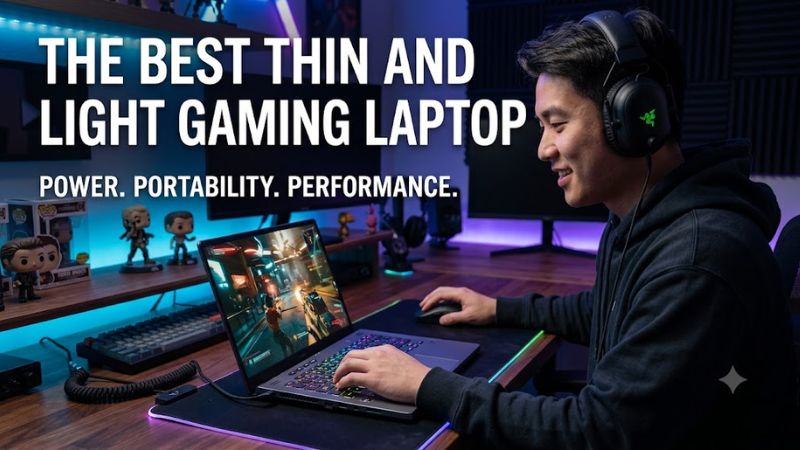
Selecting the best thin and light gaming laptop requires balancing portability with thermal constraints and graphical processing output. Compact chassis designs restrict air flow, which directly forces hardware manufacturers to tune total graphics power targets. Buyers must evaluate display panels and power draw to secure steady high frame rates.
How to Choose a Compact Gaming Notebook
Finding a modern high performance portable PC involves examining component specs rather than relying on pure clock speeds alone. Power limits determine actual frame rate delivery under prolonged thermal stress across demanding software titles. A well balanced machine pairs efficient silicon with suitable memory for high bandwidth workflows.
Power Envelope and TGP
When shopping for the best thin and light gaming laptop, graphics power limits define real performance more than the model name. An NVIDIA GeForce RTX 4070 running at a restricted 90W Total Graphic Power delivers different frame rates than a 140W variant. Lower wattage reduces heat generation inside slim frames.
Processor power allocations also impact thermal headroom during intense combined workloads. AMD Ryzen 9 8945HS processors operate efficiently within 35W to 54W limits, preserving battery life while maintaining high single core clock speeds. Balancing CPU wattage alongside GPU power prevents severe thermal throttling.
Display Panel and Refresh Rates
Display technology directly influences visual clarity and overall power draw on portable gaming rigs. High resolution panels like 2880×1800 OLED displays offer deep contrast ratios and rapid 0.2ms response times for fast motion. However, driving sharp 2.8K pixels requires increased GPU processing power in games.
Variable refresh rate standards such as NVIDIA G-Sync prevent screen tearing when frame rates fluctuate below native panel limits. A 120Hz refresh rate provides smooth motion clarity without draining the battery as quickly as 240Hz screens. High color accuracy with 100 percent DCI-P3 coverage benefits content creation.
Memory Upgradability and Compatibility
Internal memory configuration determines long term hardware viability and multi tasking capability. Many compact systems solder LPDDR5X RAM directly to the motherboard to minimize total chassis thickness. System configurations with soldered 16GB RAM cannot be expanded later, making 32GB setups ideal for heavy usage.
Storage compatibility relies on M.2 PCIe 4.0 NVMe expansion slots inside the laptop body. While most models include one preinstalled 1TB SSD, having a secondary slot allows easy storage expansion without replacing the boot drive. PCIe 4.0 interface bandwidth ensures fast game load times across demanding open world titles.
Thermal Design and Surface Heat
Thermal management in slim enclosures requires custom vapor chambers or multi fan configurations. Pushing heat away from core components keeps skin temperatures comfortable near key user touchpoints like the palm rest. Tri-fan cooling systems draw fresh air through keyboard vents to maintain sustained component clocks.
Vapor chamber coolers spread thermal energy across a wider surface area compared to traditional heat pipes. High fan noise under full load remains a common trade off for keeping internal temperatures below maximum operating limits. Setting custom fan curves in software helps manage noise levels during lighter workloads.
Top Thin and Light Gaming Laptop Recommendations
Selecting a portable machine involves evaluating specific models based on performance metrics and hardware trade offs. The best thin and light gaming laptop market includes options ranging from ultra thin convertibles to high power aluminum unibody designs. Each device targets distinct balance points between weight and graphics power.
| Product | Best For | Key Spec | Compatibility | Watch Out For | | ASUS ROG Zephyrus G14 2024 | Best Overall | AMD Ryzen 9 8945HS, RTX 4070 (90W), 32GB LPDDR5X, 2.8K 120Hz OLED | Wi-Fi 6E, USB4, HDMI 2.1 | Soldered RAM, max 90W GPU TGP | | Razer Blade 14 2024 | Best Premium | AMD Ryzen 9 8945HS, RTX 4070 (140W), 32GB DDR5-5600, 1600p 240Hz | Wi-Fi 6E, USB4, HDMI 2.1 | Higher price, surface heat under load | | Lenovo Legion Slim 5 14 | Best Value | AMD Ryzen 7 7840HS, RTX 4060 (105W), 16GB LPDDR5X, 2.8K 120Hz OLED | Wi-Fi 6E, HDMI 2.1, 2x M.2 | Soldered RAM, lacks USB4 support | | ASUS ROG Flow Z13 2025 | Best Ultraportable | AMD Ryzen AI MAX+ 395, Radeon 8060S iGPU, 32GB LPDDR5X, 180Hz IPS | Wi-Fi 6E, USB4, Touch Screen | High cost, shorter battery life |
ASUS ROG Zephyrus G14 2024
The ASUS ROG Zephyrus G14 2024 stands out as a leading choice for users prioritizing portability and screen quality. Weighing 3.31 lbs with a 0.63 inch profile, it features a 14 inch 2.8K OLED display operating at 120Hz. Powering the system is an AMD Ryzen 9 8945HS CPU alongside an NVIDIA GeForce RTX 4070 GPU running at 90W.
In independent benchmarks from Notebookcheck at 1080p resolution on High settings, the RTX 4070 configuration achieves 100 FPS in Shadow of the Tomb Raider and 39 FPS in Cyberpunk 2077 with Ray Tracing Ultra. The soldered LPDDR5X RAM limits future upgrades, so buying the 32GB model is essential. The CNC chassis stays sturdy.
Razer Blade 14 2024
The Razer Blade 14 2024 offers high graphics wattage inside an ultra compact CNC aluminum enclosure. Featuring an AMD Ryzen 9 8945HS processor and an NVIDIA GeForce RTX 4070 GPU pushed to a 140W power limit, it delivers strong graphical throughput. The 14 inch 2560×1600 IPS display features a fast 240Hz refresh rate.
In independent testing by High Performance Laptops at 1080p High settings, the system averages 74 FPS in 3DMark Time Spy gaming tests and 206 FPS in CS:GO. DDR5 memory modules are fully upgradeable via two SO-DIMM slots up to 64GB. The premium price point and warm chassis under heavy stress represent the primary compromises.
Lenovo Legion Slim 5 14
For budget conscious gamers seeking premium panel quality, the Lenovo Legion Slim 5 14 provides great value. It pairs an AMD Ryzen 7 7840HS processor with an NVIDIA GeForce RTX 4060 GPU running at 105W TGP. The 14.5 inch 2.8K OLED screen delivers 120Hz refresh rates with deep black levels and 100 percent DCI-P3 color.
According to independent benchmarks from XDA-Developers at 1080p High settings, the RTX 4060 configuration delivers 10,564 points in 3DMark Time Spy. The chassis features dual M.2 PCIe 4.0 slots for easy storage expansion, though system RAM remains soldered. The machine lacks USB4 ports, relying instead on standard USB-C 3.2 Gen 2.
ASUS ROG Flow Z13
The ASUS ROG Flow Z13 represents the ultimate expression of ultra thin convertible gaming hardware. Designed as a tablet hybrid weighing 2.65 lbs, it houses an AMD Ryzen AI MAX+ 395 processor with integrated Radeon 8060S graphics. Its 13.4 inch WQXGA IPS touchscreen supports an ultra fast 180Hz refresh rate for fluid input.
Integrated graphics performance handles esports titles effectively, though demanding AAA games require resolution adjustments compared to dedicated GPUs. The detachable keyboard design offers flexible usage modes for gaming and productivity. Limited internal space restricts battery capacity to 56Wh, necessitating frequent charging.
Frequently Asked Questions
Navigating hardware specifications for portable gaming equipment raises common technical questions regarding thermals and durability. The best thin and light gaming laptop options require clear understanding of system power limits and component longevity. Addressing these query areas ensures realistic performance expectations.
Can thin laptops handle AAA gaming at high settings?
Yes, modern compact laptops handle AAA titles smoothly at 1080p or 1440p using hardware upscaling features like DLSS. In independent benchmarks, the best thin and light gaming laptop models equipped with RTX 4070 GPUs deliver over 60 FPS in demanding games like Shadow of the Tomb Raider at 1080p. Adjusting settings keeps thermal limits stable.
Maintaining high frame rates in modern titles requires leveraging NVIDIA DLSS or AMD FSR frame generation technologies. These upscaling tools lower native render resolution internally before reconstructing image quality on high density displays. Thermal throttling can still occur if air intake vents are obstructed during sessions.
How long does the battery last during portable gaming?
Battery life during active gaming typically ranges between one and two hours on standard internal battery power. Running high wattage GPUs and bright OLED displays exhausts 70Wh batteries rapidly under full load. Switching Windows power profiles to eco mode extends productivity battery runtime to six or seven hours.
Gaming on battery power automatically limits GPU clock frequencies and TGP wattage to prevent excessive current draw. Connecting the included AC adapter or a high wattage USB-C Power Delivery charger is required to run components at full capability. Battery health management software helps preserve long term cell life.
Are RAM and SSD components upgradeable in compact models?
SSD storage is usually upgradeable via M.2 slots, while RAM is frequently soldered directly to the motherboard in thin designs. Models like the Lenovo Legion Slim 5 14 feature two M.2 PCIe 4.0 drive slots but soldered memory. Conversely, the Razer Blade 14 includes two accessible DDR5 SO-DIMM slots for easy memory upgrades.
Checking system specifications prior to purchase is essential for planning long term memory requirements. Soldered LPDDR5X RAM operates at faster clock speeds up to 6400MHz, which benefits integrated graphics and CPU tasks. Upgrading M.2 NVMe SSD storage requires removing the bottom chassis cover with standard Torx drivers.
Do compact gaming systems overheat faster than larger rigs?
Compact gaming laptops reach thermal limits quicker than full sized desktops due to restricted interior airflow volume. Modern heat pipes and vapor chamber systems keep component temperatures within safe operational limits under sustained stress. Software monitoring tools like HWiNFO report CPU temperatures near 90 degrees Celsius.
High operational temperatures under heavy load are normal for slim aluminum chassis designs. Thermal protection mechanisms automatically throttle clock speeds if temperatures exceed safe thresholds set by silicon manufacturers. Elevating the rear of the laptop off flat surfaces improves intake airflow and lowers surface heat.
Final Thoughts
Selecting the best thin and light gaming laptop comes down to balancing chassis weight against GPU power limits and screen technology. Compact 14 inch designs like the ROG Zephyrus G14 and Razer Blade 14 demonstrate that high frame rate gaming is achievable in portable form factors. Choosing the right RAM capacity initially ensures long term utility.