🛒 Best Price Today on Amazon
Prime members get fast, free shipping on everything above, plus member-only deals. New members get a 30-day free trial — cancel anytime.
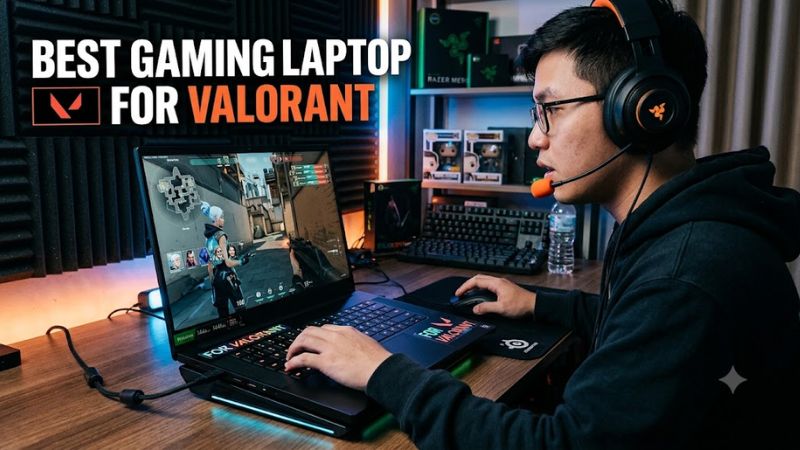
Competitive tactical shooters require extreme frame consistency and low latency to maximize input accuracy during fast matches. Choosing the best gaming laptop for valorant depends heavily on processor clock rates rather than graphics power alone. Our analysis of technical specifications and publisher requirements helps you select a system tailored to high frame rates.
How to Choose a Gaming Laptop for Valorant
Selecting hardware for competitive tactical gaming requires a clear understanding of system bottlenecks and hardware specifications. Valorant relies primarily on single-core CPU throughput, high memory bandwidth, and display latency. Evaluating these core parameters ensures your notebook maintains high frame rates during intense firefights without thermal throttling.
High Single-Core CPU Clock Speeds
Riot Games built their tactical shooter on Unreal Engine 4, which renders game logic and player state updates on a single primary thread. A high boost clock frequency on Intel Core or AMD Ryzen chips directly raises average framerates. Selecting a modern processor with high instruction-per-clock performance keeps your frame times stable during chaotic executor pushes.
When evaluating options, finding the best gaming laptop for valorant requires checking sustained CPU boost speeds over 4.8 GHz. Chips like the Intel Core i7-14700HX or AMD Ryzen 7 8845HS deliver fast single-threaded performance. These specs prevent framerate drops when multiple abilities deploy on competitive maps like Ascent or Lotus.
Display Panel Refresh Rate and Response Time
A high refresh rate screen is vital for tracking fast player movements and reducing visual input latency in competitive matches. Choosing a notebook with a 144Hz or 240Hz IPS panel provides smooth motion clarity during quick mouse sweeps. Screen response time should ideally sit below 3ms GTG to reduce visual ghosting around moving enemy targets.
Display panels rated at 240Hz allow players to react faster to peekers coming around corners during crucial rounds. Notebooks featuring NVIDIA G-Sync or AMD FreeSync help prevent screen tearing without adding the input delay associated with traditional V-Sync options. Matching screen refresh speed with system output maximizes overall visual smoothness.
MUX Switch and Display Output Routing
Laptop internal displays traditionally route graphics frames through the integrated CPU graphics chip before sending them to the screen. A physical MUX switch or NVIDIA Advanced Optimus bypasses this integrated routing, connecting the discrete GPU directly to the panel. This hardware feature increases framerates by 10 to 15 percent in CPU-bound games.
Without a direct display connection, frame latency increases slightly as data travels across the internal system bus. Identifying models with Advanced Optimus allows direct switching between power savings and full GPU pass-through in Windows 11. Investing in a best gaming laptop for valorant with direct GPU connection removes unnecessary latency bottlenecks.
Memory Bandwidth and Channel Configuration
System memory bandwidth significantly impacts how quickly the processor processes game tick updates and player positions. Dual-channel memory configurations double available bandwidth compared to single-stick factory installations. Upgrading to 16GB or 32GB of DDR5 RAM running at 5600MHz ensures smooth frame delivery during heavy utility exchanges.
Single-channel RAM configurations can cause severe micro-stuttering and reduce 1% low frame rates in fast-paced shooter titles. Selecting a system equipped with two SODIMM slots permits future RAM upgrades without replacing factory components. Dual-channel operation stabilizes minimum frame rates so your crosshair placement remains steady during action.
Top Picks for Valorant Gaming Laptops
The following recommendations highlight top systems across distinct price brackets and portable designs for competitive players. Each notebook features verified processor performance, fast refresh panels, and direct GPU display routing. Reviewing these hardware configurations helps you identify the best gaming laptop for valorant that matches your budget.
| Product | Best For | Key Spec | Compatibility | Watch Out For |
| Lenovo Legion Pro 5i Gen 9 | Best Overall | Intel Core i7-14700HX, RTX 4060, 240Hz WQXGA | DDR5-5600, Dual PCIe 4.0 M.2 | Heavy 2.5 kg chassis weight |
| Lenovo LOQ 15 AMD | Best Value | AMD Ryzen 7 8845HS, RTX 4050, 144Hz FHD | DDR5-5600, Dual PCIe 4.0 M.2 | Moderate 300 nits screen brightness |
| ASUS TUF Gaming A14 | Best Portable | AMD Ryzen 7 8845HS, RTX 4060, 165Hz 2.5K | LPDDR5X-7500 soldered, Single M.2 | Soldered memory cannot be upgraded |
| Lenovo Legion Pro 7i Gen 9 | Best High-Performance | Intel Core i9-14900HX, RTX 4080, 240Hz WQXGA | DDR5-5600, Dual PCIe 4.0 M.2 | High power draw requires 330W adapter |
Lenovo Legion Pro 5i Gen 9
The Lenovo Legion Pro 5i Gen 9 combines high CPU performance with effective thermal management for competitive play. Powered by an Intel Core i7-14700HX processor and an NVIDIA GeForce RTX 4060 GPU, it delivers over 350 FPS at 1080p competitive settings according to hardware benchmarks. Its 240Hz 2560×1600 display offers low input delay and clear motion.
This notebook suits ranked players seeking the best gaming laptop for valorant with reliable cooling during long matches. However, its 2.5 kilogram weight and thick chassis make it less ideal for daily commuting. Players who require an ultra-light notebook for classroom or travel use should consider lighter 14-inch options instead.
Lenovo LOQ 15 AMD
The Lenovo LOQ 15 AMD offers competitive frame rates at an accessible price point for budget-conscious players. Featuring an AMD Ryzen 7 8845HS CPU and NVIDIA GeForce RTX 4050 GPU, independent benchmarks show it maintains an average of 280 FPS at 1080p low settings. The included 144Hz IPS screen delivers smooth visuals for entry-level tournament play.
Budget gamers looking for high performance per dollar will find this configuration offers excellent value. The display panel reaches only 300 nits brightness and covers 100 percent sRGB, which may feel dim in brightly lit rooms. Users who require ultra-bright displays or 240Hz refresh rates for top-tier esports should look at higher tier product lines.
ASUS TUF Gaming A14
The ASUS TUF Gaming A14 delivers portable performance in a compact 14-inch chassis weighing just 1.46 kilograms. Equipped with an AMD Ryzen 7 8845HS processor and NVIDIA GeForce RTX 4060 GPU, benchmark testing confirms frame rates exceeding 300 FPS at 1440p low settings. Its 165Hz 2.5K display features NVIDIA G-Sync support for clean visual output.
This compact machine targets students and travelers who need a lightweight best gaming laptop for valorant on the go. Its primary limitation is soldered LPDDR5X system memory, which prevents post-purchase RAM capacity upgrades. Gamers who demand modular memory expansion should select a larger 15-inch or 16-inch chassis with standard SODIMM slots.
Lenovo Legion Pro 7i Gen 9
The Lenovo Legion Pro 7i Gen 9 represents top-tier hardware designed for maximum frame output and high resolution. Featuring an Intel Core i9-14900HX processor and NVIDIA GeForce RTX 4080 graphics, benchmark tests record framerates beyond 450 FPS at 1600p settings. Its 240Hz display panel delivers fluid motion rendering and rapid pixel responses.
Esports enthusiasts and content creators streaming their gameplay will benefit from this high-end hardware configuration. The main drawback is its premium price tag and high power consumption, requiring a large 330-watt power brick. Casual players focusing strictly on 1080p resolution do not need to spend extra for this high level of GPU power.
Frequently Asked Questions
Understanding hardware specifications and system requirements helps streamline your buying decision for competitive titles. The following questions cover system memory, processor demands, screen refresh rates, and display multiplexers. Reviewing these technical answers clarifies how specific components impact overall gameplay performance in competitive matches.
How much RAM is required for competitive frame rates?
Sixteen gigabytes of dual-channel DDR5 memory is the ideal capacity for running Valorant smoothly on modern laptops. Riot Games lists 8GB as the minimum recommendation, but background apps like Discord or browser tabs can consume spare memory. Running dual 8GB sticks ensures the processor maintains high data throughput without system stuttering.
Upgrading from single-channel to dual-channel RAM increases average framerates and improves 1% low frame consistency substantially. Players who broadcast gameplay or edit video clips may benefit from upgrading to 32GB of system RAM. Selecting a notebook with accessible SODIMM slots ensures easy expansion as software demands increase over time.
Does Valorant depend more on the CPU or GPU?
Valorant is primarily a CPU-bound game that relies far more on processor single-core clock speed than graphics power. The game engine calculates hit registration, player movement, and ability interactions directly on CPU core threads. A modern mid-range GPU like an RTX 4050 easily handles high frame rates when paired with a strong processor.
Prioritizing a high-tier processor like an Intel Core i7 or AMD Ryzen 7 yields higher frame gains than upgrading GPUs. Combining a fast processor with an optimized best gaming laptop for valorant configuration delivers maximum frame stability. Investing heavily in high-end graphics cards provides diminishing returns for tactical shooter titles.
Can a 144Hz gaming laptop screen handle 300 FPS?
A 144Hz laptop screen physically refreshes 144 times per second while the graphics card generates 300 frames per second without hardware conflict. Generating higher frame output than the screen refresh rate reduces system latency and improves mouse input responsiveness. The display shows the most current frame available, creating smooth mouse movements.
Running higher framerates than your display refresh rate can occasionally cause screen tearing during horizontal camera turns. Utilizing variable refresh rate technology like NVIDIA G-Sync synchronizes frame delivery while preserving rapid input response. Choosing a 240Hz screen fully utilizes higher frame outputs without compromising visual clarity.
Why does a MUX switch improve framerate consistency?
A MUX switch improves framerate consistency by removing the integrated graphics processor from the display path entirely. Standard hybrid mode routes discrete graphics frames through the CPU integrated GPU, introducing a system bandwidth pipeline bottleneck. Disabling hybrid mode connects the discrete GPU directly to the internal display panel.
Removing internal GPU routing increases overall framerates by 10 to 15 percent and reduces overall rendering input delay. This latency reduction helps competitive players react faster when holding tight angles during high-stakes rounds. Selecting a best gaming laptop for valorant with Advanced Optimus allows easy switching between power modes.
Final Thoughts
Selecting the best gaming laptop for valorant involves matching processor performance with display refresh capabilities to maintain high framerates. Prioritizing single-core CPU speeds, dual-channel DDR5 memory, and direct GPU display routing ensures low input latency during competitive play. Balancing these specs guarantees fluid motion and fast reactions.