🛒 Best Price Today on Amazon
Prime members get fast, free shipping on everything above, plus member-only deals. New members get a 30-day free trial — cancel anytime.
Selecting the best amd gaming laptop requires balancing processing capacity, thermal limits, and graphics card pairing. Modern mobile platforms utilize multi-core Zen architecture to deliver exceptional efficiency and frame rate consistency across competitive titles. Understanding hardware trade-offs ensures you buy the ideal mobile machine.
How to Choose an AMD Gaming Laptop
Finding a high-performance portable rig involves evaluating core components, system memory bandwidth, thermal design, and component compatibility. Shopping for the best amd gaming laptop means matching internal specifications against target display resolutions. Reviewing these key hardware pillars helps prevent bottlenecks and maximizes frame throughput.
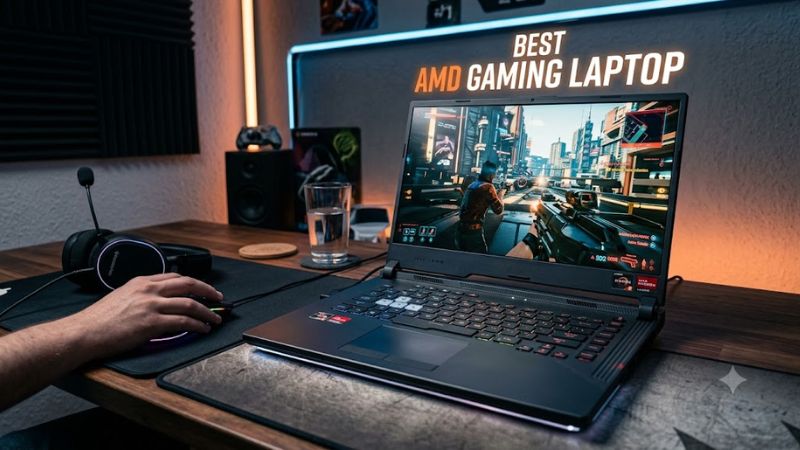
Target High L3 Cache for Frame Consistency
Processor cache size directly dictates low 1% frame times in complex gaming environments. Mobile chips with stacked 3D V-Cache, such as the Ryzen 9 7945HX3D, feature 144MB of total cache to keep graphics cards fully saturated. This architecture reduces main memory requests during intense rendered scenes like massive multiplayer battles.
Systems equipped with enlarged cache structures maintain higher average frame rates without pulling extra power from the wall. The Asus ROG Strix Scar 17 X3D leverages this design to deliver desktop-grade simulation performance inside a portable notebook chassis. Prioritizing cache benefits CPU-bound titles that demand fast data access.
Match System Memory Speed and Upgradeability
Modern mobile processors perform best when paired with fast DDR5 system memory operating in dual-channel mode. Selecting a platform with 32GB of DDR5-5600 RAM ensures sufficient bandwidth for simultaneous gaming, voice chat, and background asset streaming. Unsoldered SO-DIMM slots allow future capacity expansions up to 64GB.
Certain compact designs utilize soldered LPDDR5X memory to conserve interior space and reduce weight. While faster frequency ratings like LPDDR5X-6400 compensate for tight timings, they permanently fix total memory size at purchase. Gamers seeking long-term hardware flexibility should choose dual-slot SODIMM board configurations instead.
Balance GPU Thermal Envelope and Chassis Size
Graphics card performance relies heavily on total graphics power allocation within the chassis. A mid-tier NVIDIA GeForce RTX 4070 operating at 140W often matches a constrained high-tier GPU running in an ultra-thin frame. A well-built best amd gaming laptop balances vapor chamber thermal designs against chassis thickness.
Heavy gaming laptops offer robust dual-fan heatsinks that sustain sustained boost clock frequencies during multi-hour gaming sessions. Sleek 14-inch notebooks prioritize portability but require lower power caps to maintain acceptable skin temperatures. Reviewing system wattage ratings prevents purchasing thermal-throttled graphics.
Check Smart Access Architecture and Display Compatibility
All-AMD configurations utilize SmartAccess Memory and SmartShift technologies to dynamically allocate power between processor and graphics core. Choosing an Advantage Edition system ensures direct PCIe bus access between components for enhanced asset loading. Integrated display controllers must support FreeSync Premium.
Modern display panels demand proper multiplexer switch integration or Advanced Optimus support to bypass integrated graphics. Connecting the dedicated GPU straight to the internal display eliminates latency and increases frame output by up to fifteen percent. Ensure your selected model features HDMI 2.1 or DisplayPort over USB-C.
Top Recommended AMD Gaming Laptop Models
Selecting top mobile hardware requires evaluating real-world cooling efficiency, display quality, port selection, and overall chassis stability. Finding the best amd gaming laptop depends on whether you value maximum frame output, sleek ultraportable design, or budget value. Our featured models highlight the top options on the market.
| Product | Best For | Key Spec | Compatibility | Watch Out For |
| Asus ROG Strix Scar 17 X3D | Best Overall Performance | Ryzen 9 7945HX3D / RTX 4090 | DDR5 SODIMM / PCIe Gen4 | 16:9 Display / Short Battery Life |
| Lenovo Legion Pro 5 Gen 9 | Best Value | Ryzen 7 8845HS / RTX 4070 | DDR5 SODIMM / PCIe Gen4 | Bulky Power Brick / Plastic Deck |
| Asus ROG Zephyrus G14 | Best Portable Gaming | Ryzen 9 8945HS / RTX 4070 | Soldered LPDDR5X / PCIe Gen4 | Non-Upgradeable RAM / Lower TGP |
| Asus TUF Gaming A16 | Best All-AMD System | Ryzen 9 7940HS / RX 7700S | DDR5 SODIMM / PCIe Gen4 | Dim Base Panel / No DLSS Support |
Asus ROG Strix Scar 17 X3D
Buyers seeking uncompromised frame rates in flagship gaming titles should consider this high-end notebook. Featuring an AMD Ryzen 9 7945HX3D processor and NVIDIA GeForce RTX 4090 graphics card, this unit delivers unparalleled mobile frame rates. Installing the best amd gaming laptop on your desk gives desktop-level computing output.
System memory includes 32GB of DDR5-4800 RAM alongside a fast 1TB PCIe Gen4 solid state drive. The primary weakness centers on its legacy 16:9 1440p 240Hz screen capped at 350 nits and a weak 720p webcam without IR facial recognition. Mobile workers requiring all-day battery life or ultraportable dimensions should avoid this heavy unit.
Lenovo Legion Pro 5 Gen 9 AMD
Mid-range enthusiasts seeking optimal price-to-performance metrics will find this configuration highly effective. Equipped with an AMD Ryzen 7 8845HS processor and NVIDIA GeForce RTX 4070 graphics card, it runs modern titles smoothly at native 1600p resolution. Dual DDR5 SODIMM slots provide straightforward system memory upgrade paths.
The 16-inch WQXGA panel offers a 165Hz refresh rate with 500 nits of peak brightness for vibrant gameplay visuals. However, the heavy power adapter and slight flex on the plastic keyboard deck decrease travel appeal. Buyers who want an ultra-thin notebook or aluminum chassis build should explore thinner alternative product lines.
Asus ROG Zephyrus G14
Frequent travelers and college students needing strong graphics capability in a sleek body will appreciate this 14-inch model. It combines an AMD Ryzen 9 8945HS chip with an NVIDIA GeForce RTX 4070 graphics processor inside a thin aluminum chassis. Finding a balanced best amd gaming laptop in a lightweight form factor is easy here.
The standout 3K OLED panel displays vivid colors with a 120Hz refresh rate and deep contrast ratios. The trade-off involves soldered LPDDR5X memory that prevents post-purchase RAM upgrades and a reduced 90W graphics thermal limit. Gamers requiring maximum graphics wattage or modular expansion slots should pass on this compact frame.
Asus TUF Gaming A16 Advantage Edition
Gamers who prefer open-source graphics software stacks and synchronized AMD hardware will favor this all-AMD configuration. Combining an AMD Ryzen 9 7940HS CPU with an AMD Radeon RX 7700S graphics card, it fully utilizes SmartShift power optimization. Dual M.2 PCIe Gen4 drive slots allow rapid storage capacity additions.
The 16-inch chassis includes a spacious keyboard and broad port selection featuring USB 4.0 connectivity. Real weaknesses include the lack of NVIDIA DLSS upscaling technology and a dim 250-nit baseline screen on entry configurations. High-end buyers expecting ray-tracing hardware supremacy or premium metal decks should shop higher tiers.
Frequently Asked Questions
Selecting modern hardware requires answering core questions about processor efficiency, memory standards, and graphics integration. Evaluating the best amd gaming laptop market involves checking cooling capacity, platform upgradeability, and thermal envelopes. These direct answers clarify common questions before your final purchase.
Why Choose an AMD Processor for Gaming Laptops?
AMD mobile processors offer superior power efficiency and higher core density compared to competing mobile hardware chips. Advanced Zen core architecture manufactured on compact node processes delivers high multi-threaded performance while drawing less battery power during daily tasks. This efficiency reduces fan noise under workload.
Additionally, integrated Radeon graphics cores allow basic media streaming without engaging the dedicated graphics processing unit. This battery preservation mechanism provides extended unplugged runtime for web browsing and office productivity. Gamers gain strong multi-tasking capacity without sacrificing full unplugged flexibility.
What Is the Difference Between Ryzen HS and HX Processors?
Ryzen HX series processors are high-power desktop silicon adapted for laptops, whereas HS processors prioritize battery efficiency. The HX series targets maximum sustained clock speeds and higher thermal power limits for heavy workstation computing. HS models operate within tighter 35W to 54W envelopes suitable for thin chassis designs.
Choosing between these platforms depends on whether you value portable battery efficiency or stationary processing horsepower. HX models support enthusiast tuning options inside larger thermal frames with comprehensive liquid metal heatsinks. HS models maintain lower heat output, making them ideal for everyday backpack transport.
Can You Upgrade RAM in Modern AMD Gaming Laptops?
RAM upgradeability depends entirely on whether the laptop manufacturer uses standard SODIMM slots or soldered LPDDR5X memory. Large chassis designs like the Legion Pro series feature two accessible SODIMM slots for easy memory expansion. Ultra-thin notebooks often solder memory modules directly to the mainboard to conserve space.
Verifying internal motherboard layout before purchasing prevents running into unexpected memory capacity limitations later. Unsoldered slots allow upgrading from baseline 16GB configurations to 32GB or 64GB DDR5 memory sets over time. Always check spec sheets to confirm whether RAM modules are removable or permanently attached.
How Does 3D V-Cache Benefit Laptop Gaming Performance?
3D V-Cache increases processor L3 cache size to dramatically lower frame rendering latency in CPU-bound video games. By stacking extra static memory directly on top of the processing die, the CPU accesses game engine data much faster. This hardware layout eliminates frame drops during heavy physics and strategy calculations.
Titles like flight simulators and open-world RPGS experience significant performance gains in minimum 1% low frame metrics. Higher cache capacity keeps the graphics processor fed with instructions without relying on slower system DRAM. While higher in cost, this technology delivers smoother gameplay in demanding simulation games.
Final Thoughts
Choosing the best amd gaming laptop comes down to identifying your performance priorities, preferred screen size, and target budget. Whether you prioritize the unmatched cache capacity of X3D processors or the portability of thin 14-inch designs, modern platforms offer outstanding efficiency. Select your model to enjoy high-level mobile gaming.