🛒 Best Price Today on Amazon
Prime members get fast, free shipping on everything above, plus member-only deals. New members get a 30-day free trial — cancel anytime.
If you are choosing between Valve’s two Steam Deck designs, steam deck oled vs lcd comes down to display quality, battery life, wireless hardware and price more than raw speed. OLED is lighter and more efficient, while LCD makes sense when a low-cost refurbished unit is available.
How to Choose Steam Deck
The practical choice starts with the screen, then battery capacity, wireless hardware and purchase cost. Both models use a Zen 2 CPU, eight RDNA 2 compute units and a 1280×800 target, so this is not a different performance class. Valve’s new retail lineup is OLED, while LCD now mainly appears as refurbished stock.
Display and refresh rate
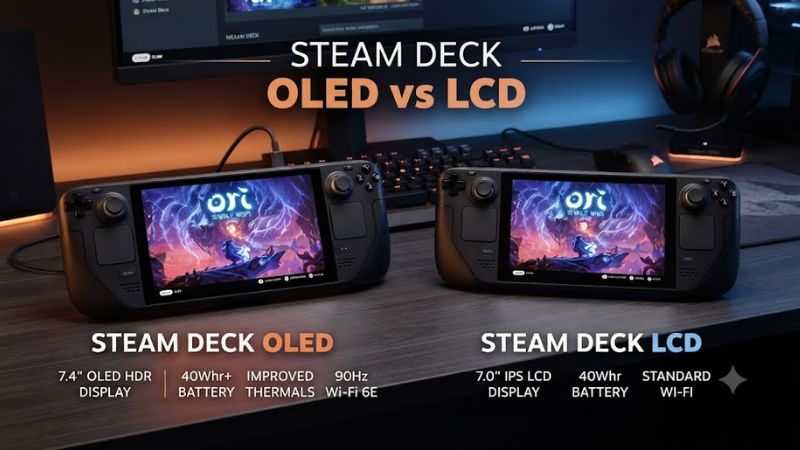
For steam deck oled vs lcd, the display is the clearest everyday difference. OLED uses a 7.4-inch 1280×800 HDR panel with a 90Hz ceiling, while LCD uses a 7-inch 1280×800 panel with up to 60Hz. OLED also provides deeper blacks and stronger contrast, especially in darker games.
Both displays target the same 1280×800 resolution, so compatibility is straightforward. The 90Hz OLED setting does not mean every game reaches 90 fps; demanding titles can remain around 30–45 fps. Even there, OLED can feel more responsive, while HDR is another display feature unavailable on the LCD model.
Battery and weight
The OLED model has a 50Wh battery versus 40Wh in the LCD model, and Valve rates them at 3–12 hours and 2–8 hours respectively, depending on content. OLED weighs about 640g, compared with about 669g for LCD, giving the newer model both more battery capacity and a lighter body.
Independent results vary with games and settings. GamersNexus measured OLED lasting 36% longer than LCD in Dead Cells using each device’s native resolution and refresh rate, while F1 2023 showed a 57% advantage with 50% brightness, medium settings and uncapped frame rates.
Wireless and thermals
OLED uses Wi-Fi 6E and Bluetooth 5.3, while LCD uses Wi-Fi 5 and Bluetooth 5.0. Valve also redesigned OLED cooling with a larger fan and updated thermal hardware. These changes matter more for wireless performance, heat and sustained comfort than for a major increase in game frame rates.
Both versions run SteamOS and support the same Steam Deck software ecosystem. Each can connect displays and peripherals through USB-C, while microSD expansion is supported across the range. OLED’s Wi-Fi 6E benefit requires a compatible network; an older router will not gain Wi-Fi 6E speeds.
Price and storage
Current U.S. pricing makes the comparison unusual. Since May 2026, Valve lists the 512GB OLED at $789 and the 1TB OLED at $949, while new LCD models have disappeared from the current retail lineup. Certified Refurbished LCD units remain a possible lower-cost route when stock is available.
Storage also changes the value equation. The 512GB OLED uses an NVMe SSD, while the 1TB OLED doubles capacity and adds premium anti-glare etched glass. Refurbished LCD models can use 256GB or 512GB NVMe storage. All configurations support microSD expansion, but refurbished condition and stock should be checked before purchase.
Top Picks for Steam Deck Buyers
The buying choice is narrower than a normal hardware roundup because Valve’s current new lineup is OLED-only, while LCD is mainly a refurbished option. The four entries below represent practical configurations a buyer may encounter. Refurbished availability changes frequently, so old LCD prices should not be treated as current retail pricing.
| Product | Best For | Key Spec | Compatibility | Watch Out For |
| Steam Deck OLED 512GB | Best Overall | 7.4-inch OLED, 50Wh | SteamOS; 1280×800; Wi-Fi 6E | $789 current U.S. price |
| Steam Deck OLED 1TB | Best For large libraries | 1TB NVMe, etched glass | SteamOS; 1280×800; Wi-Fi 6E | $949 current U.S. price |
| Steam Deck LCD 256GB refurbished | Best Value | 7-inch LCD, 40Wh | SteamOS; 1280×800; Wi-Fi 5 | Stock varies |
| Steam Deck LCD 512GB refurbished | Best For cheap capacity | 512GB NVMe, 40Wh | SteamOS; 1280×800; Wi-Fi 5 | Older display and battery |
Steam Deck OLED 512GB
The 512GB OLED is the most balanced choice if you want a new Steam Deck and care about the screen, battery and weight. Its 7.4-inch HDR OLED panel, 90Hz refresh rate, 50Wh battery and 640g weight address the areas where LCD is most dated, while 512GB NVMe storage suits a focused library.
Its main weakness is the current $789 U.S. price, far above the former $549 launch price. Buyers focused only on the lowest cost should not choose it if a much cheaper certified refurbished LCD is available. The core 1280×800 performance target remains broadly similar between the two models.
Steam Deck OLED 1TB
The 1TB OLED targets players with large installed libraries who want the same OLED experience with more internal storage. It retains the 7.4-inch 1280×800 HDR display, 90Hz ceiling, 50Wh battery and Wi-Fi 6E, while adding 1TB NVMe storage and premium anti-glare etched glass.
Its real weakness is value at $949 in the U.S. The extra storage is convenient, but microSD expansion works across the Steam Deck family, so buyers comfortable managing installed games may not need 1TB. It suits large local libraries better than buyers whose priority is minimizing purchase cost.
Steam Deck LCD 256GB refurbished
The 256GB LCD is the price-led option when a Valve Certified Refurbished unit is available. Its 1280×800 display, 60Hz ceiling, 40Wh battery and 669g weight are older than OLED, but the Zen 2 and RDNA 2 platform remains compatible with the same SteamOS ecosystem and Steam library.
Its weakness is the screen and battery experience rather than software compatibility. Valve says Certified Refurbished units receive the same one-year warranty as new units, although stock is limited and fluctuates. Skip this option if its price approaches OLED pricing, because OLED offers a larger panel and bigger battery.
Steam Deck LCD 512GB refurbished
The 512GB LCD can make sense when refurbished pricing provides substantially more storage for much less money than OLED. Its 512GB NVMe SSD, 1280×800 LCD panel, 40Wh battery and Wi-Fi 5 retain the core Steam Deck platform, while microSD expansion can add capacity later.
The compromise is the older display, battery and wireless design. GamersNexus found OLED performance ranging from essentially tied to roughly 7% higher across several matched 720p tests, so LCD is not automatically slower by a large margin. Choose it for price and storage, not for a higher frame-rate class.
FAQ: Steam Deck OLED vs LCD
The short answer to steam deck oled vs lcd is that OLED is the stronger new purchase, while LCD becomes attractive when a genuinely low refurbished price changes the value equation. The biggest differences are the screen, battery, wireless hardware, weight and availability, while core gaming performance remains broadly similar.
Is Steam Deck OLED faster than LCD?
Steam Deck OLED is only modestly faster than LCD in independent game benchmarks, not a major performance-generation change. GamersNexus measured Red Dead Redemption 2 at 720p with the Favor Performance preset at 49.7 fps on LCD and 53 fps on OLED, while Cyberpunk 2077 at 720p Low with FSR 2.1 Quality measured 44 fps and 44.6 fps respectively.
The OLED advantage comes from its 6nm APU and faster LPDDR5-6400 memory rather than a new CPU or GPU architecture. Both retain four Zen 2 CPU cores and eight RDNA 2 compute units, so frame-rate expectations remain in the same broad class. The higher refresh display can improve responsiveness even below 90 fps.
Is Steam Deck OLED battery life better?
Steam Deck OLED battery life is better according to Valve’s rated range and independent comparisons. Valve lists 3–12 hours for OLED versus 2–8 hours for LCD, with actual runtime changing substantially with game workload, brightness and frame-rate limits.
GamersNexus recorded 36% longer runtime for OLED in Dead Cells under its native-resolution and refresh-rate method, and 57% longer in F1 2023 using 50% brightness, medium settings and uncapped frame rate. These figures are useful comparisons because their conditions are stated, but they should not become fixed runtime expectations for every game.
Does Steam Deck OLED have a better screen?
Steam Deck OLED has a better screen for most handheld gaming because it is larger, supports HDR and reaches 90Hz, while LCD remains 7 inches at 60Hz. Both keep 1280×800 resolution, so the upgrade is about panel technology, refresh rate, contrast and size rather than additional pixels.
OLED is also part of a lighter 640g design compared with about 669g for LCD. Digital Foundry’s input-lag measurements found lower total latency on OLED in several tests, including when both devices ran at 60 fps. That makes the display change relevant to responsiveness as well as image quality.
Should you buy Steam Deck OLED or LCD in 2026?
You should buy Steam Deck OLED in 2026 if you want a new unit, because Valve’s current retail lineup lists 512GB and 1TB OLED models while LCD is no longer part of the new lineup. The decision changes when a Certified Refurbished LCD is substantially cheaper and you accept its older display, battery and wireless hardware.
Current Valve pricing is $789 for 512GB OLED and $949 for 1TB OLED in the U.S. Certified Refurbished LCD stock can fluctuate, with Valve’s program covering older 256GB and 512GB configurations. Check actual availability before buying because historical LCD prices do not represent guaranteed current stock.
Final Thoughts
For steam deck oled vs lcd, OLED is the better fit for a new purchase because its 7.4-inch 90Hz HDR screen, 50Wh battery, lower weight and Wi-Fi 6E improve daily use without changing core compatibility. LCD remains compelling when refurbished pricing is low enough to outweigh those upgrades.