🛒 Best Price Today on Amazon
Prime members get fast, free shipping on everything above, plus member-only deals. New members get a 30-day free trial — cancel anytime.
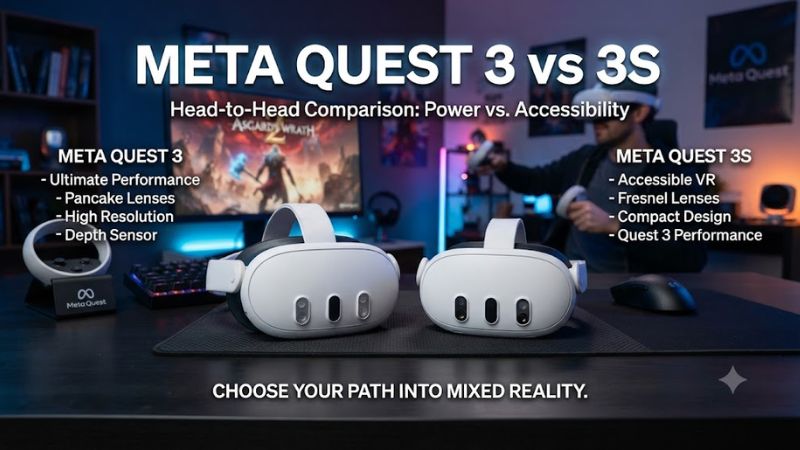
Meta Quest 3 vs 3S is mainly a choice between better optics and a lower entry price, because both headsets use Snapdragon XR2 Gen 2, 8GB of memory, Touch Plus controllers and color passthrough. The Quest 3 adds pancake lenses, higher per-eye resolution, a wider field of view and a depth sensor, while the 3S keeps the lower-cost Fresnel design.
How to Choose Between Meta Quest Headsets
The four main criteria are price, optical quality, storage and compatibility. Meta currently lists Quest 3S from around $350 and Quest 3 from around $600 in the US, so the 3S is the cheaper starting point. For regular VR use, the Quest 3’s pancake lenses and higher resolution matter more than the shared processor, while both models support standalone Quest software and PC VR through Meta Quest Link.
Price and Value
For buyers focused on entry cost, the Meta Quest 3S is the straightforward choice. Meta lists the 128GB version at around $350 and the 256GB version at around $450, giving shoppers two storage tiers below the current Quest 3 starting price. This makes the 3S particularly suitable when VR is new to the buyer or the headset will be shared occasionally.
The trade-off is that the lower price comes from the optical system rather than from a weaker processor. The 3S still uses Snapdragon XR2 Gen 2 and 8GB of memory, so choosing it does not mean moving to an older performance platform. Buyers should therefore view the 3S as a cheaper optical configuration rather than a slower Quest 3.
Lenses and Image Quality
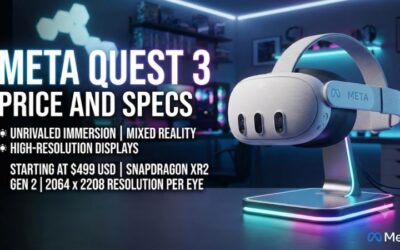
The biggest reason to choose Quest 3 is its pancake optics. Meta lists 2,064 × 2,208 pixels per eye and a 110-degree horizontal field of view, compared with 1,832 × 1,920 pixels and 96 degrees horizontally on Quest 3S. The Quest 3 also uses continuous IPD adjustment, while 3S has three preset positions.
This difference matters most for reading text, productivity, simulators and applications where your eyes move around the image frequently. Independent comparisons also identify the Quest 3’s larger clear viewing area as a major advantage, while the 3S retains the narrower optical sweet spot associated with its Fresnel design.
Storage and Long-Term Use
The Meta Quest 3S comes in 128GB and 256GB configurations, while Meta’s current comparison page lists Quest 3 with 512GB storage. Storage cannot be expanded internally, so the larger Quest 3 capacity can be useful for buyers who expect to keep many large games and applications installed simultaneously.
Storage does not change graphics performance, however. The 3S and Quest 3 share the same Snapdragon XR2 Gen 2 platform and 8GB memory, meaning the storage decision should be separated from the performance decision. A buyer who regularly removes older games can save money with the 3S without moving to a slower processor.
Compatibility and PC VR
For compatibility, Meta Quest 3 vs 3S is unusually close. Both are standalone Horizon OS headsets, both use Touch Plus controllers, and both support PC VR through Meta Quest Link using a cable or Air Link over Wi-Fi. Meta’s current developer documentation lists both models with USB-C connectivity and Wi-Fi 6E.
For PC VR, the headset is only one part of the requirement because the computer must meet Meta’s Link requirements. Meta documents Link support on Windows, while development documentation specifies Windows 10 or newer 64-bit for supported development workflows. A compatible USB-C data connection or suitable Wi-Fi network is also needed for the PC connection.
Top Picks: Quest 3S and Quest 3 Configurations
The comparison below treats current storage variants and the limited Xbox Edition as buying configurations rather than pretending there are four different hardware platforms. The underlying Quest 3S configurations use the same processor, memory, display system and tracking hardware, while the Quest 3 512GB provides the higher-end optical design. Meta’s current specifications confirm the core hardware differences.
| Product | Best For | Key Spec | Compatibility | Watch Out For |
| Meta Quest 3 512GB | Best Overall | 2,064 × 2,208 per eye, pancake lenses | Standalone Horizon OS, PC VR | Higher price |
| Meta Quest 3S 128GB | Best Value | XR2 Gen 2, 8GB | Standalone Horizon OS, PC VR | Lower storage |
| Meta Quest 3S 256GB | Best For Larger Game Libraries | 256GB, XR2 Gen 2 | Standalone Horizon OS, PC VR | Fresnel optics |
| Quest 3S Xbox Edition 128GB | Best For Xbox Fans | XR2 Gen 2, 128GB | Quest VR, PC VR, Xbox Cloud Gaming | Limited availability |
Best Overall: Meta Quest 3 512GB
The Quest 3 512GB is the strongest general-purpose choice because it combines the current Quest 3 platform with pancake lenses, 2,064 × 2,208 resolution per eye, continuous IPD adjustment and a 110-degree horizontal field of view. It also includes a depth sensor for its color passthrough system.
The main weakness is price: Meta currently lists Quest 3 from around $600, substantially above the 3S entry point. Someone who mainly wants occasional Beat Saber-style sessions or wants to minimize the initial purchase cost should not pay that premium simply for the same Snapdragon XR2 Gen 2 platform.
Best Value: Meta Quest 3S 128GB
The Quest 3S 128GB is the clearest value pick when budget matters most. It retains the XR2 Gen 2 processor, 8GB memory, Touch Plus controllers and color passthrough while using a 1,832 × 1,920-per-eye display and Fresnel lenses. Meta currently lists it at around $350 in the US.
Its real weakness is optical quality rather than compute capability. The narrower field of view, lower resolution and three-position IPD adjustment make it less appealing for frequent text-heavy use, productivity or buyers upgrading specifically for sharper visuals. A first-time VR buyer with a tight budget should still find its hardware platform appropriate.
Best For Larger Libraries: Quest 3S 256GB
The 256GB Quest 3S is the practical middle option for buyers who want more internal storage without moving to the Quest 3 price tier. Meta lists the model at around $450, while the underlying hardware remains based on Snapdragon XR2 Gen 2 and 8GB of memory.
The weakness is that additional storage does not improve the display. The Meta Quest 3S 256GB still uses the 1,832 × 1,920-per-eye display, Fresnel lenses and three-position IPD system. Buyers should choose it for capacity, not because it provides the optical improvements associated with Quest 3.
Best For Xbox Fans: Quest 3S Xbox Edition
The Quest 3S Xbox Edition is a limited 128GB version of the 3S rather than a faster headset. The bundle launched with an Xbox Wireless Controller, Elite Strap and subscription benefits, while the headset itself retains the Quest 3S platform. Xbox and Meta documentation identify the Xbox Edition as a supported Quest device.
Its weakness is availability rather than core hardware. Current retail listings can vary because the edition was limited, so buyers should not pay a large premium merely for the special finish. For someone without a strong interest in Xbox accessories or the included bundle, the standard Quest 3S 256GB offers a simpler capacity-focused purchase.
FAQ: Meta Quest 3 vs 3S Buying Questions
The most important buying questions concern image quality, performance, PC VR and value. In each case, the answer depends less on raw processing power than on the optical design, storage capacity and intended use, because the two headsets share the same Snapdragon XR2 Gen 2 platform and 8GB memory.
Is Meta Quest 3 better than Quest 3S?
Yes, Meta Quest 3 is better overall when display clarity, lens quality and storage matter. Its pancake lenses, 2,064 × 2,208 resolution per eye, 110-degree horizontal field of view and continuous IPD adjustment give it a more capable optical system than the Quest 3S.
The 3S remains attractive because it uses the same XR2 Gen 2 processor and 8GB memory. That means the extra cost of Quest 3 primarily buys a better viewing system and more storage rather than a faster CPU or GPU platform, which is why budget-focused buyers can reasonably choose 3S.
Is Quest 3S as powerful as Quest 3?
Yes, Quest 3S and Quest 3 use the same Snapdragon XR2 Gen 2 chipset and 8GB of onboard memory. Meta’s device comparison lists both with the same processor and memory configuration, so the 3S is not a cut-down performance model.
The visible difference comes from the display and optical hardware. Quest 3 has higher per-eye resolution, pancake lenses and a wider field of view, while Quest 3S uses the lower-resolution Fresnel configuration. Both support the same Quest 3-generation application platform.
Can Quest 3S play PC VR games?
Yes, Quest 3S can play PC VR through Meta Quest Link or Air Link, just like Quest 3. Meta lists both headsets as supporting PC VR through the Meta Quest Link application with either a Quest Link cable or an Air Link connection over Wi-Fi.
For wired use, the connection needs a suitable USB-C data cable, while wireless use depends on the PC and network setup. Meta’s documentation also notes that Link is currently supported on Windows, so PC buyers should verify their computer and software environment before choosing either headset for PC VR.
Should you buy Quest 3 or Quest 3S?
You should buy Quest 3 if you expect frequent VR use and care about clearer optics, wider viewing and more storage; otherwise, Quest 3S is the lower-cost route to the same core standalone platform. Meta currently lists Quest 3 from around $600 and Quest 3S from around $350 in the US.
For someone new to VR, the 128GB 3S is the easier entry point, while the 256GB 3S suits buyers who want more installed content. Quest 3 makes more sense when optical clarity is a priority or when 512GB storage justifies the additional spending over the cheaper 3S configurations.
Final Thoughts
Meta Quest 3 vs 3S ultimately comes down to whether better optics justify the higher price. Quest 3 offers the sharper display, pancake lenses, wider view and 512GB storage, while Quest 3S keeps the same core performance at a lower entry cost. Choose 3S for value and Quest 3 for optical quality and long-term use.