🛒 Best Price Today on Amazon
Prime members get fast, free shipping on everything above, plus member-only deals. New members get a 30-day free trial — cancel anytime.
For PC gamers, best vr glasses now span standalone headsets, PC-compatible mixed-reality devices and newer glasses-style hardware. The right choice depends on optics, tracking, software support and how much PC hardware you already own.
How to Choose VR Glasses
The best VR glasses should match four practical factors: display quality, compatibility, tracking and the way you play. Quest 3 is the strongest all-round option, Quest 3S lowers the entry cost, Meta VR Glasses target a lighter glasses-style design, while PS VR2 makes sense for buyers who already use PS5 or have a suitable Windows gaming PC.
Display and optical quality
For image clarity, look beyond the headline resolution and check the optical system. Quest 3 uses pancake lenses with 2,064 × 2,208 pixels per eye, while Quest 3S uses 1,832 × 1,920 pixels per eye and a simpler optical design. Meta VR Glasses use micro-OLED displays at 2,412 × 2,288 pixels per eye and reach 37 pixels per degree, giving them a different balance between glasses-like form and immersive viewing.
If you spend long sessions reading menus, simulators or desktop text, optical clarity matters as much as raw resolution. Quest 3 offers a 110-degree horizontal field of view, compared with 96 degrees for Quest 3S, while Meta VR Glasses provide a narrower 70-degree horizontal field of view because their design leaves more of the surrounding world visible.
PC and platform compatibility
Compatibility should be checked before buying because VR devices do not all connect to gaming PCs in the same way. Quest 3 and Quest 3S are standalone Horizon OS devices that can also serve PC VR use cases, while PS VR2 requires Windows 10 or Windows 11, a compatible GPU, DisplayPort 1.4, USB 3.0 and Bluetooth 4.0 or later for PC operation.
For a Windows gaming setup, PS VR2 has clearly defined minimum requirements: Intel Core i5-7600 or AMD Ryzen 3 3100, 8GB RAM, and a supported NVIDIA or AMD GPU. Sony recommends an RTX 3060 or newer or Radeon RX 6600 XT or newer for stronger performance, and the DisplayPort connection must come directly from the PC.
Tracking and gaming features
Tracking changes how naturally a headset works in games. Quest 3 and Quest 3S provide head and hand tracking, while Meta VR Glasses add eye tracking alongside hand tracking and can use optional controllers. PS VR2 combines its display with headset and controller tracking, but some PS5-specific features such as HDR, eye tracking and adaptive triggers are unavailable when the headset is used on PC.
For PC gaming, that means the most feature-rich headset on paper is not automatically the best match. Quest models prioritize a flexible standalone ecosystem, Meta VR Glasses emphasize a more open wearable design, and PS VR2 is particularly attractive when PS5 gaming is part of the same setup. Your existing platform can therefore matter more than a single specification.
Comfort and long-session use
Comfort depends on the headset’s weight distribution, optical adjustment and how much hardware sits around your face. Meta VR Glasses separate computing into a dedicated puck and leave the peripheral area open, while Quest 3 and Quest 3S use a conventional enclosed headset shape.
Prescription-lens support also deserves attention before purchase. Quest 3 includes an eye-relief adjustment, while Quest 3S includes a glasses spacer, so people who normally wear spectacles can use either device with the appropriate setup. The exact comfort result still depends on frame shape, facial fit and session length.
Top Picks
The best vr glasses choice depends on whether you prioritize broad PC compatibility, lower cost, optical clarity or the lighter glasses-style approach. The four picks below cover those different buying priorities while keeping the platform requirements visible. Current manufacturer information lists Quest 3 and Quest 3S as Horizon OS all-in-one headsets, while Meta VR Glasses use a glasses-plus-compute-puck design.
| Product | Best For | Key Spec | Compatibility | Watch Out For |
| Meta Quest 3 | Best Overall | 2,064 × 2,208 per eye; 120Hz | Standalone; PC VR | More enclosed than glasses |
| Meta Quest 3S | Best Value | 1,832 × 1,920 per eye; 120Hz | Standalone; PC VR | Fresnel optics |
| Meta VR Glasses | Best For glasses-style VR | 2,412 × 2,288 per eye; 120Hz | Meta Horizon OS; compute puck | 70° horizontal FOV |
| PlayStation VR2 | Best For PS5 and wired PC VR | 2,000 × 2,040 per eye; 110° FOV | PS5; Windows PC with adapter | PC loses several PS5 features |
Meta Quest 3: Best Overall
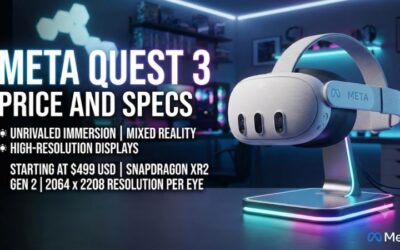
Quest 3 is the strongest general recommendation because it combines standalone gaming, mixed reality and PC VR in one device. Its Snapdragon XR2 Gen 2 platform, 8GB memory, pancake lenses and 120Hz maximum refresh rate give it a broad feature set without requiring a dedicated external tracking system.
It is also the pick for buyers who want one headset for both native VR games and a Windows gaming PC. The real weakness is its conventional headset form: people specifically seeking a lightweight glasses-like device may prefer Meta VR Glasses instead, while buyers who already own a PS5 may find PS VR2’s platform integration more useful.
Meta Quest 3S: Best Value
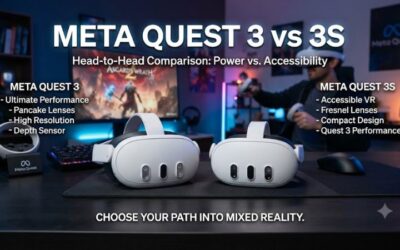
Quest 3S uses the same Snapdragon XR2 Gen 2 processor and 8GB RAM as Quest 3, giving it access to the same broad Quest software generation. Meta introduced it as the lower-cost member of the family, with a 120Hz maximum refresh rate and the same core mixed-reality capabilities.
The main compromise is its optical system. Its 1,832 × 1,920-per-eye resolution and Fresnel lenses are less refined than Quest 3’s pancake optics, so buyers who frequently read small text or care about edge-to-edge clarity should spend more on Quest 3. It is less suitable for those priorities.
Meta VR Glasses: Best For a Glasses-Style Design
Meta VR Glasses are the most literal match for the vr glasses search because they use a glasses form factor paired with a compute puck rather than the larger all-in-one Quest design. Meta lists micro-OLED displays, 2,412 × 2,288 pixels per eye, 120Hz refresh, eye and hand tracking, Snapdragon XR2 Gen 3 processing and 12GB memory.
The major weakness is immersion. Their 70-degree horizontal and 66-degree vertical field of view is substantially narrower than Quest 3’s 110-degree horizontal and 96-degree vertical view, so they are better suited to buyers who value open peripheral vision and a glasses-like form. They are not the obvious choice for maximum enclosed VR immersion.
PlayStation VR2: Best For PS5 and Wired PC VR
PS VR2 remains a strong option for gamers who already have a PS5 or want a wired PC VR setup. Its display provides 2,000 × 2,040 pixels per eye and a 110-degree field of view, while PC support opens access to SteamVR through Sony’s PC adapter and the required software.
PC buyers must account for additional hardware and compatibility requirements. Sony specifies Windows 10 or 11, 8GB RAM, a supported GPU, DisplayPort 1.4, USB 3.0 and Bluetooth 4.0 or later; on PC, HDR, eye tracking, adaptive triggers and several headset feedback features are unavailable.
FAQ
The best vr glasses question usually comes down to whether you need standalone gaming, PC VR, PS5 support or a glasses-style design. These four answers cover the buying decisions most relevant to PC gamers while separating specifications from platform requirements.
Are Meta Quest 3 and Quest 3S good for PC gaming?
Yes, Meta Quest 3 and Quest 3S can be used for PC VR as well as standalone gaming. Quest 3 has the stronger optical system, with 2,064 × 2,208 pixels per eye and pancake lenses, while Quest 3S uses 1,832 × 1,920 pixels per eye and a simpler optical design.
For someone buying one device to cover both native VR and a gaming PC, Quest 3 is the more complete choice. Quest 3S is more appropriate when the purchase price matters more than optical clarity, because both use the Snapdragon XR2 Gen 2 platform and support the same Quest software generation.
Are VR glasses the same as smart glasses?
No, VR glasses and smart glasses serve different purposes. VR devices create an immersive digital environment with dedicated displays and tracking, whereas many smart glasses focus on audio, cameras, notifications or a virtual screen without providing the same enclosed VR experience.
Meta’s newer VR Glasses blur that distinction somewhat because their physical design resembles glasses while still using dedicated displays, eye tracking, hand tracking and a compute puck. Their 70-degree horizontal field of view also reflects the more open design.
Can PS VR2 work with a Windows gaming PC?
Yes, PS VR2 works with a Windows gaming PC when paired with Sony’s PC adapter and a suitable DisplayPort 1.4 cable. The supported setup requires Windows 10 or 11, 8GB RAM, compatible NVIDIA or AMD graphics, DisplayPort 1.4, USB 3.0 and Bluetooth 4.0 or later.
Sony recommends an RTX 3060 or newer or Radeon RX 6600 XT or newer for better PC performance. PC mode also removes several PS5-specific capabilities, including HDR, eye tracking, adaptive triggers and some headset feedback features, so the experience is not identical across platforms.
Which VR glasses should PC gamers buy?
For most PC gamers, Meta Quest 3 is the safest overall choice because it combines strong optics, standalone operation, mixed reality and PC VR support. Quest 3S is the lower-cost alternative, while Meta VR Glasses are more interesting for buyers specifically seeking a glasses-style design.
PS VR2 becomes the stronger alternative when PS5 ownership or wired PC VR is central to the purchase. Before choosing, check the computer’s GPU, DisplayPort availability and USB requirements rather than assuming every VR headset will work with the same PC connection.
Final Thoughts
The best vr glasses choice in 2026 is ultimately about the platform and form factor you value most. Quest 3 offers the broadest balance for PC gaming, Quest 3S targets value, Meta VR Glasses prioritize a glasses-style experience, and PS VR2 suits PS5 owners and compatible Windows PCs.