PUBG asks two opposite things of the hand that holds the mouse. One moment you are holding a scoped shot steady on a helmet two compounds away, breathing out, barely moving. The next, a door swings open three metres in front of you and the whole match becomes one fast turn and a spray you have to pull back under control. A mouse that suits this game stays calm during the first job and loose during the second, and it keeps doing both in the last circles, when the session is hours old and your grip is no longer fresh.
This guide is written for three kinds of player: arm aimers who run low sensitivity across a wide pad, palm-grip players who want support through long looting phases, and fingertip players who steer with their fingers alone. Each pick is a wireless gaming mouse sold on Amazon, selected from the weight, sensor, battery and control figures printed on its own product page, and the four shapes below cover both symmetrical and right-handed shells.
Quick Picks
As an Amazon Associate we earn from qualifying purchases.
| Product | Best for | Key spec from title |
|---|---|---|
| ASUS ROG Harpe Ace Aim Lab Edition | Players who train their aim and swap between two PCs | ROG AimPoint 36K sensor, 54 g |
| Razer Cobra Pro | Players who bind many actions to a compact mouse | Focus Pro 30K sensor, 10 customizable controls |
| SteelSeries Aerox 5 Wireless | Claw players who want extra buttons in a light shell | TrueMove Air 18K sensor, 74 g |
| Razer Orochi V2 | Fingertip players with smaller hands | 18K optical sensor, up to 950-hour battery |
How to Choose
Start with the shell, because your grip is already fixed
Grip style is not a preference you can retrain in a weekend, so the shell has to fit the hand you already have. Palm players need length and a rear hump that carries the weight of the hand between fights. Claw players need a shorter body with room for the fingers to curl and pull the mouse back into the palm. Fingertip players need the least mouse of all: a small, light shell they can nudge without involving the wrist. Measure the mouse you use now, length and height, and compare those two numbers against any listing before you look at a single sensor figure.
Pick a DPI you can hold a spray with, then stop changing it
PUBG rewards a setting low enough that recoil control comes from a steady downward pull rather than from tiny wrist tremors. Most settled players sit somewhere between 400 and 1,200 DPI and adjust the in-game sliders around that anchor. Every sensor in this guide tracks cleanly far beyond what an arm can throw at it, so the sensor model is rarely the limiting factor. What ruins aim is switching settings every few days. Choose a figure, write it down, and give your arm two full weeks to learn it before you decide the mouse itself is the problem.
A steady wireless link beats a spectacular polling figure
Headline polling numbers are easy to print on a box and hard to feel in a firefight. A standard 1,000 Hz report rate already sends your aim to the PC every millisecond, and the gains above that are subtle even on fast monitors. What you can feel immediately is a receiver that drops packets because it sits behind a steel case or across the room. Place the dongle on the desk near the pad, use the extension lead when one is in the box, and judge a wireless mouse by whether the connection ever stutters during a full evening of play.
Count only the buttons your fingers will find under pressure
A PUBG fight asks for the two main clicks, the wheel, and usually two side buttons for lean or a throwable. Anything beyond that set has to earn its place by being reachable without loosening your grip mid-spray. Extra controls do help players who bind healing or push-to-talk to the mouse, but a crowded thumb cluster can also mean pressing the wrong input at the worst moment. Before ordering, look at a photo of the mouse and walk your thumb across it mentally: if you cannot picture each button’s job, you own too many buttons.
The 4 Best Options
ASUS ROG Harpe Ace Aim Lab Edition

The Harpe Ace Aim Lab Edition is the pick for players who treat aim as a trainable skill rather than a talent. Its ROG AimPoint sensor is rated to 36,000 DPI, the shell weighs 54 g, and the bundled Aim Lab Settings Optimizer is built to walk you toward a sensitivity that matches your arm. The shape is a compact right-handed shell that leans toward claw grip, and tri-mode connectivity is the practical headline: the 2.4 GHz receiver for your main PC, Bluetooth for a laptop, and a cable when you want the link beyond argument. Listed battery life reaches 90 hours, so the Bluetooth mode is a real option rather than an emergency fallback.
Specs
- Sensor: ROG AimPoint optical sensor
- Maximum DPI: 36,000
- Weight: 54 g
- Battery life: up to 90 hours
- Connection: 2.4 GHz RF, Bluetooth and wired USB
- Wireless technology: ROG SpeedNova
- Software: Aim Lab Settings Optimizer
- Shape: right-handed
Best for: players who split time between a desktop and a laptop and like structured aim practice.
Watch out for: the compact shell runs small under a full palm grip, so compare its length with the mouse you use now before ordering.
ASIN: B0BSKX9V7C
Razer Cobra Pro
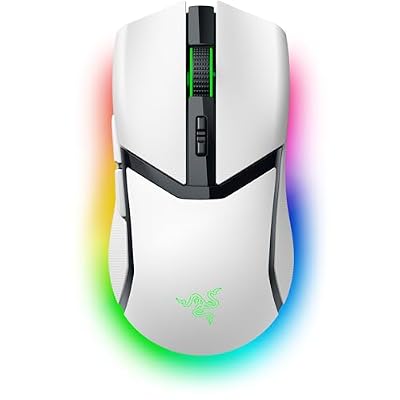
The Cobra Pro packs the control count of a much bigger mouse into a compact symmetrical shell. Ten customizable controls cover lean, throwables, healing and push-to-talk without stretching your movement fingers, and the Focus Pro 30K optical sensor with Gen-3 optical switches handles the serious work underneath. Three connection modes span the 2.4 GHz receiver, Bluetooth and a USB-C cable, the listed battery figure reaches up to 170 hours, and the 11-zone Chroma lighting with underglow gives it more presence on the desk than its size suggests. This white listing suits claw and fingertip players who still want a full set of bindings under the thumb.
Specs
- Sensor: Razer Focus Pro 30K optical sensor
- Maximum DPI: 30,000
- Controls: 10 customizable controls
- Switches: Razer Optical Mouse Switches Gen-3
- Battery life: up to 170 hours
- Lighting: Chroma RGB, 11-zone with underglow
- Connection: 2.4 GHz, Bluetooth and wired USB-C
- Colour: white
Best for: claw and fingertip players who bind lean, throwables and healing to the mouse hand.
Watch out for: this listing is the white version, and the compact shell offers little support if you rest your whole palm on the mouse.
ASIN: B0CZZKSB39
SteelSeries Aerox 5 Wireless

The Aerox 5 Wireless takes a different route from the solid shells above: a perforated body that keeps the weight at 74 g while still fitting nine buttons, including an extra side input that suits a lean or push-to-talk binding. The TrueMove Air optical sensor is rated to 18,000 DPI, which is ample headroom for the low settings PUBG players actually run, and the dual wireless link covers 2.4 GHz for play and Bluetooth for everything else. SteelSeries rates the shell IP54 for water resistance under its AquaBarrier coating, a small mercy during long sessions, and the listed battery life stretches to 180 hours between charges.
Specs
- Sensor: TrueMove Air optical sensor
- Maximum DPI: 18,000
- Weight: 74 g
- Buttons: 9
- Battery life: up to 180 hours
- Connection: 2.4 GHz and Bluetooth
- Shell: perforated design with AquaBarrier IP54 water resistance
- Lighting: RGB
Best for: claw-grip players who want lean and voice chat on the mouse without a heavy shell.
Watch out for: the open honeycomb shell gathers dust and desk crumbs, so expect to clean it out more often than a sealed mouse.
ASIN: B09VP2NV53
Razer Orochi V2

The Orochi V2 is the smallest mouse in this guide and the one that asks the least of you between sessions. Its egg-shaped shell weighs under 60 g and suits fingertip players with smaller hands, who steer it almost entirely with their fingers during close fights. Power comes from a single AA battery, and Razer lists up to 950 hours of life, which turns battery management into something you think about a few times a year. The 5G Advanced 18K optical sensor and second-generation mechanical switches are a step behind the flagship hardware above, yet at the sensitivities PUBG is played at, the tracking stays honest and the clicks stay crisp.
Specs
- Sensor: Razer 5G Advanced 18K optical sensor
- Maximum DPI: 18,000
- Weight: under 60 g
- Battery life: up to 950 hours from a single AA battery
- Switches: Razer Mechanical Mouse Switches Gen-2
- Buttons: 6 programmable buttons
- Connection: Razer HyperSpeed Wireless and Bluetooth
- Colour: white
Best for: fingertip players with smaller hands who want to forget about charging entirely.
Watch out for: this listing is the white version, and the compact shell will feel cramped if you rest your whole palm on the mouse.
ASIN: B0916MW7CG
Which One Fits Your Situation
You play ranked most nights and train between queues
Take the ASUS ROG Harpe Ace Aim Lab Edition. The 54 g shell keeps long arm sweeps cheap across a full evening, the AimPoint sensor has headroom you will never outrun, and the Aim Lab software gives your practice sessions a structure. Its receiver also travels well if a second machine enters the picture later.
Your hand does the work your keyboard used to do
Take the Razer Cobra Pro. Ten customizable controls let your thumb run lean, throwables and healing while your left hand stays on movement, and the compact shell still leaves room for claw and fingertip adjustments during a spray. The listed battery figure of up to 170 hours suits players who would rather play than manage charge cycles.
You grip with a claw and play on a small desk
Take the SteelSeries Aerox 5 Wireless. At 74 g it moves easily in tight spaces, the nine buttons put lean and push-to-talk under your thumb, and the perforated shell keeps your palm cooler during summer sessions. Bluetooth covers the same desk when the mouse moonlights on a work laptop between matches.
You split play between home and a laptop bag
Take the Razer Orochi V2. It is small enough to disappear into a bag pocket, the AA battery removes chargers from your packing list entirely, and Bluetooth pairing means the laptop needs no receiver. At home, the HyperSpeed link handles ranked play without a second mouse waiting on the desk.
Common Mistakes
- Ordering by sensor headline alone, then discovering the shell is the wrong length for the grip you have used for years.
- Raising DPI to fix shaky aim, when the real cause is a sensitivity your arm has not had time to learn yet.
- Leaving the wireless receiver plugged into the rear of the PC, where the case blocks the signal path to the pad.
- Binding every side button on day one, then pressing the wrong one in a final-circle fight because your thumb never learned the layout.
- Swapping mice every few weeks, which restarts the adjustment period each time and makes every mouse feel worse than it is.
Frequently Asked Questions
What DPI should I set for PUBG?
Start somewhere between 400 and 1,200 DPI and set the in-game sensitivity so a comfortable arm sweep turns you about half a circle. Lower figures make spray control calmer at range, while higher ones suit smaller pads. The number matters less than leaving it untouched for a couple of weeks while your arm adapts.
Is a wireless mouse reliable enough for ranked PUBG?
Yes, provided the receiver sits close to the pad. The 2.4 GHz links on every mouse in this guide report as consistently as a cable in normal room conditions, and Bluetooth is there as a second mode for laptops rather than for matches. Most connection trouble traces back to a dongle hidden behind the PC case.
How much does polling rate matter in this game?
Less than shape, weight and a clean connection. A 1,000 Hz rate already updates your aim every millisecond, which covers the speed of PUBG gunfights comfortably. Higher rates can smooth fast pans slightly on high-refresh monitors, but no polling figure rescues a shell your hand fights against, so spend your attention on fit first.
How often will I be charging if I play every evening?
It depends on the mouse. The Razer Cobra Pro lists up to 170 hours and the Aerox 5 Wireless up to 180 hours, so both run for weeks of evenings between charges. The Harpe Ace lists 90 hours. The Orochi V2 sidesteps the question with an AA battery listed at up to 950 hours.