
🛒 Best Price Today on Amazon
Prime members get fast, free shipping on everything above, plus member-only deals. New members get a 30-day free trial — cancel anytime.
At the same $249 launch price, the Arc B580 is the better gaming card for most people with a modern CPU. It’s a few percent faster on average, pulls further ahead at 1440p, and its 12 GB of VRAM avoids the stutter that 8 GB cards hit in new games. Choose the RTX 5050 if your CPU is older, your power supply is small, or you want DLSS 4 Multi Frame Generation and NVIDIA’s broad game support. Neither card is a bad buy, but each suits a different kind of system.
Quick answer: Our top pick in 2026 is the Architecture — our #1 rated choice. See the full ranked comparison, alternatives and buying advice below.
Specs at a Glance
| Specification | Intel Arc B580 | GeForce RTX 5050 |
|---|---|---|
| Architecture | Xe2 (“Battlemage”) | Blackwell 2.0 |
| Release date | 13 December 2024 | 1 July 2025 |
| Launch MSRP | $249 | $249 |
| Shading units | 2560 | 2560 |
| Boost clock | 2670 MHz | 2572 MHz |
| Process | 5 nm | 5 nm |
| TDP | 190 W | 130 W |
| Memory | 12 GB GDDR6 | 8 GB GDDR6 |
| Bus / bandwidth | 192-bit / 456.0 GB/s | 128-bit / 320.0 GB/s |
| L2 cache | 18 MB | 24 MB |
| Interface | PCIe 4.0 x8 | PCIe 5.0 x8 |
| Power connector | 1x 8-pin | 1x 8-pin |
| Length / width | 272 mm, 2-slot | Varies by model, 2-slot |
| Outputs | 1x HDMI 2.1a, 3x DP 2.1 | 1x HDMI 2.1b, 3x DP 2.1b |
The two cards match on shader count, process node and price, which makes this an unusually direct comparison. Intel uses a wider 192-bit bus, giving the B580 about 42% more bandwidth and 50% more memory. NVIDIA uses a larger L2 cache and a much lower power target.

ASUS Dual GeForce RTX 5050 8GB GDDR6 OC Edition Gaming Graphics Card | PCIe 5.0, HDMI 2.1b, DisplayPort 2.1b, 2-slot, Axial-tech Fans, 0dB Technology, Dual BIOS
Included for 'Arc B580 vs RTX 5050: Which Graphics Card Should You Buy?' because the listing specifies PCIe 5.0 and HDMI 2.1b, details this guide uses to compare options.
View on Amazon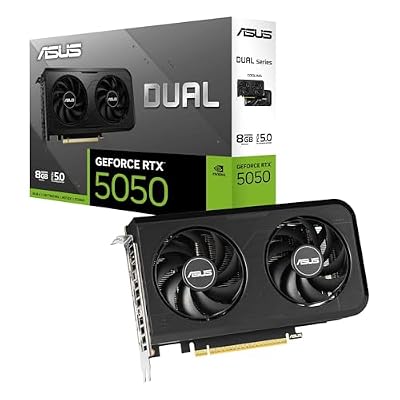
ASUS Dual GeForce RTX 5050 8GB GDDR6 Gaming Gaming Graphics Card | PCIe 5.0, HDMI 2.1b, DisplayPort 2.1b, 2-slot, Axial-tech Fans, 0dB Technology, Dual BIOS
Included for 'Arc B580 vs RTX 5050: Which Graphics Card Should You Buy?' because the listing specifies PCIe 5.0 and HDMI 2.1b, details this guide uses to compare options.
View on AmazonBenchmarks From the Big Reviewers
The reviews agree on which card is faster but differ on how much:
- TechPowerUp (RTX 5050 review, 1080p raster): the Arc B580 is about 5% faster than the RTX 5050.
- Quasar Zone (15 games at 1080p, as reported by Notebookcheck): the RTX 5050 reached about 97% of the B580’s performance, a gap of under 3%.
- Hardware Unboxed / TechSpot (dedicated B580 vs 5050 comparison): wins varied by game. The B580 led by large margins in titles such as Ghost of Tsushima and Ratchet & Clank, while the 5050 won in Black Ops 7.
- Club386: the B580 is stronger in raster, with ray tracing broadly comparable between the two.
Overall, expect the B580 to be roughly 3–10% faster on average. The lead is at the low end at 1080p and grows at 1440p, where its extra bandwidth and memory matter more. Some specific games swing much further in either direction.
Approximate frame-rate bands, which vary with settings, CPU and driver version: in demanding 1080p high-setting games both cards typically land between 55 and 85 FPS. At 1440p the B580 is more likely to stay above 60 FPS without upscaling, while the 5050 more often needs DLSS or lower textures.
The CPU Overhead Question
This section matters most for budget builders. Shortly after the B580 launched, Hardware Unboxed showed that Intel’s driver has higher CPU overhead than NVIDIA’s or AMD’s. With a fast modern CPU the B580 performs as reviewed. With older or slower CPUs, such as earlier Ryzen 5 parts or older Core i5 chips, it lost noticeably more performance than competing cards. In some CPU-heavy games it fell behind cards it normally beats.
That changes the recommendation depending on your system:
- New build with a current-gen CPU: the B580’s lead holds.
- Upgrading a PC with a CPU that’s several generations old: the RTX 5050 is often the safer pick, because its performance depends less on the CPU.
Intel cards also need Resizable BAR enabled for full performance, so check your BIOS before buying a B580 for an older motherboard.
Memory: 12 GB Versus 8 GB
The VRAM difference shows up clearly in reviews. Hardware Unboxed’s comparison found that in Marvel Rivals the RTX 5050 posted a higher average frame rate but much worse 1% lows, with stutter they attributed to its 8 GB buffer. That pattern appears across more and more new releases. Average FPS looks fine, but frame pacing suffers when textures overflow.
Rough VRAM guide:
| Scenario | Typical need | Arc B580 (12 GB) | RTX 5050 (8 GB) |
|---|---|---|---|
| 1080p medium/high | 6–8 GB | Comfortable | Fine |
| 1080p ultra textures, new AAA | 8–10 GB | Comfortable | Borderline |
| 1440p high | 10–12 GB | Workable | Often short |
| Frame generation enabled | +0.5–1.5 GB | Headroom available | Can tip into overflow |
Both cards use a PCIe x8 link. On a PCIe 3.0 motherboard that halves the link bandwidth for the B580 (PCIe 4.0 x8) and cuts it further for the 5050 (PCIe 5.0 x8 running at 3.0 speeds). In both cases the penalty shows up mainly when VRAM overflows, which happens more often on the 8 GB card.
Upscaling and Frame Generation
NVIDIA’s software is the RTX 5050’s biggest advantage. It supports DLSS 4 with the transformer Super Resolution model, Ray Reconstruction and Multi Frame Generation, and DLSS is supported in a very large number of games. NVIDIA Reflex is also widely supported in competitive titles.
The B580 offers XeSS 2, which combines XeSS Super Resolution running on Intel’s XMX matrix engines, XeSS Frame Generation and Xe Low Latency. Its image quality is good, but fewer games support it than DLSS. FSR 3.1 works on the B580 as a fallback in games without XeSS. TechSpot’s head-to-head also tested both cards with upscaling enabled, and the B580 kept a lead in several titles even against DLSS 4 Quality.
Power, PSU and Physical Size
The RTX 5050 is the more efficient card, rated at 130 W against 190 W for the B580. Each uses one 8-pin connector. PSU sizing with GPU TDP + CPU + about 150 W headroom and a 105 W CPU:
- Arc B580: 190 + 105 + 150 = 445 W, so use a quality 500–550 W unit.
- RTX 5050: 130 + 105 + 150 = 385 W, so a quality 450 W unit is plenty.
Intel’s reference B580 design is 272 mm long and two slots thick. Partner RTX 5050 cards range from short single-fan models for mini-ITX cases to longer triple-fan designs. If your case is small, the 5050 gives you more choice. The 60 W difference also means slightly less heat and noise from the NVIDIA card.
Cost per Frame at Equal Prices
With identical $249 launch prices, the cost math depends only on the performance gap. Set the RTX 5050 at 100 points and the B580 at about 106, the midpoint of the 3–10% range:
- RTX 5050: $249 / 100 = $2.49 per point.
- Arc B580: $249 / 106 = about $2.35 per point, plus 4 GB more VRAM.
The difference is small, so platform fit, features and street prices usually decide the matchup. A $20–$30 price swing in either direction can reverse the value result, so compare current prices on the exact models you’re considering.
Pick the B580 If… Pick the RTX 5050 If…
| Pick the Arc B580 if | Pick the RTX 5050 if |
|---|---|
| You have a recent CPU (current or last generation) | Your CPU is several generations old |
| You plan to play at 1440p | You play at 1080p, mostly esports |
| You want high textures in new AAA games | You want DLSS 4 and Multi Frame Generation |
| Your PSU is 500 W or larger | You have a 450 W PSU or a very small case |
| Your board supports Resizable BAR | You need CUDA for creative apps |
Frequently Asked Questions
Is the Arc B580 faster than the RTX 5050?
On average, yes, by roughly 3–10% depending on the review. TechPowerUp measured about 5% at 1080p. The lead grows at 1440p and in memory-heavy games, though the RTX 5050 wins some individual titles.
Does the B580 work well with older CPUs?
Not as well as competing cards. Hardware Unboxed found the B580’s driver has higher CPU overhead, so it loses more performance on older or slower processors. With a modern CPU this is mostly a non-issue.
Is 8 GB enough for the RTX 5050?
For esports and most 1080p gaming, yes. In new AAA games with high textures, and at 1440p, 8 GB can cause stutter and poor 1% lows. Reviewers saw this in titles like Marvel Rivals when comparing the 5050 with the 12 GB B580.
Which card has better upscaling?
DLSS 4 on the RTX 5050 has the best image quality and the widest game support, plus Multi Frame Generation. XeSS 2 on the B580 is good and includes its own frame generation, but fewer games support it.
What PSU do I need for the Arc B580?
A quality 500–550 W power supply is a sensible size with a mainstream CPU. The B580 is rated at 190 W and uses a single 8-pin connector, so most decent budget PSUs can handle it.
Ready to decide? Our #1 pick for 2026 is the Architecture.
Live price & availability on Amazon.









