🛒 Best Price Today on Amazon
Prime members get fast, free shipping on everything above, plus member-only deals. New members get a 30-day free trial — cancel anytime.
Small rooms need more than a narrow tabletop. The best small gaming desk for tight spaces balances footprint, usable depth, monitor placement, storage, and the clearance needed for a PC setup. These four current options cover straight, L-shaped, glass, and premium modular designs without relying on detailed research.
How to Choose a Compact Gaming Desk
A compact desk should be measured against the room first, then against the gaming hardware it must hold. Width determines how many displays fit, depth affects monitor distance and mouse movement, while the frame determines how much usable legroom remains. For a small setup, the published dimensions matter more than a desk’s marketing category.
Measure Width and Depth Before Buying
The best small gaming desk for tight spaces starts with the available wall or corner rather than the product photo. Measure the usable width, then measure outward from the wall to account for chair movement. A desk that fits the wall but blocks a doorway, closet, or chair path is not actually space-efficient.
Depth deserves particular attention because compact desks can become restrictive quickly. The IKEA MICKE measures 41 3/8 inches wide by 19 5/8 inches deep, while the Eureka GTG-I43 uses a 43-inch-class surface with roughly 23-inch depth.
Match the Surface to Your Monitor Setup
For the best small gaming desk for tight spaces, decide whether the setup uses one monitor, two monitors, or a monitor arm before choosing the desktop. A single display leaves more room for the mouse, while a second display can consume much of a compact surface even when the desk’s advertised width looks sufficient.
The Corsair Platform:4 provides a 47-by-30-inch surface and includes a monitor arm supporting 75-by-75mm and 100-by-100mm VESA patterns. That makes it more flexible for monitor placement than a compact desk that depends entirely on a raised shelf.
Choose the Right Desk Shape
The best small gaming desk for tight spaces is not always the narrowest rectangular model. A corner can make an L-shaped design practical because the desk occupies two directions instead of extending far into the room. However, the total corner footprint still needs to be measured before purchase.
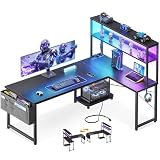
Bestier’s current 42-inch L-shaped model measures 41.61 inches long by 27.3 inches wide and includes a monitor bracket, shelves, and cable openings. Its shape suits a corner setup, but the extra side depth means it is less appropriate for a narrow wall where forward clearance is the main constraint.
Check Hardware and Mounting Compatibility
The best small gaming desk for tight spaces should match the actual hardware rather than an assumed PC configuration. Desks do not have CPU, GPU, DDR5, or PCIe compatibility requirements, but monitor mounts, desktop thickness, PC placement, and power accessories can create practical limits.
For example, the Platform:4’s included arm uses standard VESA 75-by-75mm or 100-by-100mm mounting, while Bestier’s model uses a built-in monitor bracket. IKEA’s MICKE instead provides cable routing but does not advertise an included VESA arm, so monitor-arm installation requires checking the separate arm and mounting surface.
Top Picks for Tight-Space Gaming
These four desks cover different small-room layouts rather than repeating the same design. The table focuses on manufacturer-published dimensions and features; no hands-on stability or gaming-session results are claimed here. Price tiers are intentionally broad because retailer pricing and promotions can change.
| Product | Best For | Key Spec | Compatibility | Watch Out For |
| Corsair Platform:4 | Best Overall | 47 × 30 in; 265-lb capacity | 75×75/100×100 VESA arm | Premium size and price |
| IKEA MICKE | Best Value | 41 3/8 × 19 5/8 in; 110-lb load | Single compact setup | Shallow desktop |
| Eureka GTG-I43 | Best For RGB | 43.31 × 23.62 in; 200-lb capacity | Up to two monitors per manufacturer | Tempered-glass surface |
| Bestier 42-inch L | Best For Corners | 41.61 × 27.3 in; integrated monitor bracket | Dual-display-oriented layout | Needs a usable corner |
Corsair Platform:4 — Best Overall
For buyers who want the best small gaming desk for tight spaces without giving up a deeper desktop, the Corsair Platform:4 offers a 47-by-30-inch surface, an included monitor arm, USB charging, and a RapidRoute cable-management tray. Its 265-pound maximum desk capacity also leaves substantial headroom for a conventional gaming PC and peripherals.
The main weakness is its premium positioning and larger depth compared with ultra-compact desks. The fixed model is 30 inches deep, while the Elevate version adjusts from 29 to 48 inches. Someone working with a very shallow wall recess should not buy it simply because its width is compact; the depth may be the limiting dimension.
IKEA MICKE — Best Value
For a budget-conscious buyer, the best small gaming desk for tight spaces can be a conventional computer desk rather than a gaming-branded model. IKEA’s MICKE is 41 3/8 inches wide and only 19 5/8 inches deep, with a 110-pound maximum evenly distributed load and rear cable-management design.
Its real weakness is the shallow working area. IKEA specifies a 33-pound limit for concentrated weight on a small surface, so a heavy monitor or accessory should not be treated as interchangeable with a broad desktop load. It is a poor match for buyers wanting several large displays and substantial mouse space.
Eureka GTG-I43 — Best For RGB
The best small gaming desk for tight spaces can also prioritize gaming aesthetics, and the Eureka GTG-I43 uses a 43-inch-class tempered-glass surface with integrated RGB lighting. The manufacturer lists over 200 lighting effects, phone control, a cable tray, controller stand, cup holder, and headphone hooks, making the feature set unusually extensive for its footprint.
The weakness is the glass desktop rather than its size. The manufacturer lists a 200-pound maximum capacity and a 4.6mm tempered-glass top, but glass remains a different working surface from wood or laminate. Buyers who prefer a softer, less reflective surface or frequently move heavy equipment should consider another material.
Bestier 42-inch L-Shape — Best For Corners
For an unused corner, the best small gaming desk for tight spaces can be an L-shaped design. Bestier’s 42-inch model measures 41.61 by 27.3 inches, includes an adjustable monitor bracket, two lower shelves, cable holes, and a built-in power hub with three AC outlets, USB, and USB-C connectivity.
Its weakness is the geometry: an L-shaped desk saves wall length in some layouts but still requires meaningful floor and corner clearance. The model also has a gaming-focused appearance that may not suit a shared living area. It is not the right choice for a single narrow wall where the extra side section cannot be used.
FAQ
The most useful questions about compact gaming desks concern dimensions, monitor count, PC placement, and whether a gaming-specific design is actually necessary. The answer to each depends on the physical constraints of the room and the amount of equipment the desk must support, rather than the gaming label attached to the product.
How wide should a small gaming desk be?
A small gaming desk around 40 to 47 inches wide can accommodate a compact single-monitor gaming setup, depending on monitor size and peripheral placement. IKEA’s MICKE is 41 3/8 inches wide, Bestier’s model is 41.61 inches across its main dimension, and the Eureka GTG-I43 is marketed as a compact 43-inch design.
Depth is just as important as width when space is limited. The MICKE’s 19 5/8-inch depth minimizes room intrusion, while the Eureka offers roughly 23 inches and the Platform:4 provides 30 inches. A narrower desk leaves more floor space but gives less room between the monitor and keyboard.
Can a compact desk hold a gaming PC and monitor?
Yes, a compact desk can hold a gaming PC and monitor when the published load rating, usable surface, and PC placement are suitable for the equipment. The MICKE lists a 110-pound evenly distributed maximum, while Corsair lists 265 pounds for the Platform:4.
The important distinction is total capacity versus usable space. A desk may support the weight of a tower and display while leaving too little room for a mouse or keyboard. Buyers should also check whether the PC sits on the desktop, beneath it, or on a separate stand.
Is an L-shaped desk better for a tight room?
An L-shaped desk can make efficient use of an available corner, but it is not automatically better for every tight room. Bestier’s 42-inch model provides a corner-oriented layout with storage and a monitor bracket, but its 27.3-inch width means it needs more forward clearance than a very shallow rectangular desk.
The room’s geometry should decide the shape. A corner with unused space can favor an L-shaped model, while a narrow wall beside a bed or doorway may favor a straight desk. Measure both legs and the chair path rather than comparing advertised width alone.
Do you need a gaming-specific desk for PC gaming?
No, you do not need a gaming-specific desk for PC gaming, because a suitable conventional desk can provide the necessary surface and support. The IKEA MICKE illustrates this approach with a compact desktop, cable routing, adjustable shelves, and a 110-pound maximum evenly distributed load.
Gaming-specific desks can still add useful features such as monitor brackets, RGB lighting, accessory hooks, or integrated power. The decision therefore depends on which features solve an actual space or setup constraint. For a minimalist room, those extras may occupy more attention than useful surface area.
Final Thoughts
The best small gaming desk for tight spaces depends on what the room cannot spare: depth, wall width, or corner area. Corsair emphasizes a deeper modular surface, IKEA prioritizes a shallow footprint, Eureka adds RGB features, and Bestier targets corners. Measure the room first, then match the desk to the actual monitor and PC setup.