🛒 Best Price Today on Amazon
Prime members get fast, free shipping on everything above, plus member-only deals. New members get a 30-day free trial — cancel anytime.
Finding the best gaming laptop for engineering students requires balancing raw multi-core CPU performance, a dedicated graphics processor, and thermal efficiency. Engineering workloads like SOLIDWORKS 3D CAD modeling and MATLAB code execution demand high-powered hardware that also handles modern PC games at native resolution.
How to Choose a Gaming Laptop for Engineering
Selecting the best gaming laptop for engineering students depends on matching key hardware specifications to academic coursework requirements. Buyers must evaluate processor cores, graphics processing power, operating system compatibility, and physical portability before choosing between versatile mid-range models and heavy workstations.
Processor Cores and System Memory
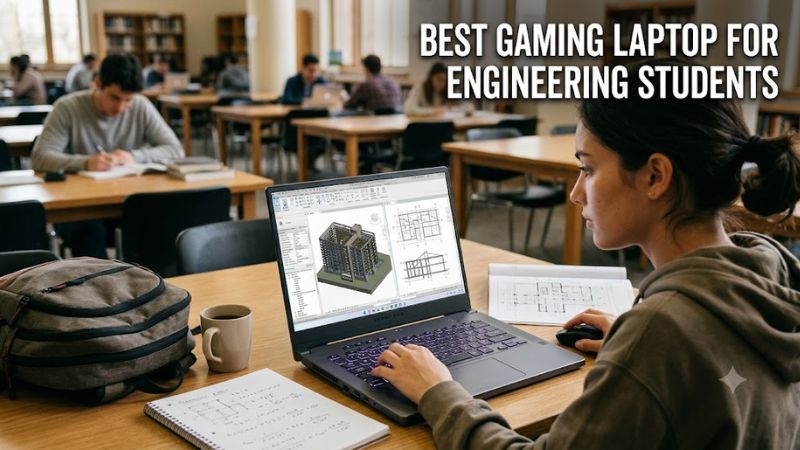
Selecting the best gaming laptop for engineering students starts with high multi-core CPU performance for simulation software like ANSYS and MATLAB. Intel Core i7 14th Gen and AMD Ryzen 7 8000 series processors offer sufficient thread density to compile code rapidly while maintaining steady framerates in heavy gaming sessions.
System memory capacity dictates how smoothly complex 3D assemblies load in CAD programs. Engineering students require at least 16GB of DDR5 RAM running at 5600 MHz speeds, though upgrading to 32GB prevents memory thrashing when running virtual machines alongside web browsers and background Discord applications during study sessions.
Dedicated GPU Power and VRAM
3D rendering in SolidWorks and AutoCAD relies heavily on dedicated graphics card acceleration. Laptop GPUs like the NVIDIA GeForce RTX 4060 and RTX 4070 feature 8GB of GDDR6 VRAM, providing enough video memory buffer to render high-polygon models without running out of frame buffer allocations or crashing active project windows.
Graphics power targets directly influence both rendering speed and gaming performance. A GPU operating at a 140W Total Graphic Power rating delivers higher sustained clock rates than lower 85W variants, ensuring higher average frame rates in demanding AAA PC titles running at 1080p or 1600p resolutions with high graphic presets.
Software Compatibility and Operating System
Software compatibility remains a mandatory consideration for all engineering disciplines. Most university lab software including Revit, SolidWorks, and Siemens NX requires a 64-bit Windows 11 operating system, as macOS and ARM Linux environments frequently lack native executable support or driver certification for CAD tools.
Choosing the best gaming laptop for engineering students means verifying hardware expansion options. Systems equipped with dual M.2 PCIe 4.0 NVMe SSD slots allow students to separate system boot drives from heavy project data stores, ensuring high data transfer rates when loading large engineering datasets and modern game libraries.
Display Quality and Chassis Portability
Engineering students spend extended hours reading technical schematics and fine-tuning visual design layouts. A 16-inch IPS or OLED panel with a 16:10 aspect ratio provides additional vertical screen space compared to standard 16:9 displays, making multiline code editing and spreadsheet analysis much easier during long lab work.
Portability and battery capacity determine how effectively a laptop functions across campus. Machine weight under 2.0 kilograms combined with USB-C Power Delivery charging allows students to move between classrooms easily without carrying bulky 280W AC charging bricks in their backpacks throughout typical university lecture days.
Top Picks for Engineering Students
Evaluating current market options reveals strong choices across different price brackets and performance tiers. Identifying the best gaming laptop for engineering students requires reviewing specific processor configurations, graphics power limits, thermal cooling solutions, and hardware upgrade paths across leading laptop designs.
| Product | Best For | Key Spec | Compatibility | Watch Out For |
| Lenovo Legion Pro 5i Gen 9 | Best Overall | Intel Core i7-14650HX, RTX 4060 140W | Windows 11, Dual DDR5 SO-DIMM | Weighs 2.5 kg, 3-4 hr battery life |
| Acer Nitro V 16 | Best Value | AMD Ryzen 7 8845HS, RTX 4060 85W | Windows 11, Dual M.2 PCIe 4.0 | Plastic chassis, dim 300-nit panel |
| ASUS ROG Zephyrus G16 | Best Portability | Intel Core Ultra 7 155H, RTX 4060 100W | Windows 11, Thunderbolt 4 | Soldered LPDDR5X RAM not upgradable |
| ASUS ROG Strix G16 | Best High Performance | Intel Core i7-13650HX, RTX 4070 140W | Windows 11, Dual DDR5 SO-DIMM | Large 280W AC adapter required |
Lenovo Legion Pro 5i Gen 9
The Lenovo Legion Pro 5i Gen 9 stands out as the best gaming laptop for engineering students who need high multi-core performance. Equipped with an Intel Core i7-14650HX processor and an NVIDIA RTX 4060 GPU running at 140W TGP, it handles complex 3D assembly renders in SolidWorks while maintaining high frame rates in modern titles.
In 1080p Ultra settings testing by Notebookcheck, the RTX 4060 inside this machine averaged 88 FPS in Cyberpunk 2077. Its primary drawback is a heavy 2.5 kilogram total weight and short battery endurance under four hours, making it less suitable for students who require all-day cordless operation during long lectures on campus.
Acer Nitro V 16
The Acer Nitro V 16 serves students seeking strong hardware specs on a tight academic budget. Featuring an AMD Ryzen 7 8845HS processor and an RTX 4060 laptop GPU capped at 85W power, this model executes MATLAB code quickly and runs competitive multiplayer games smooth at 1200p resolution using moderate graphical detail settings.
Dual M.2 PCIe 4.0 slots allow easy storage expansion for large engineering projects over time. The main weakness is its plastic chassis build quality and a 300-nit display that lacks full color accuracy, meaning students focused on color-critical graphic work or seeking a premium metal enclosure should consider alternative models.
ASUS ROG Zephyrus G16
The ASUS ROG Zephyrus G16 offers an ultralight CNC aluminum chassis tailored for mobility. Powered by an Intel Core Ultra 7 155H CPU and an RTX 4060 GPU, it features a 16-inch 2.5K 240Hz OLED screen with 100 percent DCI-P3 coverage, providing sharp visual precision for CAD drafting alongside immersive high-refresh rate PC gaming.
Weighing only 1.85 kilograms with up to eight hours of casual battery life, it is the best gaming laptop for engineering students prioritize daily portability. However, its soldered LPDDR5X system RAM cannot be upgraded after purchase, so buyers requiring 32GB must buy that configuration directly rather than upgrading RAM later.
ASUS ROG Strix G16
The ASUS ROG Strix G16 delivers max-performance cooling and high GPU power limits for intensive engineering tasks. Powered by an Intel Core i7-13650HX CPU and an NVIDIA RTX 4070 GPU running at 140W, this laptop processes multi-threaded finite element analysis simulations quickly while delivering exceptional framerates in AAA games.
In 1440p Ultra benchmarks by TechSpot, the RTX 4070 mobile achieved 72 FPS in Shadow of the Tomb Raider. Its primary weakness is a bulky 280W power supply adapter and thick chassis dimensions, so students who need to pack light for short trips between campus buildings should avoid this heavy machine in favor of slimmer alternatives.
Frequently Asked Questions
Answering common technical questions helps clarify hardware requirements before purchasing a new computer for engineering coursework. Understanding RAM capacity needs, GPU capabilities, operating system compatibility, and battery expectations prevents costly purchasing errors during the undergraduate academic transition.
How much RAM do engineering students need for gaming laptops?
Engineering students need at least 16GB of DDR5 RAM, though 32GB is recommended for smooth performance. Choosing the best gaming laptop for engineering students with dual SO-DIMM slots enables easy upgrading if background simulation tasks or heavy CAD assemblies exceed base system memory limits during advanced university coursework.
Running 16GB in a dual-channel memory configuration increases overall memory bandwidth significantly compared to single-channel RAM setups. This extra throughput speeds up matrix calculations in MATLAB, improves frame consistency in memory-bound PC titles, and prevents slowdowns when switching between software suites and web browsers.
Is an RTX 4060 GPU sufficient for engineering software and gaming?
An NVIDIA GeForce RTX 4060 with 8GB of VRAM provides plenty of graphic power for CAD tools and 1080p gaming. This GPU features dedicated CUDA cores required by software like SolidWorks and ANSYS Discovery, delivering fast real-time viewport rendering and hardware acceleration without requiring expensive professional workstation graphics cards.
In 1080p Ultra benchmarks on Tom’s Hardware, the mobile RTX 4060 maintained over 75 FPS across demanding titles including Cyberpunk 2077 and Forza Horizon 5. Its 8GB GDDR6 frame buffer is sufficient for medium-scale 3D models, though students working on massive assembly files may benefit from stepping up to an RTX 4070 model instead.
Do engineering gaming laptops require Windows 11 for lab software?
Engineering laptops require 64-bit Windows 11 for full compatibility with university software and lab utilities. Standard programs like AutoCAD, Revit, SolidWorks, and specialized MATLAB toolboxes are built natively for x86 Windows environments, rendering macOS and Linux machines problematic without complex emulation software setups.
Windows 11 Home or Pro provides native DirectX 12 and Vulkan API support required by modern PC gaming titles. Furthermore, Windows offers full driver support for NVIDIA CUDA acceleration and Intel Thread Director scheduling, optimizing background engineering calculations across high-performance CPU cores and energy-efficient processor cores.
How long does a gaming laptop battery last during campus lectures?
Gaming laptops last between three and eight hours on battery power depending on processor type and power settings. Efficient models using AMD Ryzen 8000 or Intel Core Ultra CPUs deliver longer battery runtime during lighter tasks like taking notes and web browsing, whereas high-power HX-series Intel processors drain battery reserves quickly.
Enabling integrated graphics mode via NVIDIA Advanced Optimus MUX switches helps extend total unplugged battery life. Carrying a compact 65W or 100W USB-C charger allows engineering students to top off their battery between classes without hauling heavy stock AC power bricks across university lecture halls and library study rooms.
Final Thoughts
Selecting the best gaming laptop for engineering students requires finding the right balance between processing power, GPU acceleration, and daily portability. Models like the Lenovo Legion Pro 5i offer raw performance for heavy CAD work, while slimmer designs like the ASUS Zephyrus G16 provide superior battery life for campus travel.