🛒 Best Price Today on Amazon
Prime members get fast, free shipping on everything above, plus member-only deals. New members get a 30-day free trial — cancel anytime.
Selecting the best gaming laptop battery life requires balancing high performance components with smart energy management. Modern portable rigs pair dense battery cells with efficient processors to maintain productivity away from wall outlets. Knowing how display choices and graphics switching affect daily power draw helps you choose the right mobile setup.
How to Choose Gaming Laptops for Longevity
Finding a balance between gaming capability and long battery duration involves evaluating four primary hardware specifications. Buyers should assess watt-hour ratings, CPU architecture, screen technology, and memory standards to ensure reliable cordless uptime. The best gaming laptop battery life models combine these elements into a single cohesive system.
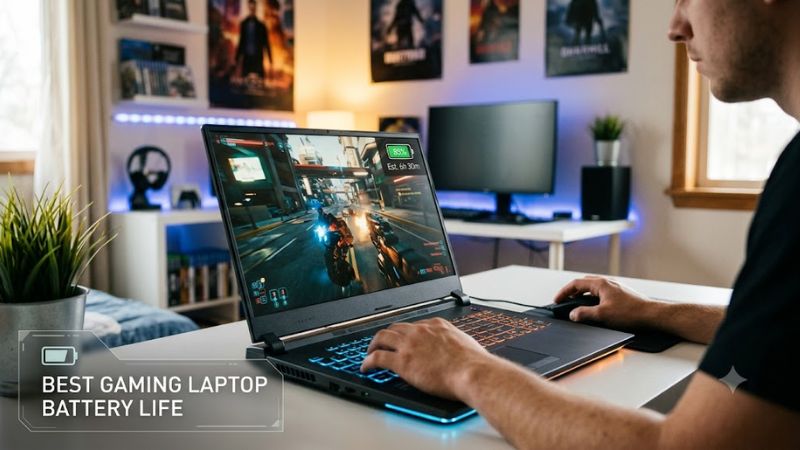
Watt-Hour Capacity and Chassis Limits
Federal Aviation Administration limits restrict laptop batteries to a maximum capacity of 99.9Wh on commercial flights. Chassis size directly influences how close a manufacturer can get to this ceiling without adding excessive weight. Compact 14-inch frames often cap internal batteries between 70Wh and 75Wh due to thermal layout constraints.
Larger 16-inch laptops utilize their footprint to house larger 80Wh to 99Wh batteries that compensate for higher display power needs. The Razer Blade 16 features a 95.2Wh internal battery that provides maximum total power reserves for users requiring sustained unplugged operation during demanding workloads or extended travel days.
Processor Efficiency and Switchable Graphics
Processor choice plays a dominant role when searching for the best gaming laptop battery life during web browsing and office tasks. AMD Ryzen processors with Zen 4 or Zen 5 cores exhibit exceptionally low idle power consumption compared to desktop-class HX processors. Multiplexor switches allow systems to bypass discrete graphics entirely.
NVIDIA Advanced Optimus automatically routes display output through integrated graphics when high-end rendering is inactive. The ASUS TUF Gaming A14 combines an efficient AMD Ryzen 7 processor with Advanced Optimus to disable the GPU completely on battery power, dropping baseline system power consumption down to single-digit wattages.
Display Panel Tech and Refresh Rates
Screen size, panel type, and refresh rate dictate a significant portion of a laptop’s passive power consumption during daily use. High-resolution 2.5K displays running at 240Hz consume substantially more energy than 1080p panels running at 60Hz. Variable refresh rate technology dynamically drops the panel speed when viewing static images.
OLED panels deliver deep contrast but consume variable power depending on the percentage of bright pixels displayed on screen. The HP Omen Transcend 14 utilizes a 2.8K OLED display that pairs with dynamic brightness adjustments to maintain high energy efficiency when viewing dark-themed applications or watching widescreen video files.
Memory Architecture and Power Compatibility
System memory configuration directly impacts overall power draw because RAM modules remain powered constantly during system operation. Low-power soldered memory like LPDDR5X consumes less energy than standard SO-DIMM DDR5 modules. However, soldered memory prevents future hardware upgrades and limits total system flexibility over time.
Laptops designed for easy maintenance feature two DDR5 SO-DIMM slots that accept user upgrades up to 64GB of memory. The Lenovo Legion Slim 5 16 uses standard DDR5 slots alongside a 140W USB Power Delivery charging standard, allowing gamers to top up their battery using compact universal Type-C adapters while working on the go.
Top Mobile Gaming Hardware for Battery Endurance
Selecting a high-end portable system requires evaluating real-world performance alongside component energy consumption metrics. The table below details four leading models designed for extended unplugged productivity. Comparing these specifications helps match individual battery expectations with realistic hardware limits for your needs.
| Product | Best For | Key Spec | Compatibility | Watch Out For |
| ASUS TUF Gaming A14 | Best Overall | 73Wh battery, 14-inch 1600p 165Hz | LPDDR5X soldered, 100W USB-PD | Soldered RAM cannot be upgraded |
| Lenovo Legion Slim 5 16 | Best Value | 80Wh battery, 16-inch 1600p 165Hz | 2x DDR5 SO-DIMM, 140W Type-C | Plastic lid flexes under pressure |
| HP Omen Transcend 14 | Best Display | 71Wh battery, 14-inch 1800p 120Hz OLED | LPDDR5X soldered, 140W Type-C | Higher draw on white backgrounds |
| Razer Blade 16 | Best High-End | 95.2Wh battery, 16-inch 1600p 240Hz OLED | 2x DDR5 SO-DIMM, 330W GaN | Heavy chassis weighs over 5.3 lbs |
ASUS TUF Gaming A14
The ASUS TUF Gaming A14 delivers the best gaming laptop battery life for gamers needing all-day productivity in a lightweight chassis. Powered by an AMD Ryzen 7 8845HS processor and NVIDIA GeForce RTX 4060 graphics, it reaches up to 10 hours of video playback in PCMark 10 battery benchmarks at 150 nits screen brightness.
Mobile workers who need lightweight hardware and long web browsing times should choose this 3.2-pound 14-inch chassis. The laptop features a 73Wh battery and 16GB of soldered LPDDR5X memory that cannot be expanded post-purchase. Buyers who require 32GB of RAM or higher display refresh rates should look at larger 16-inch alternatives.
Lenovo Legion Slim 5 16
The Lenovo Legion Slim 5 16 provides an exceptional middle ground between expansion options and extended battery runtime. Equipped with an AMD Ryzen 7 8845HS CPU, NVIDIA GeForce RTX 4060 GPU, and an 80Wh battery, this laptop achieves over 8 hours of light web browsing at 150 nits in PCMark 10 battery benchmarks.
Gamers who want dual upgradable SO-DIMM DDR5 slots and dual M.2 PCIe 4.0 SSD storage will appreciate this accessible layout. However, the outer lid uses plastic materials that exhibit minor flex, and the 5.1-pound weight makes it less portable. Budget-conscious users seeking full upgrade paths should select this mid-range machine.
HP Omen Transcend 14
The HP Omen Transcend 14 pairs premium ultraportable styling with energy-efficient components for mobile professionals. Featuring an Intel Core Ultra 7 155H processor, NVIDIA GeForce RTX 4060 graphics, and a 71Wh battery, this model delivers nearly 8 hours of 1080p video streaming in PCMark 10 benchmarks at 150 nits brightness.
Content creators who value vibrant colors will benefit from the 2.8K 120Hz OLED screen with complete DCI-P3 coverage. Users must note that maintaining dark software themes is vital to achieving the best gaming laptop battery life on OLED panels. Buyers needing maximum GPU power limits should avoid this lower wattage 65W graphics card.
Razer Blade 16
The Razer Blade 16 fits a massive 95.2Wh battery into an anodized aluminum CNC chassis built for top-tier gaming performance. Configured with an AMD Ryzen AI 9 HX 370 processor and NVIDIA GeForce RTX 5080 graphics, it achieves up to 7 hours of productivity tasks in PCMark 10 battery benchmarks when lowered to a 60Hz refresh rate.
Enthusiasts who want high frame rates alongside a premium metal build will find this machine ideal for desktop replacement duties. The system supports two DDR5 SO-DIMM slots for memory upgrades up to 64GB. However, the premium price point and 5.4-pound total weight make it unsuitable for gamers shopping on a tight personal budget.
Frequently Asked Questions
Understanding how laptop hardware consumes power helps users maximize runtime away from electrical sockets. This section addresses common inquiries regarding laptop battery duration, hardware longevity during unplugged gaming, and software power adjustments. The answers below clarify operational limits for mobile hardware users.
How Many Hours Does a Gaming Laptop Battery Last?
A gaming laptop battery lasts between six and ten hours during light office work but drops to under two hours during heavy gaming. Achieving the best gaming laptop battery life requires using integrated graphics, reducing display brightness to 150 nits, and enabling battery saver profiles inside Windows 11 during basic desktop tasks.
When running demanding 3D games on battery power, the dedicated NVIDIA or AMD graphics chip draws between 45W and 140W continuously. This high power consumption depletes even a full 99.9Wh battery within 60 to 90 minutes. Users should view battery operation primarily as a solution for productivity rather than unplugged gaming.
Does Playing Games on Battery Damage the Hardware?
Playing demanding 3D games while running on battery power does not damage modern internal laptop hardware components. Internal battery management microcontrollers prevent dangerous discharge rates and automatically throttle system performance to maintain safe current levels for lithium-polymer cells during high load scenarios.
However, frequent full discharge cycles under heavy heat load accelerate normal chemical battery degradation over long periods. Laptop owners can preserve overall battery health by setting charge limits to 80 percent in control software like ASUS Armoury Crate or Lenovo Vantage when keeping the machine connected to wall power.
How Can Windows Settings Increase Battery Uptime?
Configuring Windows 11 power modes to Best Energy Efficiency significantly reduces background CPU clock speeds and system energy draw. Navigating to System > Power & Battery allows users to activate automatic battery saver modes, lower screen brightness, and set screen timeout periods to turn off the panel during inactive periods.
Users should also disable background startup applications in Task Manager to prevent unnecessary CPU cycles from draining power quietly. Selecting dynamic refresh rate settings in Windows Display properties lowers screen power draw by dropping the panel speed to 60Hz whenever high frame rate motion is absent from the screen.
Why Do Games Drop Frame Rates on Battery Power?
Frame rates drop on battery power because internal batteries cannot supply the peak wattage required by high-end GPUs. A standard gaming laptop battery delivers around 65W to 100W of total power to the entire system, whereas an AC wall adapter supplies anywhere from 230W to 330W during full performance gaming sessions.
To prevent sudden voltage drops and hardware shutoffs, NVIDIA Battery Boost and AMD Chill limit frame rates to 30 or 60 frames per second on battery power. Gamers should maintain connected AC power when pursuing maximum frame rates and low input latency in competitive multiplayer titles like Cyberpunk 2077 or Counter-Strike 2.
Final Thoughts
Finding the best gaming laptop battery life comes down to choosing efficient hardware architectures paired with realistic power expectations. Selecting machines with 70Wh to 99Wh batteries, hybrid graphics switching, and energy-conscious AMD or Intel processors ensures long uptime for remote productivity between gaming sessions.