🛒 Best Price Today on Amazon
Prime members get fast, free shipping on everything above, plus member-only deals. New members get a 30-day free trial — cancel anytime.
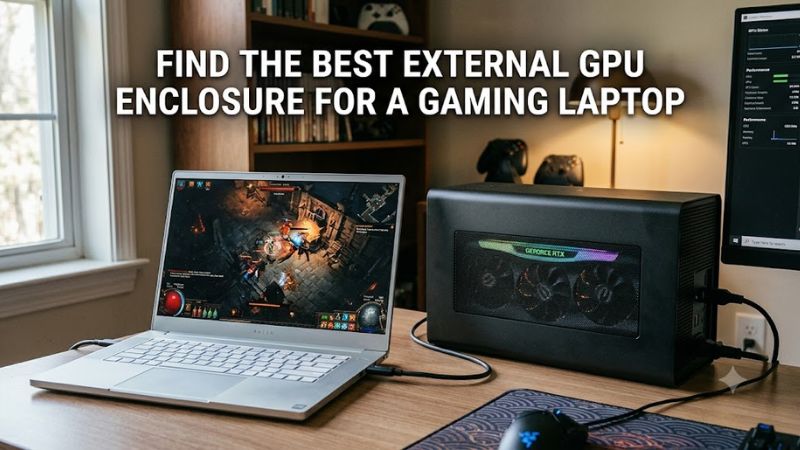
Finding the best external gpu enclosure for a gaming laptop requires matching port bandwidth with graphics card power needs. Modern ultraportable laptops feature capable processors but lack desktop graphic power. An external docking station delivers PCI Express lines to boost frame rates on external monitors without thermal throttle.
How to Choose an External GPU Enclosure
Choosing an external chassis involves evaluating connectivity interfaces, built-in power delivery capabilities, physical slot dimensions, and desktop peripheral expansion ports. Selecting the wrong specification limits graphics card selection or starves high-end video cards of necessary wattage during heavy 3D gaming workloads.
Target Interface Speed
Selecting the best external gpu enclosure for a gaming laptop starts with checking port bandwidth on your host PC. Standard Thunderbolt 4 ports offer 40 Gbps throughput over PCIe 3.0 x4 lanes, creating a performance overhead in demanding titles. OCuLink ports provide 64 Gbps over direct PCIe 4.0 x4 lanes for reduced latency.
Users running OCuLink hardware bypass Thunderbolt controller translation chips entirely. Independent benchmarks from Notebookcheck in Cyberpunk 2077 at 1440p Ultra settings show OCuLink systems retaining roughly 90 percent of desktop frame rates. Thunderbolt connections retain 75 percent due to system signal overhead on data transfers.
Power Supply Wattage
Internal power supplies must deliver enough continuous wattage for the graphics card while simultaneously charging the connected gaming laptop. High-end graphics cards require up to 450 watts under peak gaming load. Look for internal power units providing at least 650 watts total capacity to avoid sudden power loss.
Power Delivery specs over Thunderbolt range between 85W and 100W across standard designs. Modern laptops require 85W minimal power over USB Type-C to remain charged under heavy CPU gaming activity. Choosing an enclosure like the Sonnet eGPU Breakaway Box 750 supplies 85W PD alongside dedicated GPU power rails.
Physical Dimensions and Clearance
Graphics card physical dimensions vary widely across current card generations. Flagship graphics cards measure up to 330 mm in length and require 3-slot expansion depth inside the docking chassis. Standard dual-slot enclosures fail to close properly when paired with large triple-fan coolers found on modern high-end GPUs.
Measure your intended graphics card height and width before purchasing external housing. Units like the AKiTiO Node Titan support full-length expansion cards up to 320 mm while providing ample space for PCIe power connectors. Ensuring adequate internal clearance prevents heat buildup around the cooling shroud.
Integrated Peripheral Hubs
Finding the best external gpu enclosure for a gaming laptop often includes looking for integrated hub features. Standard eGPU chassis designs route all Thunderbolt bandwidth directly to graphics processing, leaving no room for extra ports. Dual-controller models add extra USB ports and Ethernet without starving the GPU.
Connecting mouse dongles, mechanical keyboards, and wired network cables directly to your eGPU transforms a mobile workstation into a desktop gaming rig. Premium choices like the Razer Core X Chroma incorporate dedicated peripheral controllers. This prevents USB data drops while running high frame rate multiplayer titles.
Top Picks for External GPU Enclosures
Comparing top choices for a best external gpu enclosure for a gaming laptop requires evaluating power outputs, card slot clearances, and connector specifications. The table below lists leading options with specific parameters to match your current desktop graphics card and gaming laptop port configuration.
| Product | Best For | Key Spec | Compatibility | Watch Out For |
| Razer Core X Chroma | Best Overall | 700W PSU, 100W PD, 3-slot GPU space | Thunderbolt 3, Thunderbolt 4 | Internal PSU fan remains active continuously |
| Sonnet eGPU Breakaway Box 750 | Best Value | 750W PSU, 85W PD, 375W GPU continuous | Thunderbolt 3, Thunderbolt 4 | Lacks extra USB hub ports or Ethernet |
| Minisforum DEG1 | Best Performance | 64 Gbps PCIe 4.0 x4 bandwidth | Dedicated OCuLink port required | Open chassis offers no dust or impact protection |
| AKiTiO Node Titan | Best Durable | 650W PSU, 85W PD, 320mm length clearance | Thunderbolt 3, Thunderbolt 4 | Included Thunderbolt cable is relatively short |
Razer Core X Chroma
Selecting a best external gpu enclosure for a gaming laptop requires dual Thunderbolt controllers if you intend to plug peripherals into the chassis. The Razer Core X Chroma includes a 700W power supply alongside 100W laptop power delivery and four USB Type-A ports. It fits 3-slot GPUs up to 330 mm long inside an aluminum frame.
Gamers seeking single-cable docking functionality should choose this model for clean workstation integration. However, the internal power fan stays active whenever connected to AC power, making it unsuitable for silent night environments. Users who do not need extra peripheral ports should skip this higher priced option.
Sonnet eGPU Breakaway Box 750
The Sonnet eGPU Breakaway Box 750 delivers solid power performance without charging premium extra docking fees. It houses a 750W internal power supply that provides up to 375W continuous power to modern graphics cards, alongside 85W laptop Power Delivery over a single Thunderbolt cable connection for quiet system operation.
Budget conscious gamers who focus strictly on graphical frame rate increases will find this layout ideal. However, it completely lacks external USB ports, Ethernet ports, or RGB lighting accents. Buyers who require multi-monitor docking hubs should look at alternatives with integrated secondary controllers.
Minisforum DEG1
The Minisforum DEG1 functions as the best external gpu enclosure for a gaming laptop equipped with an OCuLink port. Its open-frame docking mechanism uses PCIe 4.0 x4 lanes to deliver 64 Gbps interface speed. It supports standard ATX or SFX power supplies to drive high wattage graphics cards without bandwidth throttle.
Enthusiasts seeking low latency performance over OCuLink connections will appreciate this open layout. However, the exposed open frame provides no protection against spills, dust, or physical contact. Laptop owners who lack a dedicated OCuLink port cannot connect this dock without specialized adapter cards.
AKiTiO Node Titan
The AKiTiO Node Titan features a durable aluminum body equipped with a retractable top transport handle. Its internal 650W power supply delivers 85W laptop Power Delivery while supplying continuous 500W power to full-length graphics cards. It utilizes a tool-less design mechanism for easy internal installation.
Mobile gamers traveling frequently between locations will benefit from this sturdy metal construction. However, the included Thunderbolt cable measures under 0.5 meters, requiring close physical proximity between laptop and housing. Buying a best external gpu enclosure for a gaming laptop requires budgeting for extra cables.
Frequently Asked Questions
Understanding external graphics card dock compatibility, bandwidth limits, power delivery output, and platform support helps you avoid common hardware setup mistakes. Reviewing real user inquiries regarding external GPU performance clear up technical misconceptions before you finalize your desktop dock purchase.
Does an External GPU Perform the Same as Internal PC Hardware?
External graphics enclosures lose roughly 10 to 25 percent performance compared to native desktop PC card installations. Connecting a best external gpu enclosure for a gaming laptop through Thunderbolt introduces bandwidth bottlenecks due to protocol translation overhead. Direct OCuLink interfaces reduce this loss to around 10 percent.
Routing display signals back to the laptop’s internal screen increases bandwidth strain over Thunderbolt cables. Routing video output directly to an external gaming monitor bypasses internal screen loops, improving average frame rates by up to 15 percent depending on resolution and in-game graphic detail settings.
Will an External GPU Dock Power and Charge My Laptop?
Yes, external GPU docking stations equipped with Power Delivery charge laptops over USB Type-C connections. Enclosures like the Razer Core X Chroma output up to 100W, while Sonnet units supply 85W over a single cable connection. This allows thin gaming laptops to charge while driving external graphic cards.
High power gaming laptops requiring over 150 watts continuous power still require their original AC power brick connected during intense gaming sessions. When USB Power Delivery provides insufficient wattage, the laptop battery drains slowly under full load despite being plugged into the external dock.
Can I Use an NVIDIA Graphics Card with an AMD Powered Laptop?
Yes, NVIDIA desktop graphics cards operate fully inside external enclosures connected to AMD laptop platforms. Thunderbolt 4 and USB4 protocols standardize PCIE connection interfaces across Intel and AMD processor architectures. Installing proper GeForce drivers enables full hardware graphics acceleration.
Always perform a clean installation using Display Driver Uninstaller when switching graphics card brands. Conflicts between legacy integrated graphics drivers and newly connected external graphics card software cause system stability issues or frame drops until driver software caches are completely cleared.
Do External GPU Enclosures Support Internal Storage Expansion?
Most external GPU enclosures do not include internal storage slots, though select docking models offer internal SATA or M.2 drive bays. Multi-purpose hubs like the MasterCase EG200 integrate SATA drive bays directly alongside PCIe graphics slots to provide expanded game library storage on a single host cable.
Adding hard drives or solid state drives to a single Thunderbolt cable connection splits total bandwidth between GPU processing and storage data. Game loading times remain acceptable, but heavy file transfers during active gaming sessions cause frame drops. Dedicated storage drives work best over separate laptop USB ports.
Final Thoughts
Investing in a best external gpu enclosure for a gaming laptop turns a thin laptop into a high frame rate 3D gaming machine. Match your enclosure choice with power supply capacity, slot clearance, and connection type to prevent physical fitting issues or power stability throttles during intense gaming workloads.