🛒 Best Price Today on Amazon
Prime members get fast, free shipping on everything above, plus member-only deals. New members get a 30-day free trial — cancel anytime.
A good gaming cooler needs more than raw heatsink size: it must match CPU power, case height, memory clearance and socket. This best cpu air cooler for gaming roundup compares four current tower designs using manufacturer specifications and independent thermal data. The picks cover value, premium cooling, quiet builds and mainstream systems.
How to Choose a CPU Air Cooler
Air cooling for gaming is about matching thermal capacity, physical clearance and platform support. The shortlist covers four current tower designs, while the benchmark notes keep workloads separate so a CPU temperature result is not mistaken for a frame-rate result during gaming or general use tests.
Match Cooling Capacity to CPU Power
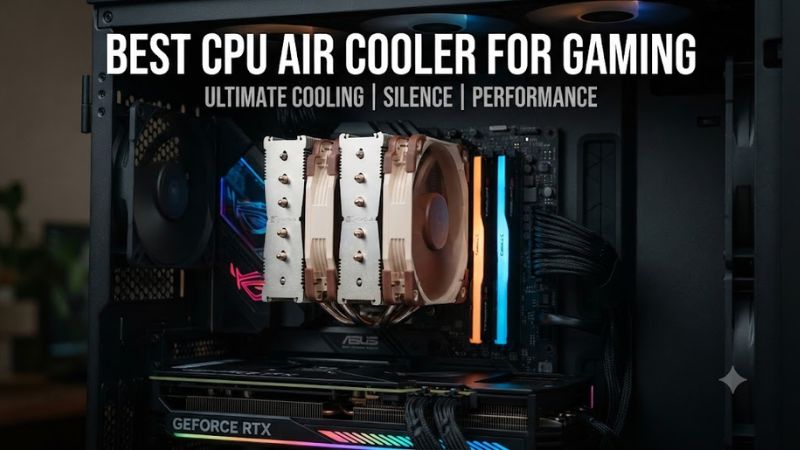
For shoppers seeking the best cpu air cooler for gaming, thermal capacity should match the processor’s real power behavior. A dual-tower cooler generally provides more heatsink area for sustained CPU loads, while a single-tower model can suit moderate-power gaming systems. Manufacturer TDP figures remain useful context, but independent workload results are more informative.
Independent results also need their test conditions stated. PC Gamer’s comparison uses a Core i7-14700K, fixed voltages and a 20°C normalized ambient temperature; its Baldur’s Gate 3 result uses 1.275 V. Resolution is not applicable to that CPU thermal measurement, so it should not be treated as a game-FPS benchmark.
Check Socket and Mounting Support
Socket support should be checked against the exact platform before comparing performance. Phantom Spirit 120 SE, NH-D15 G2 and Dark Rock 6 support AM4, AM5, LGA1700 and LGA1851, while Freezer 36 covers AM4, AM5, LGA1700 and LGA1851. PCIe generation and PSU connector type are irrelevant to these motherboard-powered PWM coolers.
Mounting hardware also differs by platform and CPU shape. Noctua supplies separate guidance for its NH-D15 G2 variants, while Thermalright, be quiet! and ARCTIC publish socket lists for their current models. For a best cpu air cooler for gaming, verify the motherboard socket and mounting kit rather than relying on the CPU brand.
Verify Case Height Before Buying
Case height is a hard limit because the cooler must fit beneath the side panel. Current dimensions are 154 mm for Phantom Spirit 120 SE, 168 mm for NH-D15 G2, 162 mm for Dark Rock 6 and 159 mm for Freezer 36. For the best cpu air cooler for gaming, leave extra room if a fan must be raised for tall memory modules.
Noise can change the practical choice even when two coolers have similar thermal results. Fan count, fan size, control range and case airflow all affect what you hear, so manufacturer noise figures and open-bench measurements should be treated as separate data sets rather than combined into one ranking.
Account for RAM Clearance
Memory clearance is a separate check from socket compatibility. Noctua specifies 32 mm standard RAM clearance for the NH-D15 G2 with both fans, while its single-fan configuration leaves at least 59 mm below the heatsink. ARCTIC’s Freezer 36 drawing lists 43 mm of RAM restriction on Intel and 44 mm on AMD.
For a best cpu air cooler for gaming, memory height should be checked before the cooler is mounted. A front fan can often be moved upward, but that can increase cooler height and create a case-clearance problem. This is especially relevant with tall RGB or overbuilt memory heat spreaders on large dual-tower designs.
Top Picks
The four picks cover different priorities, not one universal configuration. Phantom Spirit 120 SE emphasizes value, NH-D15 G2 targets premium dual-tower cooling, Dark Rock 6 focuses on quiet operation, and Freezer 36 favors a simpler single-tower layout. Platform and clearance details follow below.
| Product | Best For | Key Spec | Compatibility | Watch Out For |
| Thermalright Phantom Spirit 120 SE | Best Value | 7 × 6 mm heatpipes; 154 mm | AM4/AM5; LGA1200/1700/1851 | Tall RAM needs clearance |
| Noctua NH-D15 G2 | Best Overall | 8 heatpipes; 2 × 140 mm fans; 168 mm | AM4/AM5; LGA1200/1700/1851 | 32 mm RAM in dual-fan setup |
| be quiet! Dark Rock 6 | Best For Quiet Builds | 6 heatpipes; 162 mm | AM4/AM5; LGA1200/1700/1851 | Single-fan design |
| ARCTIC Freezer 36 | Best For Mainstream Builds | 4 × 6 mm heatpipes; 159 mm | AM4/AM5; LGA1700/1851 | Less headroom than large dual towers |
Thermalright Phantom Spirit 120 SE: Best Value
For shoppers seeking the best cpu air cooler for gaming, the Phantom Spirit 120 SE is a value choice for a gaming build that needs strong cooling without a premium dual-tower package. Thermalright lists seven 6 mm heatpipes, two 120 mm PWM fans, a 154 mm height and support for AM4, AM5, LGA1200, LGA1700 and LGA1851, covering desktop sockets.
Its real weakness is memory-space footprint and lack of low-profile support. Tom’s Hardware measured the related Phantom Spirit 120 at 234 W cooled on an i7-13700K with a 23°C room and 10-minute thermal runs. That is useful context, but it should not be transferred directly to another CPU or test bench.
Noctua NH-D15 G2: Best Overall
For shoppers seeking the best cpu air cooler for gaming, the NH-D15 G2 is a premium pick for a large dual-tower cooler with mature mounting hardware. It uses eight heatpipes and two NF-A14x25r G2 fans, stands 168 mm tall, weighs 1,525 g with fans and carries a six-year warranty. Noctua lists AM4, AM5, LGA1200, LGA1700 and LGA1851 support.
The trade-off is size and cost. With both fans installed, Noctua specifies 32 mm standard RAM clearance; moving the front fan upward creates more memory room but increases total height. Buyers also need to choose standard, HBC or LBC variants because their base shapes target different CPU contact conditions.
be quiet! Dark Rock 6: Best For Quiet Builds
Shoppers comparing best cpu air cooler for gaming options can consider the Dark Rock 6 when acoustic behavior is a concern. Its asymmetrical fin layout supports RAM and VRM compatibility, while the Silent Wings 135 mm PWM fan offers quiet and performance modes. The cooler measures 162 mm tall and supports AM4, AM5, LGA1200, LGA1700 and LGA1851.
be quiet! lists a 220 W thermal design target and 31.1 dB(A) maximum rated noise, but those figures are not directly comparable with independent meter readings. PC Gamer recorded 54°C maximum in Baldur’s Gate 3 at 1.275 V on a Core i7-14700K with 20°C normalized ambient; its open-bench full-speed reading was 49 dB(A).
ARCTIC Freezer 36: Best For Mainstream Builds
Shoppers comparing best cpu air cooler for gaming options can consider the Freezer 36 when a single-tower layout is easier to place around the motherboard. ARCTIC lists four 6 mm copper heatpipes, two P12 PWM PST fans, a 159 mm height and support for AM4, AM5, LGA1700 and LGA1851. Its drawing also specifies 43–44 mm of RAM restriction by platform.
Its limitation is lower thermal capacity than the largest dual-tower designs when CPU power rises substantially. In PC Gamer’s comparison, the Freezer 36 recorded 51°C average and 54°C maximum in Baldur’s Gate 3 at 1.275 V, using a Core i7-14700K at 20°C normalized ambient. That is a thermal result, not an FPS comparison.
FAQ
The right choice depends on thermal headroom, noise, physical fit and platform compatibility. The answers below address four common questions that affect a gaming build, while keeping thermal figures tied to their original CPU, workload, voltage and ambient conditions rather than mixing separate test methods.
Which air cooler should I buy for a gaming PC?
For a broad gaming build, the Phantom Spirit 120 SE is the value-oriented choice, while the NH-D15 G2 is aimed at buyers who prioritize premium construction and long-term platform support. Dark Rock 6 targets quieter builds, and the Freezer 36 is easier to place when a single-tower layout suits the system.
Final fit should be decided by the CPU, case and memory rather than the cooler name. The NH-D15 G2 needs at least 168 mm of case clearance in its normal configuration, while the Freezer 36 is 159 mm tall and the Phantom Spirit 120 SE is 154 mm tall. Check the case specification before ordering.
Is the NH-D15 G2 compatible with AM5 and LGA1851?
Yes, the standard NH-D15 G2 supports both AM5 and LGA1851, alongside AM4 and several older Intel sockets. Noctua also provides platform-specific mounting guidance and different base-convexity variants, so the exact version matters when choosing between the standard, HBC and LBC models for your CPU.
On AM5, Noctua’s standard version is designed around offset mounting, while the LBC version is optimized for relatively flat CPUs such as AM4 and AM5. On LGA1700, the standard version is intended to benefit from the supplied shim washers or a compatible contact frame, which is separate from basic socket compatibility.
Do CPU air coolers improve gaming FPS?
Air coolers can affect gaming performance indirectly by controlling CPU temperature and sustained boost behavior, but cooler choice is not itself an FPS setting. PC Gamer’s Baldur’s Gate 3 comparison measures processor temperature with a Core i7-14700K at 1.275 V and 20°C normalized ambient, not frame rates between coolers.
The goal is to keep the processor within its intended thermal operating range without unnecessary fan noise. A cooler with more thermal capacity matters more for high-power processors or mixed workloads, while a mid-range model may suit a lower-power gaming CPU. Case airflow and CPU power limits also influence the result.
Do I need DDR5-specific compatibility from an air cooler?
No, air coolers do not have a DDR4 or DDR5 interface, but RAM height and motherboard layout can determine whether the cooler fits. Tall DDR5 modules can conflict with a front fan on large dual-tower models, so memory clearance is a physical compatibility issue rather than a memory-standard requirement.
The NH-D15 G2 provides 32 mm standard clearance with both fans and at least 59 mm below the heatsink in single-fan mode. The Freezer 36 drawing lists 43 mm of RAM restriction on Intel and 44 mm on AMD. Those figures describe space, so check the exact motherboard and memory kit before installation inside your case.
Final Thoughts
The best cpu air cooler for gaming depends on CPU power, case height, memory clearance and noise tolerance. Phantom Spirit 120 SE suits value builds, NH-D15 G2 premium systems, Dark Rock 6 quiet builds, and Freezer 36 simpler single-tower layouts. Use the verified socket and clearance data. Check before buying.