
🛒 Best Price Today on Amazon
Prime members get fast, free shipping on everything above, plus member-only deals. New members get a 30-day free trial — cancel anytime.
The RTX 5060 is the stronger choice for nearly every gamer: it is considerably faster, uses less power, and brings DLSS 4 with Multi Frame Generation. The Arc A580 only wins when it costs far less, typically as a used or clearance card for a 1080p build on a very tight budget in a system that supports Resizable BAR.
Quick answer: Our top pick in 2026 is the Architecture — our #1 rated choice. See the full ranked comparison, alternatives and buying advice below.
Where Each Card Comes From
The Arc A580 launched in October 2023 as a budget member of Intel’s first-generation Alchemist family. It uses a large 256-bit memory bus and 512 GB/s of bandwidth, unusual for its price class, but its architecture was early and its drivers were still maturing at launch. The RTX 5060 launched in May 2025 at $299 as NVIDIA’s entry Blackwell card, built on a much smaller and more efficient chip with a narrow 128-bit bus and fast GDDR7. Both have 8 GB of VRAM, so the decision hinges on performance, features and efficiency rather than memory capacity.
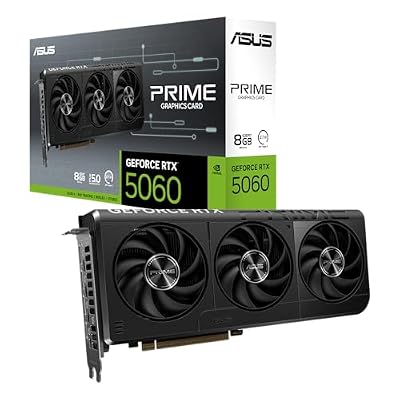
ASUS Prime GeForce RTX 5060 8GB GDDR7 Gaming Graphics Card | PCIe 5.0, HDMI/DP 2.1, 2.5-slot, Axial-tech Fans, Dual BIOS
Included for 'Arc A580 or RTX 5060? Picking the Right GPU' because the listing specifies PCIe 5.0 and HDMI/DP 2.1, details this guide uses to compare options.
View on Amazon
ASUS TUF Gaming GeForce RTX 5060 8GB GDDR7 OC Edition Gaming Graphics Card | PCIe 5.0, HDMI/DP 2.1, 3.1-slot, Military-grade Components, Protective PCB Coating, Axial-tech Fans
Included for 'Arc A580 or RTX 5060? Picking the Right GPU' because the listing specifies PCIe 5.0 and HDMI/DP 2.1, details this guide uses to compare options.
View on AmazonSpec-by-Spec Breakdown
| Spec | Arc A580 | RTX 5060 |
|---|---|---|
| Architecture | Generation 12.7 (Alchemist) | Blackwell 2.0 |
| Release date | 10 October 2023 | 19 May 2025 |
| Launch MSRP | Budget tier | $299 |
| Shader units | 3072 | 3840 CUDA cores |
| Boost clock | 2000 MHz | 2497 MHz |
| Process | 6 nm | 5 nm |
| TDP | 175 W | 145 W |
| VRAM | 8 GB GDDR6 | 8 GB GDDR7 |
| Bus / bandwidth | 256-bit / 512.0 GB/s | 128-bit / 448.0 GB/s |
| L2 cache | 8 MB | 32 MB |
| Interface | PCIe 4.0 x16 | PCIe 5.0 x8 |
| Power connectors | 2x 8-pin | 1x 8-pin |
| Width | 2-slot (length varies by partner) | 241 mm, 2-slot |
| Outputs | 1x HDMI 2.1, 3x DP 2.0 | 1x HDMI 2.1b, 3x DP 2.1b |
On paper the A580 has the bandwidth advantage, but bandwidth alone does not decide performance. The RTX 5060’s 32 MB L2 cache and newer architecture let it do far more with less.
Gaming Results From Published Data
Raster at 1080p
No major outlet has published a direct A580 versus RTX 5060 shootout, so the clearest picture comes from linking two well-documented comparisons through the RTX 4060. Notebookcheck’s game average places the A580 about 24 percent behind the RTX 4060. Reviews of the RTX 5060 then place it roughly 15 to 25 percent ahead of the RTX 4060, with TechRadar’s review at the lower end and Notebookcheck’s at the upper end. Chaining those figures puts the RTX 5060 roughly 35 to 60 percent ahead of the A580 in modern games, with variation by title.
In practical terms, a demanding new game that runs around 45 to 60 FPS on the A580 at 1080p high settings may run around 65 to 90 FPS on the RTX 5060. These are approximate ranges that change with settings, CPU and driver updates.
1440p
The A580’s wide bus helps it hold up somewhat better at 1440p, and some aggregators show a smaller gap there. Still, neither card is an ideal 1440p option because both stop at 8 GB, and newer games at 1440p with high textures can exceed that.
Ray tracing
Alchemist had respectable ray tracing for a first-generation design, but the RTX 5060 is newer and faster overall, so it leads in RT as well. With DLSS enabled, the RTX 5060 can run moderate RT effects at 1080p in many games; the A580 generally needs XeSS and lower settings to do the same.
Software Features
| Feature | Arc A580 | RTX 5060 |
|---|---|---|
| AI upscaling | XeSS (XMX-accelerated) | DLSS 4 Super Resolution (transformer model) |
| Frame generation | XeSS Frame Generation in supported games | DLSS Multi Frame Generation (up to 3 generated frames) |
| Latency reduction | Xe Low Latency | NVIDIA Reflex |
| Other upscalers | FSR 3.x | FSR 3.x |
| Video encoding | AV1 | AV1 |
Both cards offer a hardware-accelerated upscaler, which is good news for the A580. The practical difference is coverage: DLSS appears in many more games, and NVIDIA’s app can push older DLSS titles to the newer model.
Things to Know Before Buying an Arc A580
- Resizable BAR: Alchemist cards depend heavily on ReBAR. Without it, performance can fall dramatically. Your platform should support it and have it enabled in BIOS.
- Older games: Intel’s drivers have improved a lot since launch, but some older DirectX 9 and DirectX 11 titles still run less efficiently than on NVIDIA or AMD hardware.
- Idle power: early Alchemist cards were known for relatively high idle power draw, which can usually be reduced by enabling PCIe power management (ASPM) in BIOS and Windows.
The RTX 5060 has its own platform note. It uses a PCIe 5.0 x8 link, which drops to 3.0 x8 on an older PCIe 3.0 board and can cost a little performance when VRAM overflows. The A580’s full x16 link is more tolerant of older boards, although those same older boards may lack ReBAR.
Power and PSU Calculation
Using GPU TDP + CPU gaming draw + about 150 W headroom:
- Arc A580: 175 W + about 120 W for a mainstream CPU + 150 W = roughly 445 W. A quality 550 W unit with two 8-pin cables is the safe choice.
- RTX 5060: 145 W + 120 W + 150 W = roughly 415 W. A good 450 W to 550 W unit with one 8-pin cable is enough.
The two 8-pin connectors on the A580 are a detail worth checking on budget power supplies, which sometimes provide only one PCIe cable. A580 length depends on the partner model, so measure your case. The RTX 5060’s 241 mm reference length fits nearly all mid-towers and many small form factor cases.
Value Check
The Arc A580 now mostly turns up used or as leftover stock, usually around $100 to $150. Taking the A580 as 100 and the RTX 5060 as about 145, the midpoint of the chained estimate:
- RTX 5060 at $299: about $2.06 per performance point.
- A580 at $125: about $1.25 per point.
The A580 wins on raw cost per frame, but the RTX 5060 adds roughly half again as much performance, lower power draw, wider upscaler support and a new-card warranty. If you can spend about $300, the RTX 5060 is the better long-term purchase; if the hard limit is around $130, a used A580 is a reasonable 1080p card.
Alternatives Worth a Look
Before settling on either card, consider the nearby options. Intel’s Arc B580 is the A580’s direct successor and fixes much of what held Alchemist back, with better driver consistency, 12 GB of VRAM and stronger efficiency, at a launch price below the RTX 5060. AMD’s RX 9060 XT is another contender in the same price band and offers a 16 GB version that removes VRAM worries at 1440p. On the NVIDIA side, the RTX 5060 Ti 16 GB costs more but pairs the same feature set as the RTX 5060 with double the memory.
The right choice depends on what you value most. If DLSS support across a large game library and low power draw are priorities, the RTX 5060 remains a strong 1080p card. If memory headroom for future games matters more, one of the 12 GB or 16 GB alternatives is the safer long-term buy. The A580 only stays competitive at clearance or used prices well below these newer cards.
Decision Guide
| Budget and use | Choose |
|---|---|
| Around $100 to $150, 1080p, ReBAR-capable PC | Arc A580 (used or clearance) |
| Around $300, 1080p high-refresh | RTX 5060 |
| Older PC without ReBAR | RTX 5060 |
| Ray tracing and frame generation | RTX 5060 |
| Lots of older DX9/DX11 games | RTX 5060 |
| 1440p with high textures | Consider a 12 GB or 16 GB card instead |
Frequently Asked Questions
How much faster is the RTX 5060 than the Arc A580?
Combining published comparisons through the RTX 4060 suggests the RTX 5060 is roughly 35 to 60 percent faster in modern games. The gap varies by title and resolution, narrowing slightly at 1440p.
Does the Arc A580 support frame generation?
Yes, in games that support XeSS Frame Generation, using the card’s XMX units. The RTX 5060 offers DLSS Multi Frame Generation, which can insert up to three generated frames and appears in more games.
Do I need Resizable BAR for the Arc A580?
Effectively, yes. Arc Alchemist performance can drop sharply without ReBAR. Check that your CPU and motherboard support it and that it is enabled in BIOS before buying.
Which card uses less power?
The RTX 5060, rated at 145 W versus 175 W for the A580. It also needs just one 8-pin connector, while the A580 needs two.
Is 8 GB of VRAM a problem on either card?
For 1080p with sensible texture settings, 8 GB is workable in most games. Some recent titles exceed 8 GB at high textures, especially at 1440p. Both cards share this limitation, so if you want more headroom, look at a 12 GB or 16 GB model.
Ready to decide? Our #1 pick for 2026 is the Architecture.
Live price & availability on Amazon.









